Table of Contents
Table of Contents

Perspective
We all know that very few things in this world function well in isolation. A sailboat, for example, doesn’t go anywhere without water and some wind. The same idea applies to people in the workplace. Employees perform at their best when given healthy expectations and a variety of support. This usually means goals with high standards, realistic deadlines, a culture of continuous improvement, and the active assistance of leaders, coworkers, and the organisation. Recently, we explored this concept in more depth and discovered something else: Employees, perhaps now more than ever, also require a sense of connection to excel—and they’re turning to their community at work to find it.
{{report_insert_1}}
Introduction
Organisations and leaders have long assumed that high performance and employee wellbeing are mutually exclusive. That “getting ahead” and greater productivity required longer hours at work, less personal time, and more mental and emotional stress. This belief has led to 79% of employees reporting symptoms of burnout.1 And a clearer picture of how inaccurate the assumption is—especially over time—has taken shape.
Employee burnout was expanding across industries before the Covid pandemic, costing organisations billions of dollars in healthcare,2 as well as higher employee turnover. However, it wasn’t until the pandemic hit and statistical measures of employee wellbeing fell 15 points in just a few months3 that organisations pulled back on performance expectations to take care of their people.
Interestingly, the priority placed on employee wellbeing during the pandemic (including remote and flexible work arrangements) didn’t hurt productivity. In the second and third quarters of 2020, individuals and teams were more productive compared to the same time frame the year before.4 This combination of factors demonstrated that companies in most industries could support employee wellbeing and still see high performance.
Of course, some philosophies are stubborn. With the pandemic behind us, many employers have returned to focusing on productivity and performance at the expense of focusing on employee wellbeing. Some, prioritising measures they believe will lead to greater performance, have called people back to the office five days a week, increased the use of software to monitor their behaviour, and set up stricter performance metrics.
However, this is not a zero-sum game. Employee wellbeing is not at odds with high performance and business success. On the contrary, our research shows that the right employee support has the potential to maximise profitability.
Unfortunately, our studies also find only 34% of employees have levels of support high enough to match the expectations of their workplace. The good news is there are concrete ways organisations can achieve an ideal mix of expectations and support that leads to more great work and better outcomes for all.
“Being the ‘best you can be’ is really only possible when you are deeply connected to another. Splendid isolation is for planets, not people.”
—Dr. Sue Johnson, Clinical Psychologist
A Model for Understanding Employee Performance
Robert Karasek’s Job-Demand-Control-Support model argues that high and stressful job demands can be present as long as an employee has control over their job and has strong workplace relationships that help the employee to cope.5 This model is influenced by, and shares similarities with, Diana Baumrind’s popular behavioural model illustrating the importance of healthy expectations and high levels of support.6
In our current work, we found that employees also crave high expectations if they receive high levels of support from their employer. The following diagram illustrates four different types of workplace cultures, each with varying levels of support and healthy expectations.
Uninvolved: Low expectations and low support; the least healthy and least productive culture
Permissive: Low expectations with high support; the lack of challenge compromises productivity and can eventually lead to employee frustration
Authoritarian: High expectations but low support; the lack of feedback, resources, or help compromises both employee wellbeing and productivity
Authoritative: High expectations with high support; the healthiest and most productive culture
This approach to understanding performance corresponds well with our findings from 2023: Workplaces with a strong sense of community and support (Authoritative) see an estimated 62% increase in employee tenure (4.4 years), a 58% decrease in employees seeking a new job, and a 38% reduction in employee burnout.7
{{report_insert_2}}
{{report_insert_3}}
High Expectations With Strong Support Can Lead to Greater Workplace Satisfaction and Better Mental Health
As demonstrated in our experiment, employees given high support and high expectations (Authoritative) scored the highest in workplace satisfaction and positive mental health outcomes. Workplaces with less support (Uninvolved and Authoritarian) or lower expectations (Permissive) were least satisfied and felt their mental health was negatively impacted. Organisational support includes providing employees with growth and development opportunities, a voice in decisions, transparent communication, and resources to do their jobs.
In looking at burnout and mental health, those employees with less supportive workplaces reported the highest levels of depression and anxiety, and mental health outcomes appear to improve when organisations provide support. Highly supported employees see lower odds of probable depression (–47%), probable anxiety (–44%), and burnout (–88%).
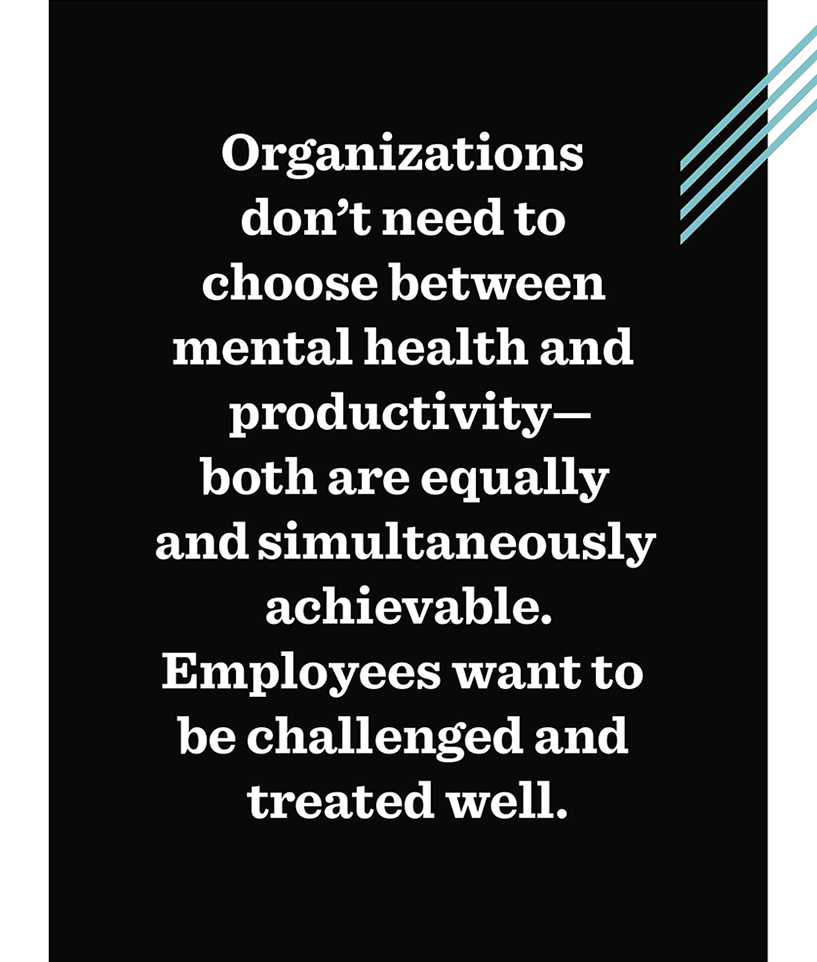
These results underscore the importance of fostering a supportive and ambitious work environment to enhance employee wellbeing and performance. Organisations don’t need to choose between mental health and productivity—both are equally and simultaneously achievable. Employees want to be challenged and treated well.
Organisations With Healthy Performance Cultures Have the Best Business Outcomes
High expectations and support also impact culture and, ultimately, business success. Employees in healthy performance workplaces report higher levels of culture metrics like purpose, opportunity, and appreciation, as the following table shows. Plus, they’re more likely to have leaders practicing modern leadership,8 which leads to more engagement and great work.
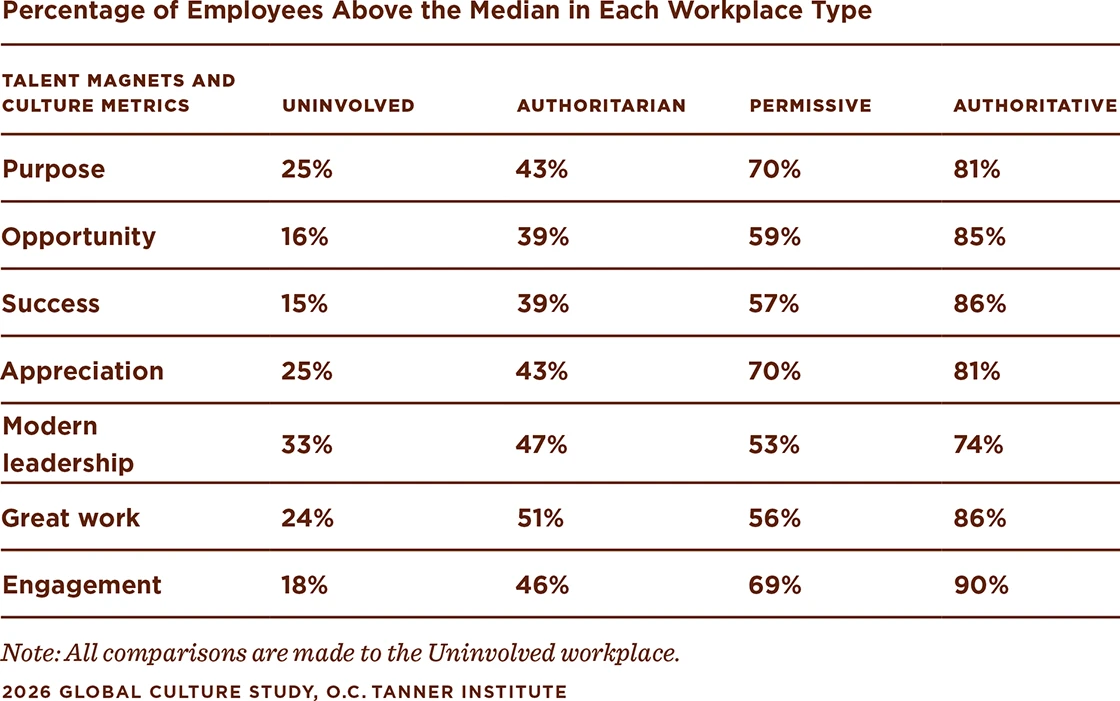
When we looked at employee retention, those in Authoritative and Permissive workplaces have the longest expected retention, staying two years longer on average than those in Uninvolved or Authoritarian cultures. Interestingly, people in Authoritative cultures have the longest expected retention—indicating that high support and expectations produce the highest level of loyalty.
Expectations and Support Lead to More Great Work and Innovation
A culture of healthy performance allows every employee to do great work and innovate. This means they meet goals, collaborate, and are always learning, which helps them find inspiration and practice hope on a regular basis, leading to more innovation.
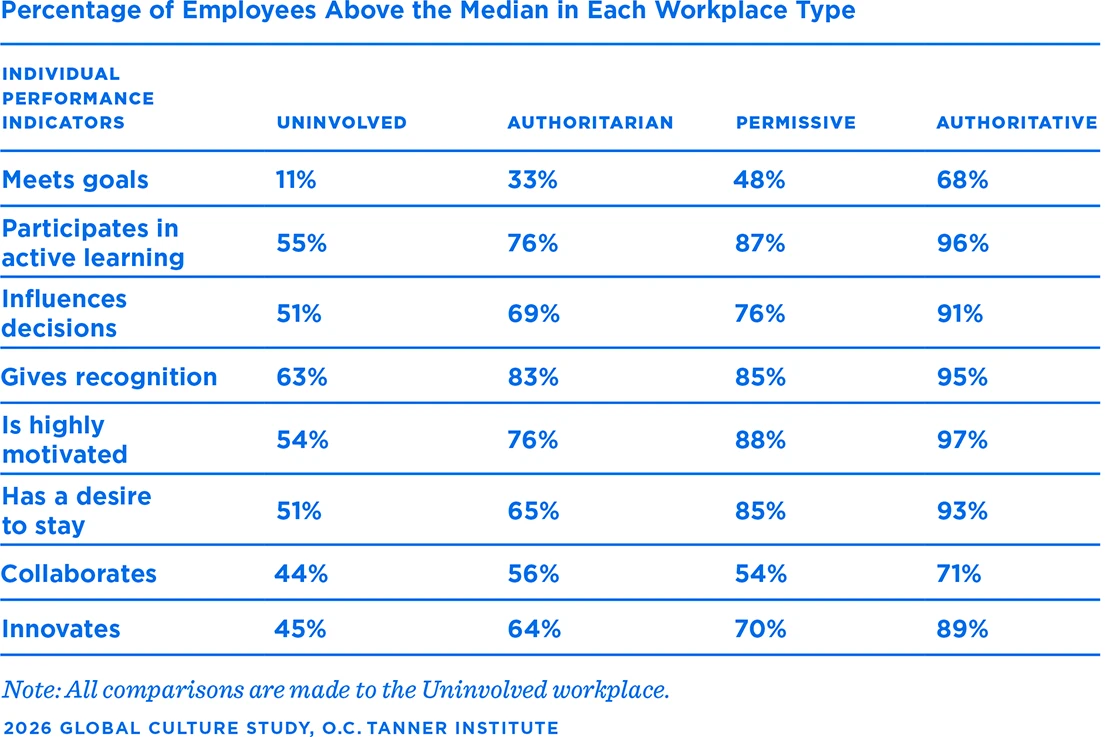
One effective way for organisations to foster healthy performance is with employee recognition. Recognition acknowledges, identifies, and honors people when they achieve goals and meet high expectations. It also inspires them to set higher goals. By regularly recognising employees, organisations can reward effort, celebrate project milestones, and help workers see their progress and understand that the company values and cares about them. Recognition helps people take ownership of their work and feel sustained along the way.
Recommendations
To create a healthy performance culture that has high expectations and high support for employees, remember the basics:
1. Communicate well and provide opportunities for growth
Employees believe their workplace has high but healthy expectations when they have regular, open communication and see potential to progress in their careers. The following table shows the increased likelihood of this positive perception when the most impactful factors are present.
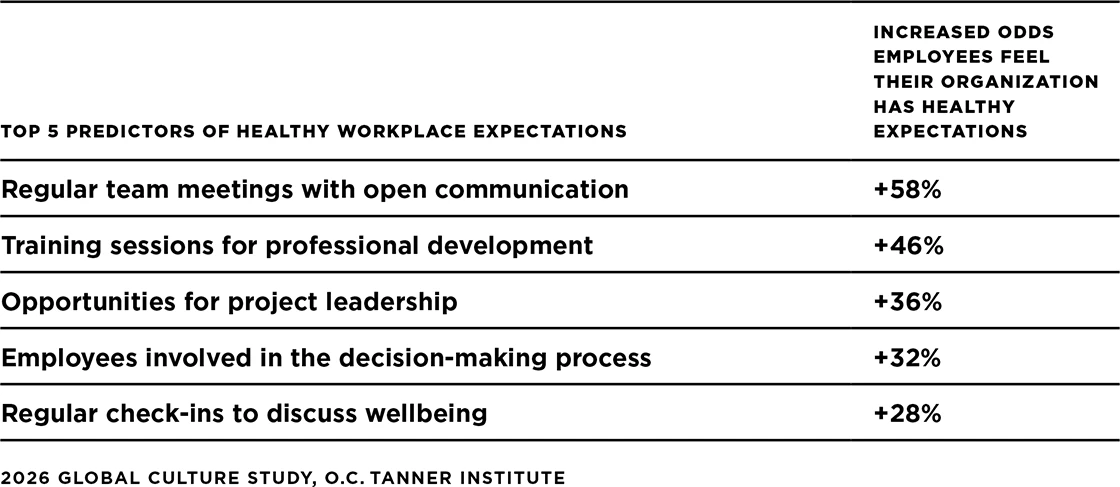
When setting expectations, use clear goals tied to the organisation’s purpose and vision, and ensure employees not only understand these goals but know how their individual work contributes to them. Reinforce the connection in regular team meetings.
Ideally, leaders and employees co-create inspiring, hopeful goals with opportunities to ask questions and give feedback. Follow up with the resources, training, and time to improve skills, and provide a detailed plan for leadership development that includes mentorship and growth projects. Employees who are encouraged to meet expectations and given chances to grow and lead see the targets as personal challenges they want to accomplish.
“The key to unlocking better results is an abundant approach. The best and fiercest leaders find a way to look for the ‘and’ in small and big moments. They are both resolute and exacting on standards and caring with the people involved.”
—Doug Conant, Author, The Blueprint: 6 Practical Steps to Lift Your Leadership to New Heights
2. Provide high support with regular connection
Supporting employees requires regular communication and development, which have even more impact when leaders inquire about their wellbeing. Demonstrating empathy can strengthen the sense of connection by acknowledging and addressing mental health concerns. The following table shows how employees are most likely to feel supported.
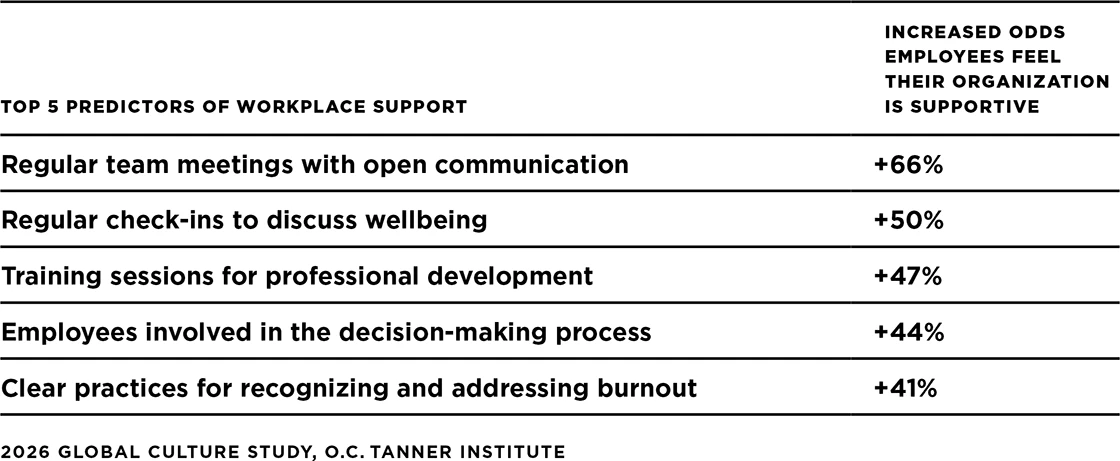
Provide feedback through ongoing, open interactions. Use one-to-ones or team meetings to monitor progress on goals and recognise efforts and accomplishments along the way. These moments of connection can also help revisit expectations and address obstacles to the work.
Regardless of how leaders connect with employees, it’s critical they know and address the concerns and struggles their people have—in or out of the workplace. This starts with asking about employees’ wellbeing and providing resources to address burnout and improve mental health.9 Openly discussing mental health, allowing time off when necessary, and providing access to mental healthcare help employees feel supported.
Of course, leaders need support, too.10 Check in, ask how they’re feeling, and help them sustain their teams by removing roadblocks, addressing challenges, providing resources, and showing appreciation.
3. Leverage employee recognition
Recognition can support employees by validating, encouraging, and celebrating their efforts, accomplishments, and great work. Employees at organisations with integrated recognition are 18x more likely to say their workplace has a healthy performance culture with high expectations and high support.
Recognise employees frequently and for a variety of reasons: meeting individual or team goals, doing above-and-beyond work, innovating, and sharing in company milestones and achievements. Be specific in the recognition and describe what the individual uniquely did. Connecting employee accomplishments to the company’s purpose, goals, or vision can help show how they met expectations, while recognition that’s genuine and personal demonstrates support.
{{report_insert_4}}
“Someone’s overall contentment with their job isn’t just about the dollars; it’s about their overall experience. Do they feel connected to the organisation, do they have good relationships, do they feel fulfilled from the work they are doing? Feeling recognised and appreciated makes a huge impact.”
—Lindsay Landry, Employee Experience Lead, ICF
Healthy Performance Cultures—Key Takeaways
A healthy performance culture provides high expectations and high support for employees.
Organisations with a healthy performance culture have the best employee mental health and business outcomes.
Providing open communication and growth opportunities helps set high but healthy expectations.
Regular check-ins and an active focus on wellbeing help employees feel supported at work.
Healthy Performance Cultures Sources
- Burnout, 2020 Global Culture Report, O.C. Tanner Institute.
- Burnout, 2020 Global Culture Report, O.C. Tanner Institute.
- Crisis, 2021 Global Culture Report, O.C. Tanner Institute.
- “Remote Work Productesttivity Study: Surprising Findings From a 4-Year Analysis,” Chandni Kazi and Claire Hastwell, Great Place to Work, May 20, 2025.
- Karasek, R. A., & Theorell, T. (1990). Healthy Work: Stress, Productivity, and the Reconstruction of Working Life. New York: Basic Books.
- Baumrind, D. (1971). “Current patterns of parental authority.” Developmental Psychology, 4(1, Pt.2), 1–103.
- Workplace Community, 2023 Global Culture Report, O.C. Tanner Institute.
- Leadership, 2020 Global ultur Report, O.C. Tanner Institute.
- The Mental Health Link, 2025 Global Culture Report, O.C. Tanner Institute.
- Leadership at Risk, 2023 Global Culture Report, O.C. Tanner Institute.
- “ICF: Making the World a Better Place, One Recognition Moment at a Time,” O.C. Tanner.


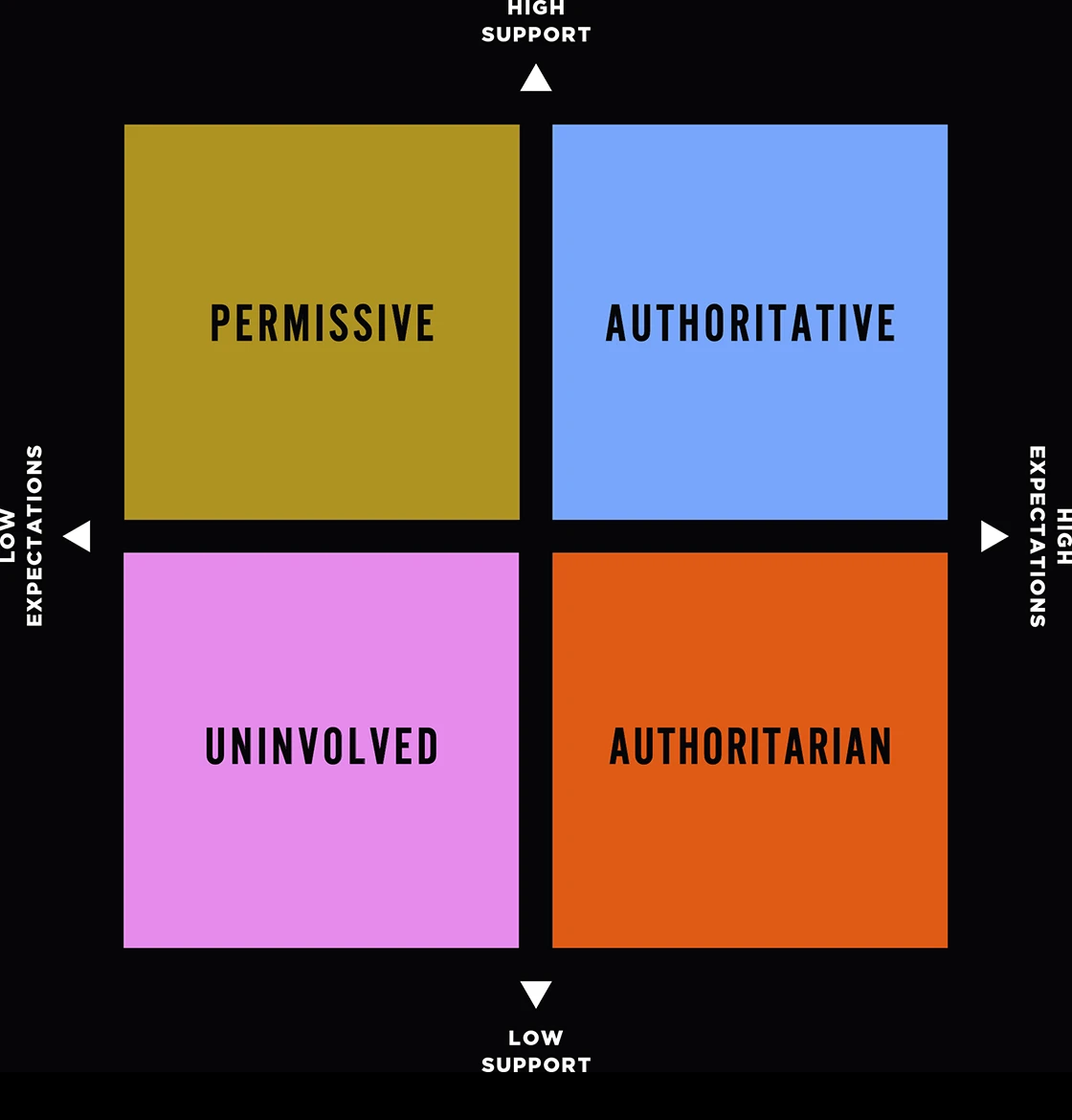
The four combinations of support and expectations that affect performance at work.
Experiment
Testing the Two Dimensions
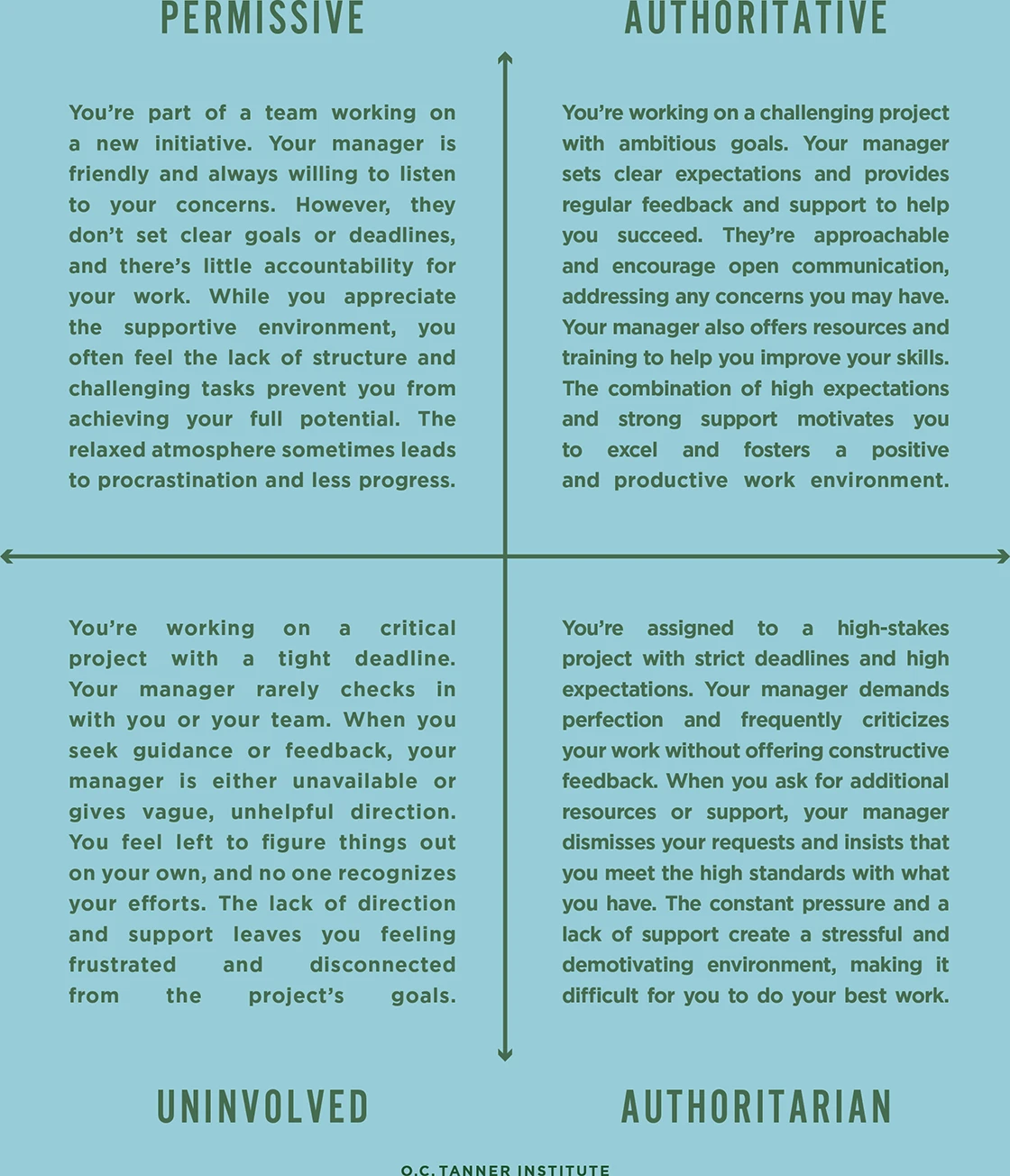
To better understand the impact of expectations and support on employee wellbeing and workplace satisfaction, we conducted an experiment by randomly assigning more than 13,000 employees to the four different scenarios on the adjacent page.
We then asked the employees to rate their satisfaction with the workplace and how much their situation would impact their mental health. All comparisons were made to the Uninvolved condition.
Results
The experiment, which allows us to infer cause, yielded two important findings:
- There were no differences between the Uninvolved and the Authoritarian condition across all dimensions. This means workplace cultures that lack support have similar negative impacts on their employees’ workplace satisfaction and mental health, regardless of whether expectations were high or low.
- Those in the Authoritative scenario (high support and high expectations), scored highest on all outcomes. We found 76% of employees were satisfied with their workplace (much higher than the other conditions; d=0.91), and 69% of employees said an Authoritative workplace would positively impact their mental health (d=0.73). Additionally, 72% of employees reported belonging to an Authoritative workplace would help prevent their mental health problems (d=0.76).

Case Study—Healthier Performance Through Recognition
ICF, a global advisory and technology service provider, uses recognition to ensure its 9,000 employees feel supported. The company’s recognition platform, by O.C. Tanner, combines frequent recognition with wellness resources to support employees. Recognition data integrated into ICF’s Workday HRIS help leaders draw the connection between expectations and achievements in performance reviews. It also allows ICF to celebrate team efforts in a way that ties back to its core values.
The result: significantly higher retention and both leaders and employees feel more supported and connected to insights that help them perform at higher levels.11
Turn Recognition Into Real Connection
Get Started Today
Top