Updated on
August 5, 2026
5 August 2026
Key Takeaways:
Hope and inspiration are critical drivers of retention. Employees who feel hopeful about their future at work are more engaged, innovative, and connected. Clear goals and supportive communities drive hope and increase retention and other positive outcomes.
Concrete support for offline employees boosts loyalty. When organisations make these employees feel seen and appreciated, the odds of belonging, fulfillment, and retention rise dramatically.
Recognition and support during job transitions are proven to increase retention. Positive job transition experiences can multiply the odds of retention by up to 8x.
Companies can use data-driven recognition to reduce attrition. Integrating recognition into daily culture and tying it to company values can accurately predict and improve retention rates.
How do you retain employees in 2026? Keeping employees happy is a moving target that’s hard to define from one day to the next—and can change significantly over a year.
In this article, we’ll review the research on what employees really want from their organisations. By directly meeting these needs and improving the employee experience across an organisation, leaders can create workplace cultures where employees want to stay.
What is the impact of high turnover on companies?
Although a certain amount of turnover is a reality for all organisations, an unnecessarily high turnover rate can cost organisations in several ways.
The most immediate impact of turnover is that human resources teams must spend additional time and money on the hiring process to replace those employees walking out the door. Even more critical, high numbers of employees leaving can negatively impact employee morale and productivity—as well as damage the organisation’s reputation with both customers and potential employees.
High turnover hurts business performance. In a discussion with McKinsey & Company, Zynep Ton notes how companies that choose to operate with higher turnover rates can experience operational problems, customer service issues, lower productivity, and reduced sales.
In short, they may pay less to acquire their employees, but they sacrifice the greater performance and long-term value that comes with investing in more experienced workers.
The alternative, Ton points out, is to see people as drivers of value, profit, and customer service—not just a cost to be minimized. Companies who choose this approach may spend more for talent, but in turn will generate more valuable work—which ultimately more than pays for the added investment.

What factors impact employee retention?
You’ll find many well-documented reasons employees choose to leave. Some of the root causes include poor management, lack of job advancement, and a deteriorating work-life balance. Conversely, the factors that influence employees to stay include feelings of belonging, greater connection, and autonomy. These traits can help build a positive workforce culture and reduce turnover.
More than pay and benefits, employee retention strategies should include modern leadership, development opportunities, mental health support, and giving employees a say on how and where they work. Even physical factors, like the work environment and technologies a company chooses can affect whether employees will want to stay long term.
6 people strategies for improving company culture and reducing turnover
In the face of a complicated HR landscape, companies are looking to create workplaces where all employees can thrive. This requires taking the pulse of employee experiences and fine-tuning culture initiatives as needed.
For a deeper dive into this data, watch our on-demand webinar, 5 Workplace Trends for 2026

Following are specific findings from our research and the people strategies organisations can focus on to help create and sustain cultures where people want to work.
1. Help employees meet their survive and thrive needs
Employees evaluate their relationship with their employer by asking two questions: Am I surviving? Am I thriving?
The research finds 1/3 of employees are merely surviving at work. They feel anxious, financially uncertain, doubtful of growth opportunities, and pessimistic about the future. But employees who are thriving feel their organisation cares about their mental health, they work in organisations with strong cultures and purpose, and they have opportunities for growth and advancement.
Companies can help employees who are surviving by offering competitive compensation and health benefits to help provide financial stability and meet survival needs. Then, once employees’ basic needs are met, career development, skill building, and recognition help them thrive.
When employees feel they are thriving at work, the odds of important business outcomes like retention soar:
- Retention (6x)
- Promoting the organisation to others (7x)
- Great work (8x)
- Overall satisfaction with employee experience (14x)

2. Transform hope into an active practice
According to new research from the O.C. Tanner Institute, when thinking about their future at work, 35% of employees feel depressed and only 52% feel hopeful. Consider the context: economic uncertainty, changing market expectations, and rapidly advancing technologies create conditions where employees struggle to feel good about the trajectory of their careers.
But we know that hope is important. It’s key to feeling inspired, motivated, and resilient in the face of challenges. When employees have a strong sense of hope, odds of key outcomes, including retention, increase across the board:
- Great work (8x)
- Engagement (7x)
- Innovation (5x)
- Connection to organisation (5x)
- Belonging (5x)
- Retention (4x)
Each of these outcomes drives retention. When employees are engaged in great work, feel connected to their organisation, and experience a meaningful sense of belonging, they are more likely to stay.
To enable this type of hope in your organisation, our research shows that you need to help employees develop pathway thinking (“I can see a path to my goal”) and agency thinking (“I believe I’m capable of following that path”). Hope increases when employees have clear, achievable goals and the support of their work community to achieve those goals. This builds positive momentum and fuels inspiration.
Learn more about the role of inspiration and hope in the employee experience from two senior researchers from the O.C. Tanner Institute in this on-demand webinar.
3. Help offline and customer-facing employees feel seen
Offline, deskless, and frontline workers often feel overlooked and underappreciated. About half of these employees feel their organisation treats them as expendable. They also lack connection and a sense of community, which can lead to feeling unfulfilled in their work.
It’s no surprise that companies find it increasingly difficult to retain employees in this group. Many employees leave for jobs where they feel more valued. Forbes reports turnover rates up to 500% per year. But just as harmful, the employees who do stay due to financial constraints or lack of training or opportunity feel more demoralized, resigned, and unfulfilled in their work.
When leaders take time to understand the role, career aspirations, and perspectives of offline team members, the odds of several outcomes improve dramatically:
- Belonging (+1,069%)
- Community at work (+834%)
- Fulfillment at work (+603%)
- Accomplishing great work (+933%)
Retention and employee satisfaction are both natural results of these improved outcomes.

Elevate your people and help them feel valued through authentic appreciation from patients, passengers, and the public they serve. A little gratitude can go a long way.
4. Create an environment that’s flexible, but fair
Although the employee experience has never been more flexible, the next step is making it fair. Companies that offer more flexibility get loyalty and better work outcomes in return. But to create a long-term work culture where people want to stay and thrive, that flexibility must remain equitable.
Research on Equitable Flexibility revealed workplace flexibility that appears unfair can be damaging to key cultural outcomes, leading to burnout and reduced job satisfaction. The bottom line? Giving employees flexibility in when, where, and how they work will help them feel engaged and want to stay with their organisation.
When they experience equitable flexibility, employees are:
- 385% more likely to be satisfied with their job
- 466% more likely to be satisfied with the employee experience
- 679% more likely to want to stay one more year
5. Support employees through job changes and transitions
When employees are changing jobs or starting a new role, especially in the same company, it’s important to support them through the job transition so they are more likely to stay.
This means building 4 important elements into every job change or transition: connection, community, development, and flexibility.
When employees have an above-average job transition experience, there are 251% increased odds the employee will stay with the organisation 2 or more years (compared to 44% lower odds of staying when the job transition experience is below average). And if an employee’s job transition experience was so positive it was “life changing”, odds of staying with the organisation improve 8x.
This is particularly important for newly promoted leaders. Being promoted doesn’t always mean new leaders have the soft skills or leadership qualities to succeed, and ADP finds 29% of new leaders leave within a month of receiving their promotions due to lack of support and training from the company. But when leaders have a positive job transition experience that includes connection and integrated recognition, odds they want to stay with the organisation increase 5x.
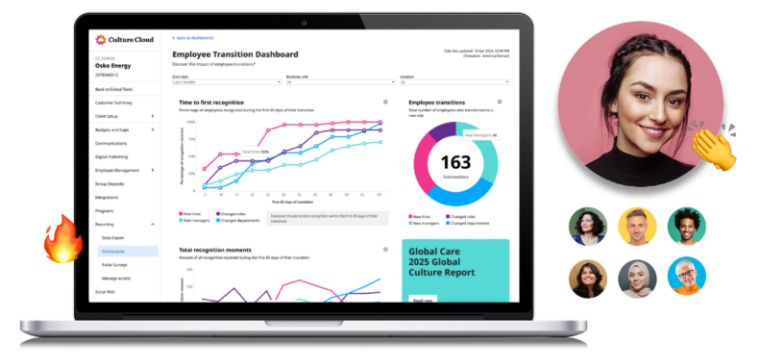
The Culture Cloud Job Transitions Dashboard allows you to track employee transitions and how much recognition is happening within related groups—so you can create an environment where people want to stay.
6. Leverage your employee recognition programme
Not surprisingly, a common element of cultures that feel supportive and genuine is an effective employee recognition programme. And the fact that regular recognition can help retain employees longer is not lost on HR leaders.
Consider this striking statistic: When leaders do not effectively communicate accomplishments, employees are 74% less likely to stay at their organisation. On the other hand, employees who feel appreciated are 5x more likely to stay and consistent recognition can add 3.5 years to an employee’s tenure.

Read our Employee Recognition Guide to learn more about what it takes to build and launch a successful programme.
What are successful companies doing to retain top talent?
Organisations can invest in various strategies to build workplace cultures where employees thrive and want to stay.
As noted earlier, companies that recognise their employees are better at retaining them. For example, ICF, a global advisory and technology services provider, refreshed their employee recognition programme to ensure it was integrated into the everyday employee experience, connected directly to their company values, and built belonging and inclusion.
ICF celebrates employees in big ways and small, for important milestones and achievements and for day-to-day contributions to the company’s success. Career service awards, recognition messages, company-wide gifts, and personalised Yearbooks ensure everyone feels seen, valued, and appreciated.

Analysis of ICF’s recognition data shows the impact of recognition on attrition:
- Receiving recognition accurately predicted whether an employee voluntarily stayed with or left the company 91% of the time
- Receiving recognition from leaders increased the likelihood an employee would stay at the company by 3-8x (depending on the level of leader)
- Being recognised for “Living in line with ICF values” almost doubled the likelihood an employee would stay with the company
Receiving recognition accurately predicted whether an employee stayed with or left the company 91% of the time.
—O.C. Tanner Institute
See how the Culture Cloud recognition platform can help your people thrive and want to stay with your organisation longer. Or request a demo today.
Turn Recognition Into Real Connection
Top