
Updated on
October 9, 2026
9 October 2026
Recognition is more than saying thank you. It is a way for organisations to acknowledge the contributions, behaviours, and achievements of employees, showing their work matters and that they matter. When employees feel seen, they are more likely to feel engaged and motivated to do their best work. Feeling valued shapes how people experience their work and their sense of belonging within the organisation.
But the impact of recognition depends not only on how often it happens, but also on who delivers it and how it is expressed.
Appreciation that comes from someone who has a meaningful influence on an employee’s experience, growth, and day-to-day work can carry greater weight. For many employees, that person is their leader. Our research across the Middle East shows that recognition from leaders is among the most meaningful forms of recognition employees receive. Yet creating these moments consistently requires more than a recognition programme. Leaders need to understand what meaningful recognition looks like, and have the tools, training, and support to make recognition part of how they lead. When organisations get this right, recognition stops being a checkbox and becomes part of the daily employee experience.
Leaders understand their role in recognition, but need help giving it effectively
When a leader recognises, it shows employees that someone who shapes their day-to-day work and growth has noticed them and values their contribution. Leader-led recognition strengthens trust in leadership and deepens an employee’s connection to the organisation.
Our research shows that most leaders are not struggling with intent; they are struggling with execution. They want to recognise their people well, but what is often missing is practical guidance: when to recognise, what to say, how to make it personal, and how to connect appreciation to what matters most. Recognition can become occasional, generic, or dependent on individual leadership style rather than something employees can consistently experience.
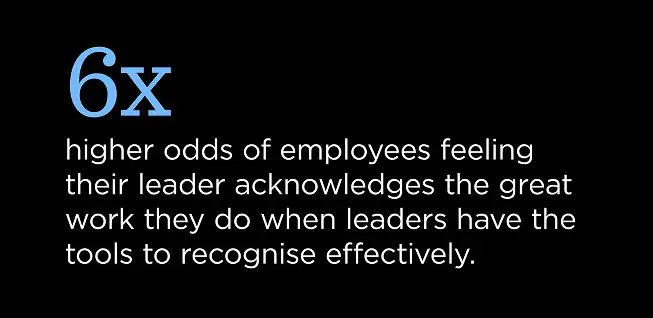
When leaders have the tools they need to recognise effectively, employees have 6x higher odds of feeling their leader acknowledges the great work they do. Those tools also need to account for regional, cultural, and organisational differences and preferences.
While recognition preferences may vary by country, recognition best practices remain the same
Recognition preferences can differ from one country to another. For examples, in Saudi Arabia, 40% of employees say their most meaningful recognition would come from their immediate leader, compared with 34% in the UAE. This is because In Saudi Arabia, leader-led recognition is closely tied to trust, a direct signal of respect and value. In the UAE, it plays a stronger role in building belonging, so both leader and peer recognition is important.
The fundamentals of great recognition remain consistent, however: it should be timely, sincere, specific, and connected to purpose. Organisations should help managers understand what makes recognition meaningful locally, so they can deliver appreciation in a way that feels authentic to the people receiving it.
Understanding these differences is an important first step. The next is giving leaders the practical tools and confidence to put that understanding into action.
What equipped leadership looks like
When leaders are well-equipped to give recognition, it becomes part of the culture. Leaders not only recognise their people more often, they also model what good recognition looks like and encourage others to recognise. In fact, recognition is 17x more likely to feel embedded in the culture when leaders have the tools to recognise effectively and train others to do the same. This creates a ripple effect across teams. When leaders have effective recognition tools, employees have 10x higher odds of feeling their leaders support them in recognising others.
Equipping leaders means:
- Reinforcing recognition skills over time. Provide ongoing training and best practices on how to give recognition. Embed reminders in recognition platforms and leadership tools. Treat recognition training as an ongoing practice, not a one-time intervention.
- Give leaders a simple framework for recognising well and tools to do so. Leaders need practical guidance on how to make recognition timely, personal, sincere, specific, and connected to purpose. Embed these best practices in recognition tools and programmes.
- Build recognition into existing leadership routines. Instead of treating recognition as a separate task, use moments leaders already have, like 1:1s and team check-ins, to recognise great work as it happens.
Together, these shifts move recognition from something leaders occasionally remember to do to something they are equipped to do well, consistently, and in ways that are meaningful and impactful to their people.

Recognition is a leadership behaviour, not a programme
The organisations that make leader-led recognition part of everyday culture will be the ones that equip leaders to make recognition part of how they lead. For employees across Saudi Arabia and the UAE, recognition from a leader can signal more than appreciation. It can build trust, strengthen belonging, and remind people that their contribution matters.
The opportunity, then, is to close the gap between knowing that recognition matters and giving leaders the ability to deliver it well. When leaders are empowered and equipped to make appreciation a natural part of everyday leadership, recognition moves beyond a programme activity and becomes part of how leaders lead and engage their people.
Turn Recognition Into Real Connection
Top
Explore other resources
No items found.