Updated on
August 5, 2026
5 August 2026
Key takeaways:
Living company values means demonstrating the behaviours your organisation cares about, whether it’s integrity, innovation, customer service, or other values.
Recognition reinforces company values by reminding employees what matters most, showing employees what values look like in action, and encouraging others to do the same.
The best recognition programmes directly tie recognition to company values, recognise effort and behaviours as well as results, and encourage leaders and employees to be specific in how the employee lived out the values.
Your company values and purpose shape your culture and drive business success. But how do you bring your values to life? With employee recognition.
Recognition helps reinforce and encourage behaviours that align with company values. Platforms like Culture Cloud® make it easy to connect recognition to your company values through peer-to-peer and leader recognition messages, Initiatives, and custom awards.
See how recognition reinforces your values and brings them to life.
“Values should always be at the heart of recognition, driving forward the behaviours the company wants to see repeated over and over again. It’s only when values are truly embedded into appreciation and rewards that organisations fully reap the benefits of a recognition programme.
—Robert Ordever, Managing Director of O.C. Tanner Europe.

What does it mean to live your company values?
Employees live out their company values when they act in ways that demonstrate each value. Your company values communicate what’s most important to your organisation and what customers and clients should expect from you. This builds external and internal trust, strengthens workplace culture, and leads to better business performance.
Some examples of company values include collaboration, people-first, customer service, integrity, innovation, accountability, etc. When employees do something at work that embodies or represents these values, they are living out your values.
How does employee recognition reinforce values?
Employee recognition reinforces company values by reminding employees what your values are and tying them to specific actions. Recognition can make abstract values feel real and actionable, helping put company values into practice. As only 58% of employees see reminders of their organisational purpose in their workplace, recognition is a great communication tool to reinforce values.
When recognition is regularly given for demonstrating company values, behaviours that further your values and purpose are repeated by others. For example, if one of your company’s values is innovation, you would recognise employees when they try new things, take risks, and even if they fail. This encourages other employees to try new things as well.
Recognising behaviours that embody your company values fosters a sense of belonging and ownership and becomes a self-fulfilling way to instill the behaviours you want to see.

Why is it important that recognition is tied to company values?
Here are some stats that show the ROI of recognising company values:
Recognition tied to purpose is 10x more meaningful than generic recognition.
Employees are 121% more motivated to do their best work when recognition is tied to their organisation’s purpose.
When employees feel they are doing meaningful work, there is a:
- 42% increase in feeling their leader supports them
- 52% increase in feeling successful
- 61-point increase in employee Net Promoter Score
- 49% increase in feeling highly motivated to contribute to company success
The Wall Street Journal reports that companies who use values-based systems to influence employee behaviour see better financial performance, innovation, employee engagement, and customer satisfaction.
“Celebrating not just what people achieve, but how they achieve it, and recognising employees who do the right thing—especially when it’s hard—can send a powerful message.”
—Geoff Kovesdy, Principal, Deloitte
What types of recognition best support value alignment?
To best align recognition to company values, reward both effort and results. Recognise what the employee did to achieve results, and how that demonstrates one of your values.
Values-based recognition can be given through peer-to-peer or leader formal and informal recognition, company-wide awards tied to core values, group point deposits and Initiatives for values lived, or symbolic awards that represent a company value. Your recognition platform should automatically connect the recognition given to a company value and track that over time.

“Anchoring around company values ensures employees are accountable for the ‘how’ just as much as the ‘what’, improving employee interactions and encouraging better collaboration.”
—Kathleen Pai, Chief People Officer, N-able
How can leaders model and encourage value-based recognition?
Leaders can model tying recognition to company values every time they recognise. They should be specific in how an employee’s work or behaviour embodies company values and makes a difference. They can also embed recognition into team meetings and team-building activities.
Modern leaders connect employees to purpose, accomplishment, and one another—the ultimate trifecta for connection.

How should employers design awards to reflect company values?
Custom, symbolic awards communicate your company’s values and purpose, reflect the significance of employee contributions, and build a sense of community. When awards are thoughtfully designed with your purpose, values, and culture in mind, they have more impact than generic awards.
Employees who receive custom awards that reflect an organisation’s brand, values, and history are 4x more likely to be engaged and 5x more likely to do great work. Why? These awards highlight employee work and company purpose and values. They reflect both the personal identity of the employee and the organisation’s identity. In fact, 69% of employees believe it’s important that their award reflects the identity of their organisation, and 72% believe it’s important that the award shows how they made a difference.
O.C. Tanner can help you create custom awards for your company’s specific values. Each award is designed to reflect your culture and values and tie employees to a collective purpose.

When both the award and the recognition experience meaningfully reflect the company’s values, organisations are 63% more likely to increase in revenue and 261% more likely to have a thriving culture.
BHP, one of the world’s leading mining companies, partners with O.C. Tanner to create symbolic pins that represent their company values to celebrate employees’ years of service. The awards represent the company’s past, present, and future, connecting BHP’s employees to purpose, accomplishment, and one another.

What are some real-world examples of value-based recognition programmes?
Here’s how some of the world’s top companies do value-based recognition:
ICF
ICF aligns and connects recognition to their 6 company values through their You Matter recognition platform. All recognition given is tied back to one of the core values, and employees can be recognised specifically for “living their values.” Their annual, highly prestigious Value Awards were redesigned to include custom trophies for the top 8 employees across the enterprise who exemplified ICF’s values that year. Analysis finds that being recognised for “Living in line with ICF values” almost doubled the likelihood an employee would stay with the company.
“The You Matter programme has significantly contributed to our culture of cooperation, teamwork, and overall happiness at work. Taking time to recognise the accomplishments of our employees helps reinforce our values and drive success.”
—Patrick McConnell, Senior Vice President, Digital Modernization

ACG
ACG’s Celebrate as One recognition solution aligns recognition to their core values. “Instead of generic reasons to recognise, recognition is aligned to who we want to be,” says Toi Johnson, Employee Programmes and Experience Specialist. ACG provides training and communication about Celebrate as One and how to recognise in meaningful ways that are aligned with the company’s core values, so employees know how their work directly impacts the organisation’s mission.

Delta Air Lines
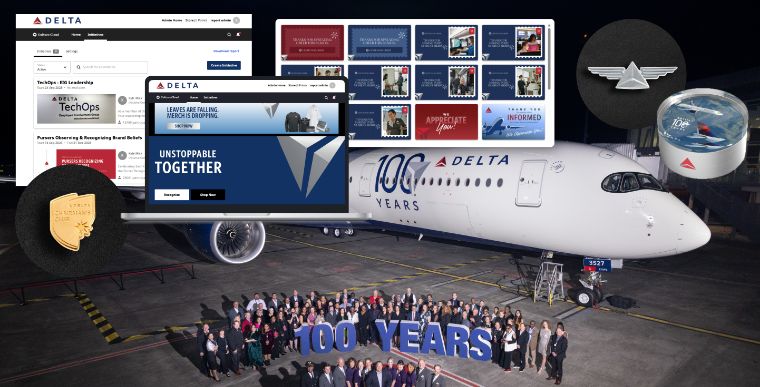
Delta wanted to help employees feel connected to their company values and mantra of Never Stop Climbing. They created Unstoppable Together, which empowers Delta leaders and employees to recognise one another with points, messages, Group Point Deposits, Initiatives, custom awards, Yearbook® for service anniversaries, and company celebrations, like their 100th anniversary. All recognition is directly tied to their values and mantra. Because of this, 76% of employees are excited to go to work each day, and Delta makes the top of most of the best places to work lists.
“It is recognition with purpose—it is inspiring, energetic, and creates a movement that comes through Delta. It shows we belong and at the centre of it is caring for our communities, customers, and one another,” says Jeanie Brady, Flight Attendant and Ambassador.
Brillio
Brillio wanted a way to celebrate intent, effort, and values in addition to results and outcomes. High performers were often rewarded through salary increases and promotions, yet everyday behaviours that embodied Brillio’s agile culture needed more recognition.
The company turned to O.C. Tanner to evolve its recognition framework, ensuring it reflected effort and values as much as outcomes. Their recognition programme is value-driven. celebrates effort as well as results and ties every recognition moment directly to Brillio’s core values. As a result, there is a 13% increase in overall recognition, and employees embrace Thanks as part of their everyday work.

Amway
One of Amway’s core values is Celebrate and Uplift Personal Worth, so they use recognition to appreciate, champion, and support employees as a whole person. In addition to peer-to-peer and service anniversary recognition, the company also provides life event gifts for new hires, births and adoptions, graduations, marriages, and to celebrate new citizenship.

Amway also celebrates employee anniversaries and retirement with Yearbook. “Yearbook really helps us tell the stories of our employees, because everything links back to our values and who we are in our organisation. The Yearbooks integrate and weave that imagery in,” says Jenni Lee, Director of U.S. Benefits, Payroll, and Employee Programmes.
How do you measure the impact of recognising values?
To measure the impact of recognising company values, measure changes in the employee experience, culture measures, and business results.
Employee experience
Look at improvements in engagement and employee satisfaction through pulse surveys and other feedback loops. Do employees feel connected to the organisation? Do they feel a sense of belonging? Do they believe in your company values?
Company culture
Monitor changes in employee behaviour and great work. Are more employees being recognised for specific company values?
Business results
Evaluate metrics like employee retention, likelihood to promote the organisation as a great place to work, etc. See how much recognition is being given for each value category and if results in that category are improving (customer satisfaction, innovation, productivity, etc.)
How can I start a value-based recognition programme?
If you want to start recognising company values in your organisation, find a partner who can help you implement a recognition platform that will directly connect recognition to your values.
- Start by identifying the values you want to tie recognition to
- Define what behaviours connect to each value and communicate that across your organisation
- Build these values into your recognition platform and tools (website, communication, training), and ensure every recognition given is connected to a company value
- Train leaders and employees to clearly articulate how employees’ work ties to company values in their recognition presentations
Turn Recognition Into Real Connection
Top