Table of Contents
Table of Contents

Perspective
Leaders managing risk in uncertain times tend to reach for control: tighter policies, more approvals, less room for error. It feels like the safe choice, but our research finds it’s often the riskiest one. The controls meant to protect the organisation are frequently the very barriers stalling the creative collaboration it needs to grow. This means many leaders are unknowingly paying for safety at the cost of their future.
And the reality is, innovation isn’t something leaders have to generate: employees want to think creatively, share ideas, and improve how work gets done. Most organisations already employ all the innovation they need. The ones that pull ahead will be those that stop suppressing it.

Introduction
To grow in today’s market, organisations must constantly innovate. Employees need freedom to be creative and explore new ideas, yet organisations crave control.
Many well-intentioned organisational practices actively inhibit innovation. The controls designed to manage risk and maintain resources and consistency can unintentionally slow or stop innovation before it ever takes shape.
At its core, innovation follows a clear, repeatable process. Employees must be able to think critically, share ideas, and act with support. Innovation stalls when time and resources are tightly constrained. It’s no surprise that we find only 33% of employees today are innovators, and 64% wish they were doing more.1
While organisations tend to hyper-focus on creating strict processes and protocols around innovation to maintain control, employees need the flexibility to be creative and space to innovate. These seemingly opposing forces can shut down innovation completely.
What feels like a trade-off between innovation and control doesn’t have to be. Innovation does not require unlimited autonomy, resources, or acting on every idea. However, it does require a culture of trust, support, and acknowledgement.
When leaders intentionally create an environment that encourages employees to think, build safe pathways to share ideas, and provide support to act, innovation becomes amplified as part of everyday work, not a rare event.
Innovation isn’t a singular moment, but rather a process where employees think, share, and act.

When employees are regularly encouraged to think differently, know that they are safe to share ideas, and have assurances that leaders will thoughtfully consider and act on appropriate ideas, they’re more likely to innovate. Removing barriers to sharing and enabling thoughtful processes around new ideas can produce innovation and growth at scale, leading to more resilient, high-performing companies.
“An innovative workplace is one that’s willing to try things—even if they fail. You keep pushing forward, pivoting, and finding what works. That’s what keeps companies alive.”
—Jacob, Focus Group Participant
Think: Creative thinking is the foundation for all innovation
Creative thinking (Think) is the first step employees take in the process of innovation. Our research finds there are specific attributes that enable innovative thinking and creative problem-solving—what we call our Think Index. This index includes employees who:
- Regularly come up with new ideas
- Are encouraged to be creative in their roles
- Take time during work to think of new ways to get things done
- Enjoy thinking about ways to improve their organisations
- See creative problem solving as an important step towards organisational success
When employees are given autonomy and trusted to decide how to do their work, odds of thinking creatively improve 9x.
However, often an organisation’s efforts to maintain control and standardize processes can unintentionally introduce barriers to innovation and hinder employees’ ability to think creatively. Odds of creative thinking drop when employees are discouraged from thinking outside the box (-89%), or are not recognised when they do (-93%).
“Creativity is figuring out ways to get out of tradition so everyone can work the way they want and still achieve goals.”
—Olivia, Focus Group Participant
Organisations can take simple steps to inspire and foster more creative thinking in the workplace.2 Ensuring employees have the time, tools, and autonomy to think creatively can significantly improve the odds of it happening.

Thinking in new ways is the start of innovation, and organisations must remove barriers and empower employees to think creatively in their daily jobs.
Share: Give employees a voice to share ideas with one another
Employees continue the process of innovation when they feel comfortable sharing their ideas at work. Innovative employees feel empowered to share ideas—which we measure in our Share Index. This index includes employees who:
- Share ideas with direct leader
- Enjoy sharing ideas at work and do so regularly
- Have seen the organisation improve because of their idea being shared
- Work in organisations that have systems in place for employees to share ideas
- Feel safe challenging how things are currently done at their organisation
Like thinking creatively, organisations can unintentionally create barriers to giving employees a voice in sharing ideas. Employees have 92% decreased odds of feeling empowered to share ideas at work if there are no clear channels to share ideas. A foundation of trust and safety is also crucial to encouraging employees to speak up: they are less likely to suggest new ideas when trust is lacking (-94%), leaders do not offer feedback on why ideas won’t work (-88%), or employees have given ideas in the past and nothing happens (-20%). To enable employee voice, trust, communication, and follow-up must be present.
Organisations can easily empower employees to share ideas by having clear communication and developing formal channels for idea sharing, whether that’s team huddles, one-on-one meetings, a specific Slack or Teams channel, physical idea boards and walls, or apps and platforms. Giving feedback on employee ideas improves the odds of sharing ideas 16x. Even if the organisation can’t move forward with an idea, when leaders are transparent about the reasons, the odds of sharing ideas still increase 9x. To keep innovation flowing, leaders should prioritise listening and responding to employee suggestions.
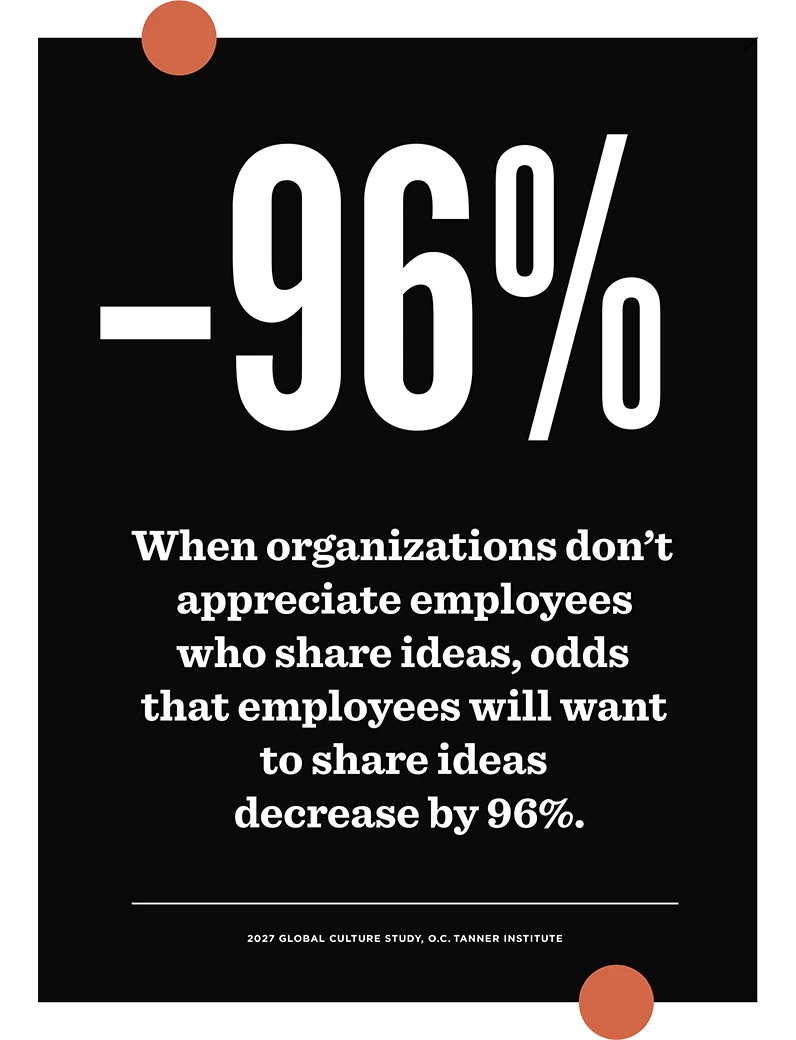
Providing regular opportunities for idea-sharing and specific processes to facilitate sharing ideas, as well as recognising employees when they do share ideas, will encourage them to do it more often.

It’s not enough to think of new ideas—employees must feel empowered to share those ideas in order to push them forward.
“Companies say they want innovation, but then they stay stagnant because ‘it’s always worked this way.’ You have to take chances—(make) even small changes—to keep up. Employees are the voice because we’re living it.”
—Matt, Focus Group Participant
Act: Innovation only happens when employees are empowered to take risks and try
Taking an idea and implementing it is the final step in the process of innovation. Our Act Index measures employees who implement ideas regardless of setbacks. The index includes employees who:
- Go out of their way to improve processes
- Execute ideas that make work more efficient
- Enjoy implementing new ideas at work
- Have improved their organisation as a result of implementing new ideas
- Strive to act on good ideas despite obstacles
- Are willing to take calculated risks to improve how work gets done
- Follow through on ideas, even if implementation is difficult
As we’ve seen in previous research, a practice of hope, which includes pathway thinking (“I can see a path to my goal”) and agency thinking (“I believe I’m capable of following that path”), drives employees to work towards a goal even if obstacles stand in their way.3
Organisations can remove common barriers that decrease odds of employees acting on new ideas. This includes not letting employees implement new things at work (-86%), punishing employees when new ideas don’t work out (-68%), not recognising employees when they try something new (-82%), and not supporting employees when they try something new at work (-87%) or not protecting employees when they face setbacks in innovation (-78%). Similar to enabling employee voice, a psychologically safe workplace is imperative to fostering innovation.
Cultural amplifiers like employee recognition and trust are powerful ways to encourage employees to act on new ideas. Whether it’s providing support during the process of trying new ideas, focusing on learning and encouraging employees to try again when something doesn’t work out, or recognising employees even if they fail—actions that strengthen trust and relationships can inspire employees to keep innovating.4

Taking an idea from thought to implementation requires active encouragement and support from organisations throughout the entire process. Yet often frontline employees don’t have the flexibility or autonomy to think, share, or act creatively.5 More than one third (35%) say senior leaders minimize or dismiss their ideas.
By empowering frontline workers to think creatively, share their ideas, and act on those ideas, leaders tap into the tremendous potential of their people. Innovative frontline employees see a 15x increased odds of producing great work, 13x increased odds of engagement, and a 12x increase in a desire to stay with the organisation. These empowered employees are also 9x more likely to feel a strong sense of connection to their organisation and a 14x increase in trust.
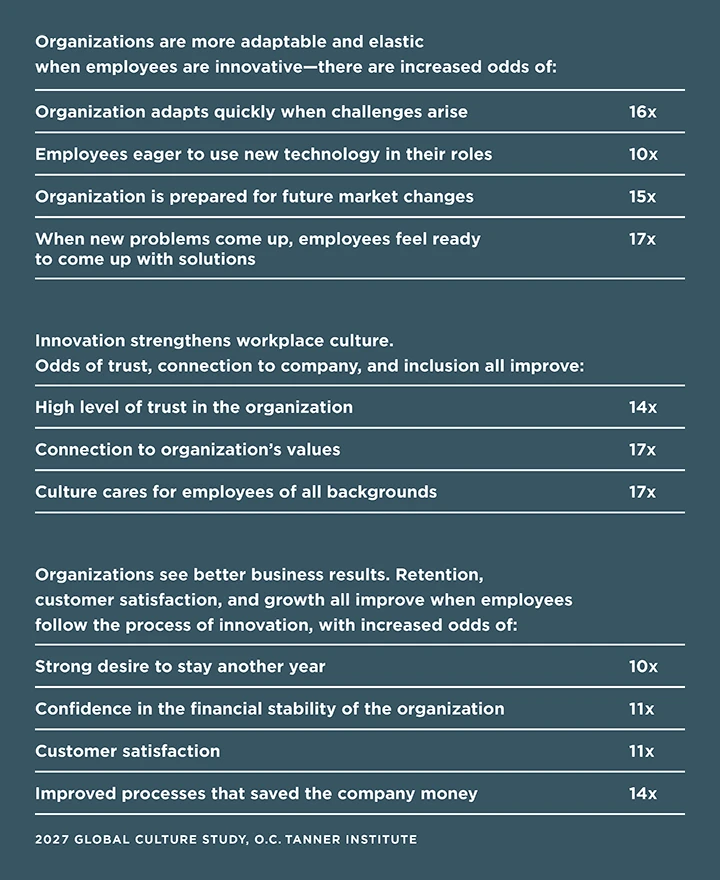
Fostering the process of innovation unlocks tangible business results
Organisations that both remove barriers to innovation and encourage employees to think, share, and act can expect to not only see more innovation, but also positive outcomes in organisational resilience, culture, and business results.
While innovation creates new ideas or products and results in process improvements, it does so much more. Organisations with cultures that regularly encourage, enable, and see innovation happening are stronger and perform better. They are more well-equipped to handle the changes and challenges they face. And they will be more likely to grow over the long-term.
“If you decide that you’re going to do only the things you know are going to work, you’re going to leave a lot of opportunity on the table.”
—Jeff Bezos, Founder, Amazon
Recommendations
To unlock innovation, organisations must support employees as they think of, share, and act on new ideas.
1. Intentionally build conditions for creative problem-solving
Employees don’t think creatively in a vacuum: organisations must build workplace conditions to foster creative thinking. This includes providing employees with autonomy and flexibility to think of new ways of working, access to resources that inspire thinking outside the box, and encouragement to do so.6
Offer employees opportunities and time to interact with leaders and colleagues outside their normal teams so they can be inspired to uncover new ideas. When employees felt their jobs were monotonous, there was 17% decreased odds of creative thinking. But when they regularly collaborate with others, odds of thinking of and sharing new ideas improve 4x.
Organisations must set the stage for, and believe in, employee innovation. When ideas are welcomed in theory but discouraged in practice, odds of employees sharing new ideas drop 16%.
2. Build a workplace with strong trust and psychological safety
Trust is the foundation of employee confidence to share ideas. Organisations can build trust in meaningful ways (see Active Trust), like consistent one-to-ones with leaders.
Create a culture that encourages employees to experiment, try new things, and fail. When organisations punish employees who attempt to innovate and fail, their odds of suggesting new ideas in the future plummet 68%. But when the focus is on learning rather than assigning blame when an idea doesn’t work, employees are 7x more likely to suggest new ideas.
Giving feedback and being transparent (especially about employee ideas that won’t be acted on) also builds trust and psychological safety. If leaders don’t offer feedback on new ideas, odds of employees suggesting more new ideas decrease 86%; odds increase 8x when leaders take the time to provide feedback when an idea doesn’t work.
3. Use recognition as a consistent, organisation-wide way to show and amplify care and compassion
Few employees will take on the risk of implementing something new if they don’t have the support of their leaders and fear punishment for a potential failure. Rather than blaming employees for failed innovation, recognise them for trying.
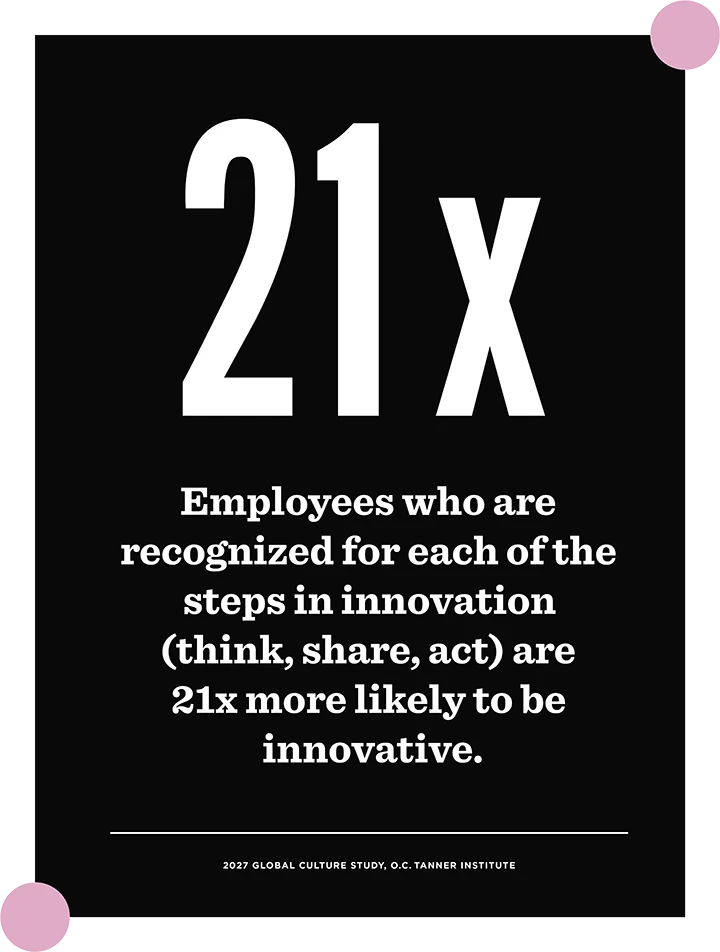
Show appreciation throughout the process of innovation, not just at the end—when employees come up with a new idea, when they share their ideas with others, and when they take actions to bring that idea to life. Recognising at each step of the innovation process encourages effort along the way and helps employees overcome obstacles they may run into.
When organisations recognise the steps of innovation publicly, they also encourage other employees to try new things. While there are 84% decreased odds of trying new things when the organisation doesn’t appreciate employees, there are 14x increased odds of coming up with new ideas when employees have been recognised for innovation before. Meaningful recognition encourages employees to try again and continually think of new ways to do great work.
{{report_insert_1}}
Unlocking Innovation—Key Takeaways
Innovation is a process, requiring employees to think creatively, share new ideas with others, and implement change.
Organisations may unintentionally suppress innovation with the need for control. Instead, they should provide autonomy, encouragement, and support during each step of innovation.
Recognition can unlock innovation when organisations recognise along each step of the innovation process and not just at the end.
Unlocking Innovation Sources
- “Leaders Demand Innovation While 41% Of Employees Fear Getting Fired,” Caroline Castrillon, Forbes, April 21, 2026.
- Sparking Inspiration, 2026 Global Culture Report, O.C. Tanner Institute.
- Hope in Practice, 2026 Global Culture Report, O.C. Tanner Institute.
- State of Employee Recognition 2026, O.C. Tanner Institute.
- The 80% Experience, 2024 Global Culture Report, O.C. Tanner Institute.
- Sparking Inspiration, 2026 Global Culture Report, O.C. Tanner Institute.


Case Study—Empowering Innovation
At Amazon Web Services (AWS), innovation is an integral part of the company’s ecosystem. AWS provides on-demand IT infrastructure, processing power, storage, and security for nearly 5 million businesses worldwide, from small startups to the world’s largest enterprises. And every employee at AWS is expected to innovate.
“We have hired incredibly intelligent, bright people, and our job is to let them do what they do best and remove roadblocks for them, so they can create and build new things,” says Cameron Dobson, Senior Manager, Recognition at AWS.
In fact, all employees at AWS are referred to as “builders,” and many of the best ideas come from those closest to the work and customers, who often have greater visibility into day-to-day issues. Says Dobson: “They are the ones who are best equipped to identify and solve those problems. And the job of leadership is to give them the tools, the technologies, the capabilities, and the freedom to do just that.”
The company encourages outside-the-box thinking and recognises up front that not all ideas will be successful. Employees are encouraged to work on BHAGs—Big, Hairy, Audacious Goals—and leaders frequently reward failures.
“We think there’s a very direct link between innovation and failure. This is not something where we sweep it under the rug,” says Dobson. “We’re happy to talk about it, and there are so many learnings that come out of failure. If you’re not pursuing BHAGs, you’re not striving for things that are difficult, and you’re not going to be innovative.”
Recognition plays a major role in supporting the spirit of innovation at AWS. Through the AWSome Awards programme, employees are recognised frequently for pursuing new ideas, even when desired outcomes don’t materialize.
At AWS, failure is not a dead end, but rather proof of effort and an opportunity to learn and grow.
Turn Recognition Into Real Connection
Get Started Today
Top