Table of Contents
Table of Contents
Foreword
How can organisations amplify the meaningful connections they need to make performance happen at scale? Despite the rapid adoption of advanced technologies, performance and growth in today’s workplace remain rooted in the fundamental connections between people. This year’s report provides an insightful pathway to performance that amplifies care and champions the trust that drives innovation. Of course, challenges persist. Skepticism about the future remains high and in many corners trust in systems, leaders, and institutions is shaky. But the way forward is clear. And it starts with amplifying what already generates value: your people.
Change isn’t the exception, the one-off event, or the random result of something new. Continual change is the day-to-day environment in which we now all operate. From advances in AI to shifting employee expectations and increasing economic uncertainty, leaders are constantly navigating disruption. But our research points to a hopeful insight: employees are ready for more. They are not simply bracing for what comes next. They want to make an impact, take their work further, and help their organisations innovate and grow.
This year’s report is about what happens when organisations learn to amplify, to make what is already valuable more powerful. You have people with ideas, leaders with purpose, relationships built on trust, and moments that make employees feel appreciated and connected. The challenge is turning those moments into momentum.
Culture is the system that enables amplification. It is the daily practices and programmes that actively create the conditions where positive experiences can happen and ripple outward. It is where recognition strengthens belonging, belonging encourages contribution, and contribution ignites performance.
This report examines four areas where organisations can create those multiplier effects: embedding compassion, building growth cultures, practicing active trust, and unlocking innovation. We also consider the essential role of frontline employees in carrying these efforts into the moments that matter most.
Our research makes one thing clear: sustainable success is not about extracting more from your people. It is about investing in the systems, environments, and expectations that amplify the people and practices that already create value. We’re excited to share with you a roadmap to help shore up the cultural infrastructure of your organisation.
Introduction
Today’s workplace is defined by disruption and change. From the rapid rise of AI and cybersecurity threats to shifting employee expectations, persistent skills gaps, and economic pressures, organisations are navigating unprecedented complexity. Yet amid the uncertainty, employees remain remarkably optimistic. They want to contribute. They want to grow. They want to make a meaningful impact.
Our research reveals that employees are not looking for workplaces that simply help them adapt to change. They are looking for workplaces that amplify their ideas, talents, contributions, and potential. The organisations that thrive in this environment will not be those that do the most. They will be those that amplify what matters most.
Our research uncovered something important this year: workplace culture is an amplifier. Every culture amplifies something. Struggling cultures amplify bureaucracy, uncertainty, and burnout. Thriving cultures amplify trust, connection, innovation, purpose, and performance. The question facing leaders is, what is your culture amplifying every day: confidence or fear, possibility or doubt, energy or exhaustion?
Amplification is the intentional practice of increasing the impact and influence of people, experiences, and behaviours that create value.
Successful organisations understand that positive workplace experiences do not remain isolated. They spread. They shape decisions, influence relationships, and create ripple effects that strengthen performance across the organisation. Indeed, amplification is what happens when culture transforms positive moments into lasting organisational impact.
Historically, organisations have responded to changes by introducing new programmes and training initiatives. But our research suggests that sustainable success comes from a different approach. Most organisations already have talented people, strong values, meaningful work, and capable leaders. Too often, those strengths are drowned out by the noise of modern work. The most effective organisations do not focus on doing more. They focus on amplifying what already creates value. They identify the moments, relationships, and experiences that bring out the best in their people and intentionally expand their impact. In these organisations, culture becomes a multiplier of human potential rather than simply another management tool.
Amplification is more than a metaphor. Research shows that the strongest workplace practices produce multiplier effects. A simple moment of recognition can amplify belonging. Belonging amplifies contribution. Contribution amplifies performance. Performance amplifies the outcomes organisations care about most. Small moments can create extraordinary impact when culture is designed to carry them further.
This year, our research begins with organisational compassion. Compassion creates conditions that allow amplification to happen. When employees feel supported and valued as people, they are more willing to contribute their best work. Organisations that provide equitable support create environments where wellbeing and high performance reinforce one another. Achievement becomes sustainable because success is shared rather than extracted.
Growth is another powerful amplifier. Employees want opportunities to build their capabilities, expand their influence, and take on meaningful challenges. When organisations invest in helping people grow, they amplify confidence, contribution, adaptability, and long-term performance. The strongest cultures view growth as a partnership that elevates both the individual and the organisation.
With compassion and growth in place, trust becomes a third performance amplifier. Employees are unlikely to adopt new technologies or take smart risks unless they trust their leaders and the systems around them. Trust transforms uncertainty into possibility. When employees believe their leaders are authentic and committed to their success, they become more willing to collaborate across boundaries and contribute new ideas. Trust does not simply improve relationships. It amplifies performance, innovation, and progress.
With compassion, growth, and trust in place, innovation becomes possible at scale. Innovation is no longer an accidental outcome. It becomes a natural result of a culture that encourages experimentation, learning, and shared problem-solving. Organisations that intentionally cultivate these conditions remove barriers and amplify creativity throughout their workforce, transforming individual insights into collective progress.
The future of work is not something organisations should brace for. It is something we can actively shape by deciding today what we will amplify.
Talent Magnet Areas
Each year, we measure changes in the six core elements of workplace culture that determine an employee’s decision to join, engage with, and stay at their place of work. We call these the Talent Magnets because of their power to attract and connect people to their teams and organisations.
This year, each of the Talent Magnet scores increased by 1% except for Success. This indicates that while organisations are making improvements to their cultures, there is still opportunity for more growth, especially in the areas of wellbeing, appreciation, and leadership.
The Success Talent Magnet has remained stagnant since last year. As organisations look for ways to drive innovation and performance, connecting business goals and successes to individual employee achievements and success is another opportunity to improve. Employees want to feel they are growing, innovating, and playing on a winning team. Celebrating success is an effective way to build a sense of growth and accomplishment.
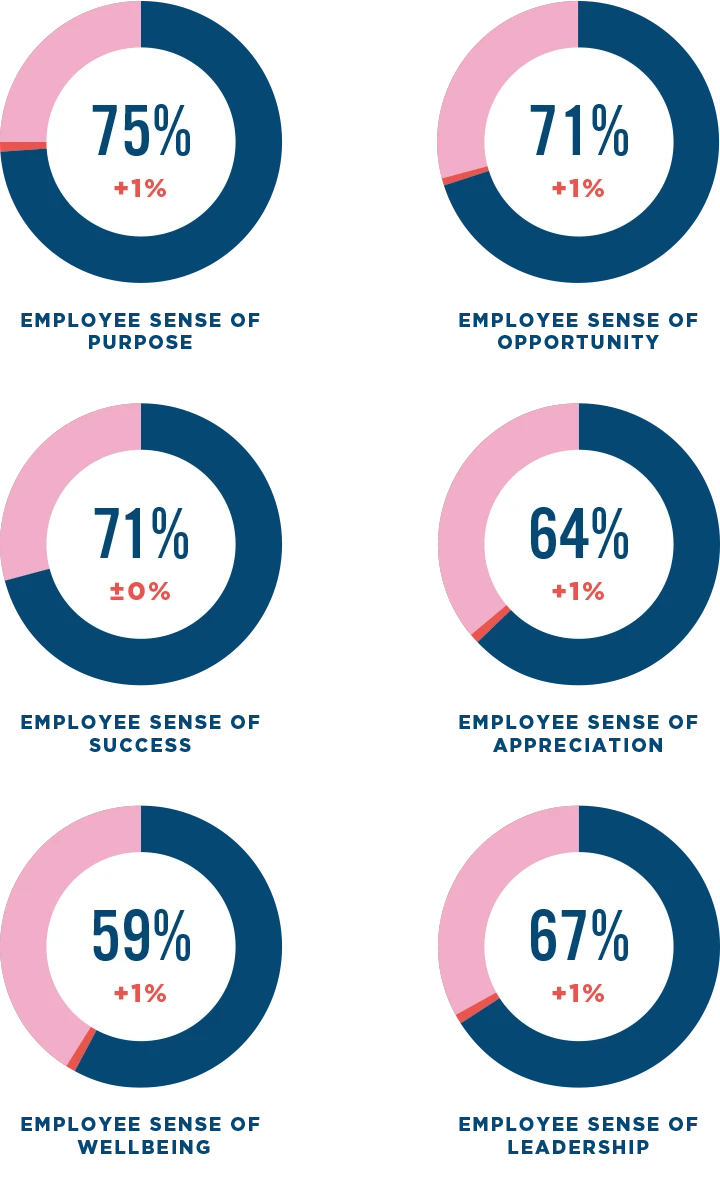
Current state of the six essential elements that define thriving cultures.
{{report_insert_1}}
Opportunities for Organisations in 2027
This year, organisations should focus on 4 areas to amplify employee and organisational growth:
1. Embed compassion
Compassion that is embedded into an organisation’s systems and processes is sustainable, equitable, and drives performance. Three pillars of compassion ensure it improves both employee wellbeing and business results.
2. Build growth cultures
Growth is a partnership between employees and their organisations and goes beyond learning and skill building. The six elements that shape growth cultures also create cultural elasticity.
3. Practice active trust
In today’s workplace, trust means more than expertise and integrity. It’s about fostering a sense of authenticity, security, and reliability during times of uncertainty and the disruptions of technology like AI.
4. Unlock innovation
A process, not a moment, innovation happens when organisations let go of control and employees feel empowered to think creatively, share ideas, and implement change. Innovation occurs in environments that are designed to bring new ideas to life.
We can’t forget about our frontline workers—those essential employees who carry forth an organisation’s mission, purpose, and customer care. As organisations help employees grow through compassion, trust, and innovation, they must include frontline employees in their strategies.
By acting on these opportunities and the specific findings behind them, organisations can awaken improved performance, innovation, and growth in the coming years.
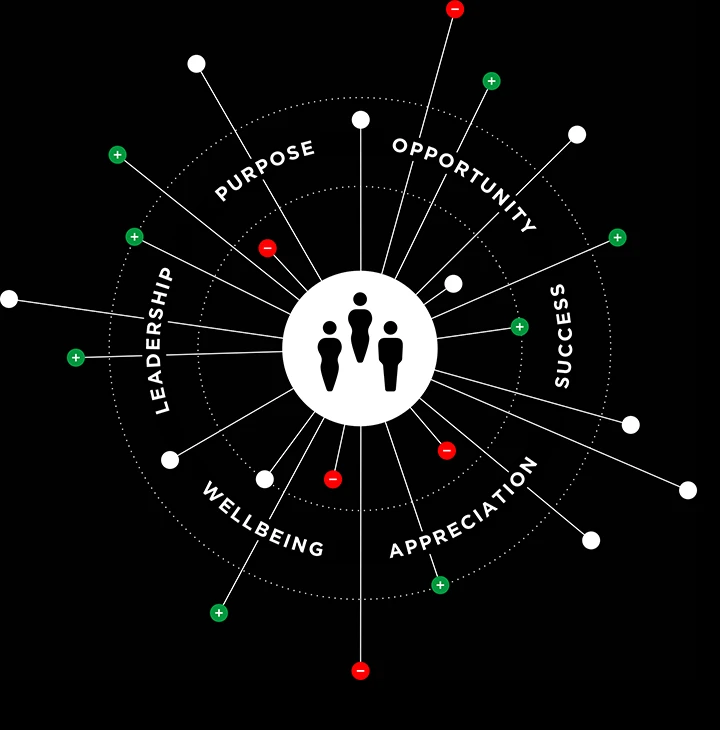
Six essential elements that define thriving workplace cultures.
Purpose
An organisation’s reason for being besides profits. The difference it makes in the world, why the company exists. Employees need to feel connected to purpose and understand how their jobs contribute to it. Once they do, their work takes on meaning. Organisations should clearly articulate the connection between work and purpose.
Leadership
The mentoring, coaching, inspiring, and facilitating that allow individuals, teams, and, ultimately, organisations to thrive. Great leaders co-create a shared purpose for their teams and empower their employees to do great work. As the most influential of the six Talent Magnets, leadership cultivates the other five.
Wellbeing
Caring about the employee as a whole—their physical, emotional, social, and financial health. Wellbeing ensures employees can be their strongest, most capable, most authentic selves at work. A comprehensive approach to wellbeing requires leaders to create an environment of inclusivity, life balance, and connection.
Opportunity
The chance to develop new skills, contribute to meaningful work, feel challenged, have a voice, and grow. Opportunity is more than the lure of promotions and pay increases. It’s about preparing and empowering employees to make decisions, inviting them to participate, and offering them projects that will expand their skills and relationships.
Success
The thrill of accomplishment, innovation, breaking barriers, playing on a winning team, and experiencing victories. Employees must find success at the individual, team, and organisational levels, and it should be nurtured and celebrated publicly.
Appreciation
Feeling valued for one’s contributions and being recognised for one’s worth. Appreciation is essential to employees—they need to know their leaders and peers notice and are grateful for their efforts and contributions. Appreciation is most effective when it’s delivered in timely, personal, and meaningful ways.
Turn Recognition Into Real Connection
Get Started Today
Top