Updated on
September 11, 2026
11 September 2026
Key takeaways:
Global recognition programmes need to work consistently across borders while still feeling relevant to local cultures and employees.
The right employee recognition software connects people to company values, supports business performance, and gives leaders data they can act on.
These nine questions will help you evaluate any recognition platform and identify which ones are built for global organisations.
Running a recognition programme for 50,000 people across a dozen countries is a fundamentally different challenge than running one for a single-country team of 500.
Cultural norms around recognition vary significantly. What feels meaningful in the United States may land differently in India or Australia. Local languages, currencies, tax laws, and compliance requirements add complexity. And the bigger the organisation, the harder it is to ensure your recognition programme is consistent, equitable, and actually used.
The best global recognition systems build on a world-class rewards experience and layer in the infrastructure, data, and cultural tools that enterprise organisations need.
Your recognition platform needs to:
- Support culture at scale
- Meet compliance requirements across every region you operate in
- Make it easy for employees to recognise each other across borders
- Connect recognition activity to measurable business outcomes
These nine questions will help you evaluate any platform and find the one that's right for your international organisation.
Question 1: Can the platform support both global consistency and local relevance?
This is one of the harder things to get right in global recognition. A programme that looks and feels the same everywhere tends to miss the mark locally. A programme that's fully localized can lose the sense of shared culture that makes recognition meaningful at a company level.
Look for a platform that lets you set global awards and recognition standards while allowing regional flexibility in language, currency, imagery, and reward preferences. Employees should be able to write recognition messages in their native languages. Reward catalogs should feature options that feel relevant to where they live.

O.C. Tanner's platform is available in 26 languages and supports global awards programmes with local fulfillment. With over 1,000 global clients across industries and geographies, the platform is built to handle both the consistency and the nuance that global recognition requires.
When Delta Air Lines needed a recognition platform that could reach tens of thousands of employees across dozens of countries and roles, they turned to O.C. Tanner.

“Recognising the flight attendants who took care of our customers, or the gate agent who is hustling to get a flight out early, or the medical team who has helped, or the captain who has kept us safe, is easy on the platforms O.C. Tanner gives us. Recognition is inspiring, motivational, and energising. What O.C. Tanner and our leaders do for us gives us the opportunity to keep climbing.”
—Flight Attendant and Culture Champion, Delta
Question 2: Does it meet global compliance and data security standards?
Compliance is one of the first things global HR leaders need to evaluate any time they invest in a new software platform, but it's also one of the easiest things to overlook when you're focused on features and user experience.
Ask specifically about:
- Regional data privacy regulations, including GDPR in Europe and equivalent frameworks in other markets
- Security certifications like SOC 2 and ISO 27001
- Single sign-on (SSO) and identity management capabilities
- Role-based permissions and administrative controls that scale across regions
A platform operating across multiple countries needs to be able to adapt to evolving regional requirements without requiring a rebuild of the entire programme. O.C. Tanner maintains rigorous security and compliance standards across all markets.
Question 3: Does it offer meaningful local rewards and incentives?
A rewards marketplace is only as valuable as how appealing and useful it is to employees in each region. When the options don't reflect local preferences, local vendors, or the way people in a given market actually shop and spend, redemption rates drop.
Low redemption is one of the clearest signals that recognition isn't landing the way it should. If employees are logging in, looking around, and not finding anything that feels worth choosing, it's time to reevaluate your recognition provider.
Look for a platform that offers regionally relevant reward options, local vendor relationships, and clear guidance on tax and compliance considerations for rewards in each country. O.C. Tanner's global rewards marketplace is designed to give employees in each region access to rewards that feel exciting and relevant to their everyday lives.

Chevron, with 40,000 employees across more than 50 countries, is a good example. They needed a unified global recognition platform that could provide equitable, locally meaningful rewards across every location. Today, 93% of Chevron employees have been recognised.
“We have a global programme, one tool, one partner, and a culture that is being enriched through recognition.”
—Recognition & Variable Pay Analyst, Chevron
Question 4: Does the vendor offer local support?
When an employee in Singapore or Brazil runs into an issue, they need help from someone who understands their context, speaks their language, and is available in their time zone.
Ask early on whether the vendor has in-country or regional support teams, whether support is available in local languages, and whether there are dedicated client success partners who understand the cultural context of each market they serve.
O.C. Tanner has six offices around the world and provides 24/7 customer support for end users, with dedicated client success partners for programme administrators. That means someone is always available, in the right time zone, with the right context.
Question 5: Can employees recognise each other across borders?
Cross-border peer-to-peer recognition is one of the most powerful ways to build a sense of shared culture across a global organisation. When an employee in the UK can appreciate a colleague in India for a collaborative project, it reinforces that recognition is a company-wide behaviour, not something that only flows from managers to direct reports.
Look for a platform that makes cross-border recognition as easy as local recognition. Find a team that can remove friction around currencies and give visibility into recognition moments across teams and locations. O.C. Tanner supports over 1,100 multinational clients with 14 million users across 180 countries.

Newgen, an AI-enabled digital transformation company with 4,600 employees across eight countries, made cross-border recognition a priority when they chose O.C. Tanner. Their CHRO wanted to maintain the company's close-knit culture across global offices, and recognition became the vehicle for that. "It's very easy for employees to appreciate each other. Everyone knows how to do it and it's very seamless," says Vivek Mani Tripathi, CHRO.
Question 6: What data connects employee recognition to business performance?
The most effective employee recognition software connects recognition patterns and history to the business outcomes that matter most: retention, employee engagement, productivity, and performance. The question to ask any vendor is whether their reporting can tell you what's actually changing inside your organisation, not just how many recognition moments happened last quarter.
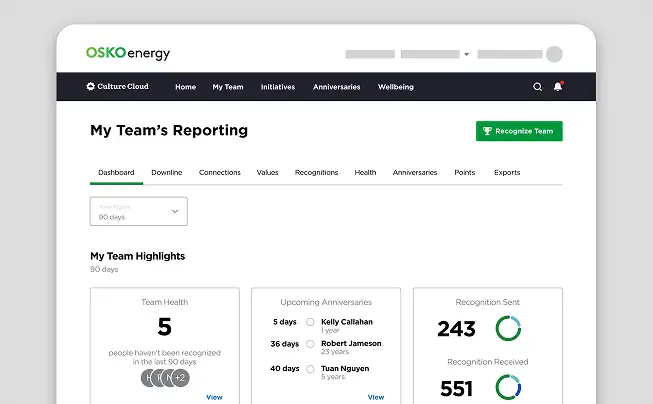
O.C. Tanner’s platform provides analytics to help you track your recognition, identify at-risk teams, and demonstrate ROI to leadership. The ability to connect recognition to business performance makes a strong case for investment.
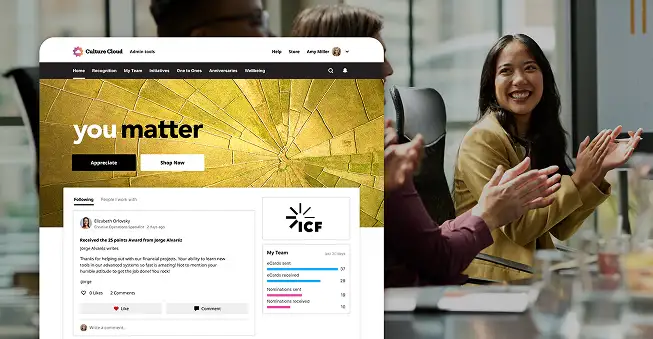
Global technology consulting group ICF found that recognition accurately predicted employee turnover 91% of the time. Their HR team used that data to connect recognition directly to retention strategy. Employees recognised by leaders were 3-8x more likely to stay.
Question 7: Can the software scale as your organisation grows?
Global organisations change constantly. New countries, mergers, growing headcount. A good recognition platform should be able to keep up without needing to be rebuilt every time something shifts.
Mergers and acquisitions are a particularly important use case. Bringing two organisations together is challenging. Recognition can play a meaningful role in unifying culture after a merger or acquisition. O.C. Tanner’s platform is flexible enough to accommodate both organisations during the transition.

3M had 285 separate recognition programmes running across the organisation with little tracking or consistency. Using the O.C. Tanner platform, they consolidated all of them into one unified programme called Everyday Wins. The result: 94% of their 93,000 employees use the platform, with nearly 2 million recognition moments in the first year alone.
Question 8: Does it integrate with your existing HR technology?
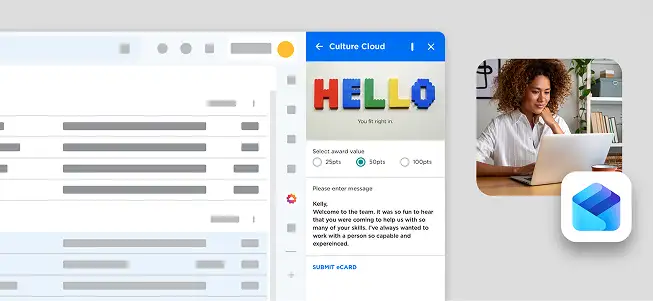
When recognition lives inside the tools employees already use (their Workday profile, their Teams or Slack interface) it becomes part of how work happens. When it lives in a separate system, it becomes something people have to remember to open.
Ask recognition vendors how deep their integrations go. Can a manager see recognition data alongside performance data? Can an employee send appreciation without leaving the app they're already in? Those details tell you a lot.
O.C. Tanner integrates with over 75 HRIS systems. It also has pre-built integrations with dozens of common workplace platforms, with the ability to custom-build an integration for almost any proprietary system.
Question 9: What does long-term success actually look like?
When a recognition strategy is truly working, you stop thinking of it as a programme and start thinking of it as culture. Leaders recognise people because it's become part of how they lead. Employees appreciate each other because the culture supports it. And the retention, engagement, and participation numbers reflect all of that over time.
Find out whether the recognition vendor you’re speaking with provides ongoing strategic support beyond implementation, and how they help organisations evolve their programmes over time. O.C. Tanner’s consulting approach is based on research and behavioural science and we’re committed to supporting our clients across every phase of programme development, from implementation to ongoing programme evolution.

Take BHP, for example. The global mining and resources company has partnered with O.C. Tanner since 2008 and as their needs have evolved, so has their recognition programme. Their workforce of nearly 40,000 employees currently spans 16 countries and 85-90% of their employees are offline. BHP uses recognition to reinforce safety behaviours, celebrate milestones, and build community across their entire workforce. The programme has driven continuous improvement across the organisation and has become a core part of how BHP maintains a strong culture across countries and languages.
"For us, having a simple globally-consistent programme was really important to help engage everyone and be on the same page of appreciation.”
—Head of Global Rewards, BHP
World-class recognition for global organisations
The right employee recognition software for a global organisation does a lot of things at once. It gives employees consistent awards across every location, with the flexibility to keep local incentives meaningful. It meets regional compliance requirements without requiring a different system in every country. It connects people across borders, integrates with existing HR technology, and gives leaders data they can actually use to improve business performance. Culture Cloud does all of this, and more.
Most importantly, it helps organisations build culture intentionally. The companies that get the most out of recognition treat it as a strategic lever, connecting their employees to company values, no matter where in the world they work.
If you're evaluating recognition platforms for a global workforce, these nine questions are a good starting point. And if you want to see how O.C. Tanner approaches recognition for global organisations, the Recognition Buyer's Guide and Why O.C. Tanner page are both worth exploring.
Turn Recognition Into Real Connection
Top