Table of Contents
Table of Contents
Perspective
When DEI initiatives first gained mainstream attention, many people thought that focusing on diversity and equity would naturally lead to inclusion. Some well-intentioned employers tried to capture the benefits of inclusion by tying it to recruitment targets or treating it as part of risk management efforts. However, these approaches rarely made employees feel truly included. The good news is our research this year reveals a different path to success: Inclusion flourishes when purposefully practiced and supported at the team level—as a skill coworkers build together day by day. And as teams foster trust and belonging, these inclusive micro-cultures collectively become a stronger, higher-performing organisation.
{{report_insert_1}}
Introduction
For more than a decade, research in multiple countries has routinely shown that organisations with inclusive cultures deliver dramatically better results. However, none of it has ever suggested that inclusion is easy.
Although 85% of global companies say diversity and inclusion is a priority, and 485 of the Fortune 500 actively promote their inclusion initiatives, most have found limited success.1 A hyper-focus on risk mitigation and compliance, limited or erratic support, and an incomplete understanding of the principle itself have made achieving and sustaining inclusion extremely difficult for many organisations.
As we discussed in our 2021 Global Culture Report, true inclusion is a “synthesis, a coming together, of unique individuals with their own combination of experiences, skills, perspectives, and personalities to enhance culture and business performance.”2
Some organisations have rallied around creating diverse teams, often lumping inclusion initiatives with DEI programmes, but they lack a strategy for helping employees feel like they’re included or belong. A team with different backgrounds and perspectives won’t automatically feel inclusive. Far from a policy or programme, inclusion is a regular, everyday practice that works best at the team level and leads to feelings of belonging (not just tolerance). Inclusion happens when team members, leaders, and the organisation demonstrate an ongoing commitment to helping everyone feel seen and heard. Having a proactive, rather than reactive, approach not only appears more genuine to employees; it makes inclusion achievable and scalable.
This is critical because recent studies show 30% of employees feel invisible at work, 65% feel unappreciated, and 82% feel lonely.3 Employees are showing up, but they don’t believe they belong or that they matter.
“Mattering,” according to Zach Mercurio, a leadership development researcher and professor, “is the experience of feeling significant to those around us because we feel valued and know that we add value. It is a primal need. When people know that they matter at work, they thrive. Employees who believe they matter report greater satisfaction, are more likely to be promoted, and are less likely to leave.” Helping all employees feel they matter deepens the definition of inclusion.
This presents an extraordinary opportunity for organisations. Our research shows that when employees feel their teams are inclusive, they are:
- 4x more likely to be promoters
- 7x more likely to believe senior leaders can achieve the organisation’s goals
- 10x more likely to be thriving
With two-thirds of employees choosing to work for companies that champion inclusion,4 organisations need new strategies to harness the strengths of all team members. The ability to solve problems creatively and innovate consistently hangs in the balance.
“Diversity is a fact, but inclusion is a choice we make every day.”
—Nellie Borrero, Managing Director and Senior Strategic Advisor, Global Inclusion and Diversity, Accenture
Anatomy of Inclusion as a Practice
Ideally, inclusion is a daily habit built into the normal flow of work. We found that when employees have peers at work who understand them, they’re 5x more likely to feel included. Based on focus groups and surveys, five key categories of behaviour support inclusivity on teams.
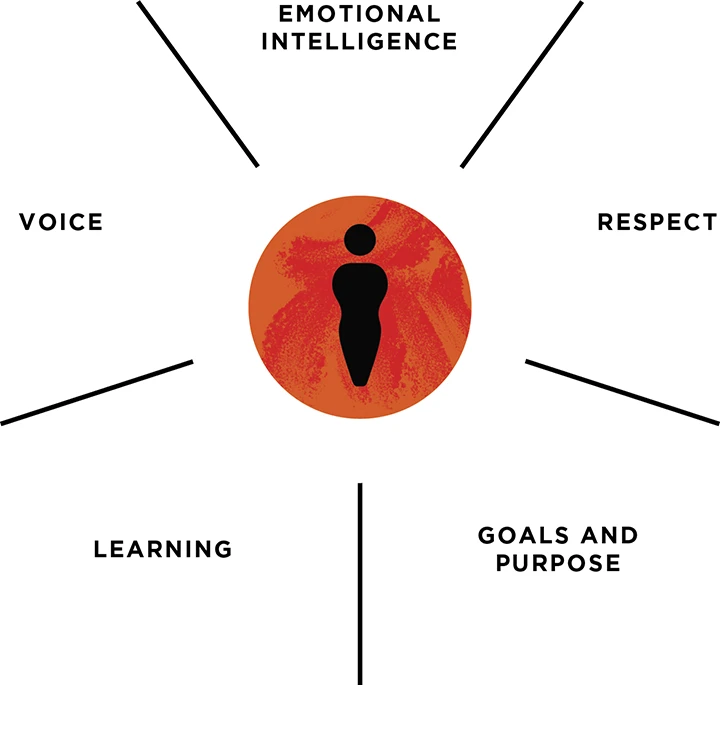
The five types of behaviours that support inclusivity on teams.
Emotional Intelligence: Team members understand one another, have open discussions, celebrate each other’s successes, and manage emotions
Respect: Coworkers honor each other’s time, boundaries, and perspectives equally
Goals and Purpose: Team members work together to accomplish shared goals that advance the organisation’s purpose
Learning: Employees exercise freedom to experiment, collaborate, and make mistakes
Voice: All team members feel comfortable expressing opinions and giving feedback
When leaders practice these behaviours, the odds employees feel included increase 6x. And when teams practice them, members are 7x more likely to feel they belong and 9x more likely to feel a sense of community.
Furthermore, as the following table shows, inclusive team practices lead to equally significant outcomes for organisations.
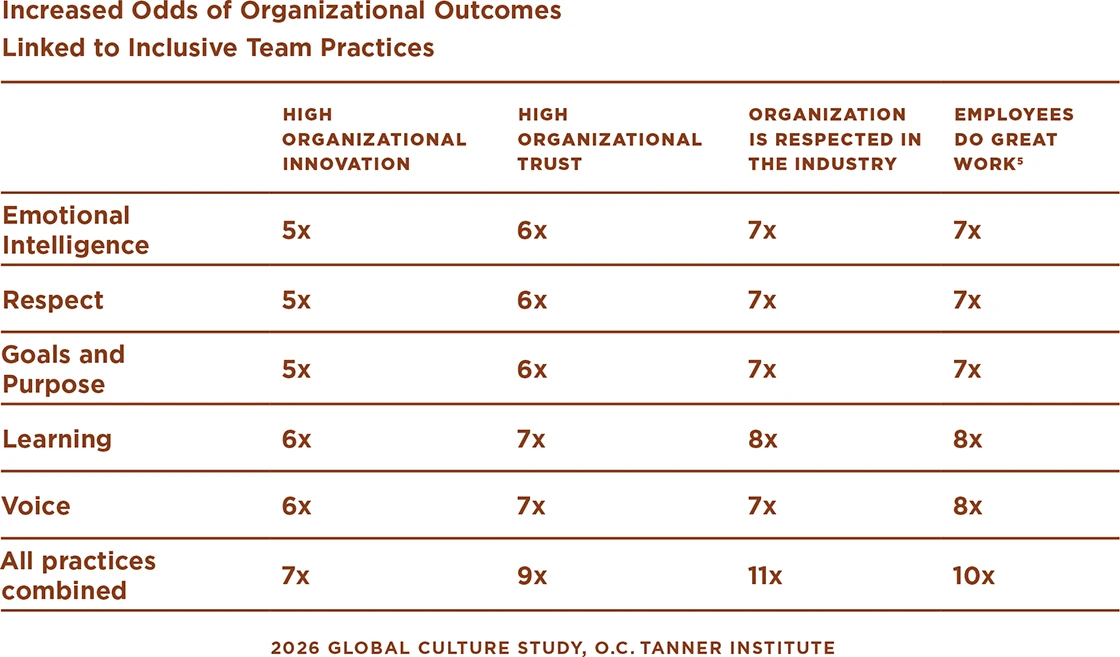
Employers don’t need a formal programme to reap the benefits of inclusion. Teams that learn and model inclusive behaviours by any means available can be more impactful. When employees feel they’re part of an inclusive team, the odds that they perceive their organisation as inclusive increase 12x.
The Corroborating Role of Recognition
Employee recognition can help foster inclusive teams by emphasising and celebrating behaviours in each of the five key areas (Emotional Intelligence, Respect, Goals and Purpose, Learning, and Voice). And, as the following table demonstrates, at organisations where recognition is a familiar, frequent, integrated part of the culture, people are significantly more likely to practice the behaviours.
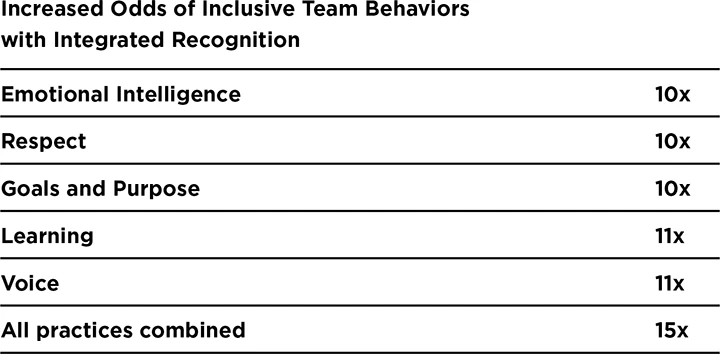
Recognition also inherently demonstrates that employees and their work matter, that they make a difference and belong. Remember, inclusion is really about feeling seen and valued—exactly what recognition does best.
“When we listen and celebrate what is both common and different, we become wiser, more inclusive, and better as an organisation.”
—Pat Wadors, Former Chief People Officer, Procore Technologies
Teams May Build Inclusion, but Inclusive Teams Don’t Build Themselves
It should come as no surprise that the modeling and nurturing of inclusive practices start with emotionally intelligent, modern leaders.
When leaders practice inclusive behaviours, employees are 34x more likely to do the same. Other specific positive outcomes appear in the following table.
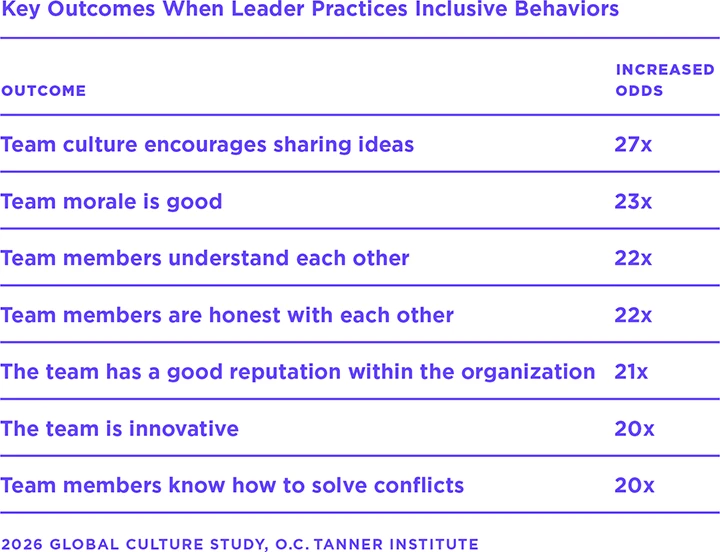
Of course, most leaders have leaders, too. And those leaders, together with the organisation, can provide critical support. When they do, middle managers are 9x more likely to practice behaviours in the five areas of inclusion. Likewise, the odds of inclusive leadership improve 10x when a leader has the tools they need to innovate.
Organisations should give leaders the time and resources to learn and practice emotional intelligence, purposeful goal setting, active listening, and respect. Recognising leaders who demonstrate these behaviours reinforces the behaviours’ importance and encourages leaders to practice them regularly.
What Does Inclusion (or Its Absence) Mean for Organisations?
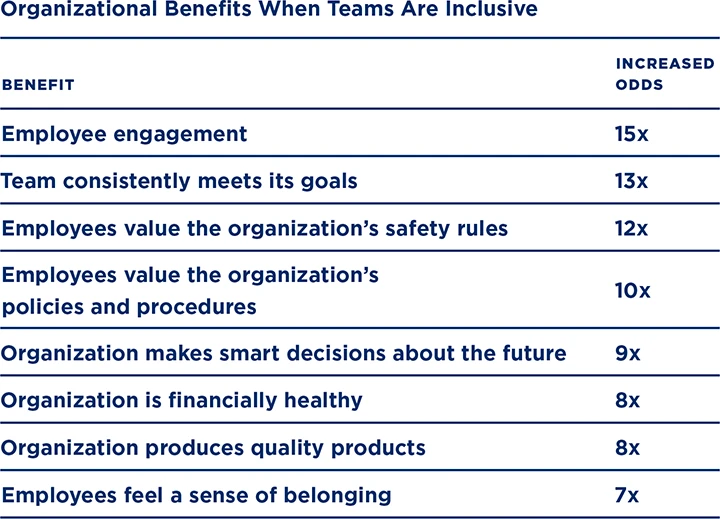
While inclusion benefits individuals in many ways, inclusive teams also directly improve the business. When teams are inclusive, employees are not only more engaged and have a sense of belonging; they’re also more likely to perceive themselves as part of the organisation, have a sense of ownership, and feel invested in the organisation’s success. Additional benefits appear in the following table.
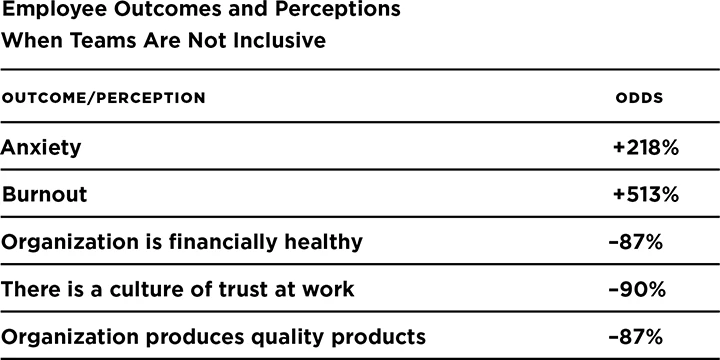
Conversely, as the next table shows, when teams don’t feel inclusive, we see elevated levels of anxiety and burnout and more negative perceptions of the organisation. Regrettably, only 32% of employees report having an inclusive team.
“I work for a retail company, and we sell to everyone, doesn’t matter what you look like. So, I think having a diverse group of people running it, and group meetings where everyone has different ideas, and everyone is trying to sell to the different type of customers…it benefits the bottom line.”
—Focus group participant, Los Angeles
Recommendations
To build true inclusion in the workplace, encourage leaders and teams to adopt inclusive behaviours.
1. Empower leaders to practice inclusion
The most effective way to practice inclusion at the team level starts with leaders setting an example for their teams. And when leaders have the support of their organisations, they’re 8x more likely to engage in inclusive behaviours themselves.
This support can take many forms:
- Training leaders to solicit and understand the perspectives and opinions of all team members
- Encouraging leaders to have open, transparent discussions
- Creating a safe space for employees to express their opinions and give feedback
- Providing leaders best practices for respecting employees’ time and boundaries equally
- Helping leaders connect employees and their work to shared goals and purpose
- Promoting a culture where employees feel safe to take risks and fail
- Giving leaders the resources to learn about building inclusive teams, plus the autonomy, flexibility, and time to practice inclusive behaviours
2. Ensure teams and leaders practice inclusion regularly
One-and-done training is not enough. Consistency is key. When employees feel their teams are inclusive all the time, rather than some of the time, odds of anxiety and burnout decrease (–60% and –80%, respectively), and the odds of great work and thriving at work increase (447% and 724%, respectively).
Examples of inclusive behaviours include:
- Scheduling routine meetings at times that alternate so international team members don’t have to always meet outside of business hours
- Providing avenues to gather every employee’s perspective and feedback on an issue or project
- Connecting employees’ contributions and accomplishments back to the team and organisation in frequent recognition moments
Building inclusive behaviours into the everyday employee experience through leader modeling, communication, and recognition, eventually makes them an embedded part of your culture.
{{report_insert_2}}
3. Use recognition to further encourage inclusive practices
Employee recognition plays an important role in fostering inclusive teams. However, if the goal is to build inclusion as an outcome, how you recognise people is important.
Recognition that’s most effective is accessible to all, meaning every employee has the opportunity to give and receive it. Employees should feel empowered and comfortable joining in recognition moments for others, whether as an observer, presenter, or someone who simply shares remarks. Integrate recognition into the everyday employee experience, where it’s frequent and open, and connects employees to the organisation and its purpose.
When employees receive and witness recognition in these ways, they’re more likely to perceive their teams as inclusive. The following table shows how positive perceptions improve the odds of creating an inclusive team.
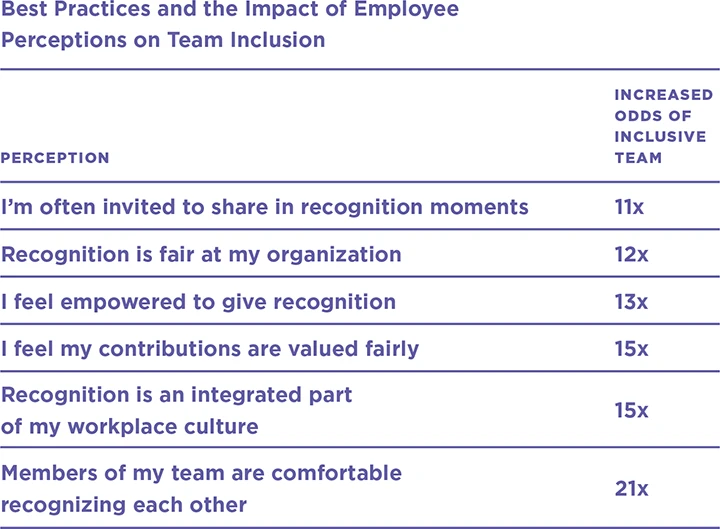
Finally, the relationship between recognition and inclusion is a cycle that perpetuates itself. Recognition supports the development of inclusive team practices, which, in turn, encourages more recognition—as well as greater feelings of belonging, community, and engagement.
“When you recognise people for the great work they’re doing and the impact they have, they feel good about being part of the organisation. And when people feel good and feel connected to the organisation, they stay. You can have lofty goals around belonging, but it’s the people you work with day to day that make you feel like you belong.”
—Peggy Essert, Manager of Human Resources, St. Elizabeth Healthcare
{{report_insert_3}}
Inclusive Teams—Key Takeaways
More than a programme or policy, inclusion is a practice that occurs at the team level.
Inclusion has a demonstrated ROI for individuals, teams, and organisations.
Five key practice areas build inclusive teams: Emotional Intelligence, Respect, Voice, Learning, and Goals and Purpose.
Recognition encourages and rewards inclusive behaviours, helping to build inclusive teams.
Inclusive Teams Sources
- Diversity, Equity & Inclusion Benchmarking Survey, PWC, July 2022.
- Inclusion, 2021 Global Culture Report, O.C. Tanner Institute.
- “The Power of Mattering at Work,” Zach Mercurio, Harvard Business Review, May–June 2025.
- “How To Make Inclusion And Belonging A Real Priority,” Julie Kratz, Forbes, January 12, 2025.
- Engagement Revisited, 2022 Global Culture Report, O.C. Tanner Institute.
- “St. Elizabeth Healthcare: Recognition Builds Care and Belonging,” O.C. Tanner, 2025.
- “Chevron: Rewarding Human Energy Around the World,” O.C. Tanner, 2024.



Case Study—Included Every Day
St. Elizabeth Healthcare, a trusted regional medical system in the U.S., partnered with O.C. Tanner to create a formal recognition strategy that helps facilitate its inclusive culture. The programme automatically notifies leaders when recognition is given so they can call out employees in daily team huddles. Senior leaders also see who’s been recognised recently and hand out spot awards. And the HR team deploys ongoing recognition goals for encouragement.
The results of this regular recognition are equally impressive. Belonging is now the highest scoring metric on the employee survey, engagement and patient satisfaction receive high scores as well, and employee turnover has steadily declined.6

Case Study—Human Energy and Inclusion
Employee recognition has been part of Chevron’s culture for over 100 years. And to ensure recognition is fair, equitable, and inclusive, the company recently refined its recognition programmes, processes, and policies. It created one centralised recognition solution to standardize eligibility and recognise anyone across the world in an equitable way. Plus, new, robust offline tools, built in partnership with O.C. Tanner, ensure all 40,000 employees in 50 countries—even those in oil fields or on a platform in the middle of the ocean—feel appreciated, valued, and part of Chevron.7
Turn Recognition Into Real Connection
Get Started Today
Top