Table of Contents
Table of Contents

Perspective
Inspiration can take many shapes from just as many sources, but it’s more than a flash of discovery or motivation that randomly comes and goes. In fact, it’s a measurable force that reliably creates thriving workplaces. Our studies confirm that inspiration for employees often originates from meaningful interactions with leaders and colleagues. For example, managers who support open conversations, share insights, and promote experimentation subsequently foster cultures of innovation and growth. Likewise, connections between workers built on shared ideas and encouragement boost job satisfaction, creativity, and loyalty. By intentionally sparking inspiration with resources and recognition, organisations raise their potential and fuel lasting success.
{{report_insert_1}}
Introduction
Many employees feel uninspired at work, and it’s costing organisations an enormous amount of money. At last count, $9.6 trillion (roughly 9% of the world’s GDP) was lost globally in 2024 due to low engagement.1 Beyond being disengaged, people feel resigned and apathetic at work,2 a contagious sentiment that can weaken workplace culture and destroy productivity.
Despite all the literature about how to inspire employees, organisations are still clearly missing the mark. We found that 33% of workers feel uninspired, 30% don’t want to be working for their current employer a year from now, and only 16% are thriving in their roles.
All this said, inspiration in the workplace is a realistic goal that delivers significant returns. When employees feel inspired, the benefits go beyond individual innovation and productivity. Feeling inspired increases the odds that people will:
- Promote the organisation as a great place to work (20x)
- Want to stay with the organisation (14x)
- Have a strong sense of fulfillment at work (6x)
- Produce great work (6x)
For their part, employees seek inspiration to meet a challenge, find a new way of working, or envision a hopeful future. According to our studies, 74% of employees want their experience at work to feel inspiring, and 69% actively look for ways to gain new ideas or a new perspective from something they read or hear from others. These numbers present a huge opportunity for employers.
How can organisations best inspire employees? First, it’s important to remember that inspiring people is different than motivating or engaging them. It’s helping them find a “sudden insight or leap in understanding that produces new, creative ideas or approaches to a problem.”3 This reframes the goal and role of inspiration at work as innovation or adaptability rather than a sense of happiness or engagement.
Second, look beyond leaders. The ability to inspire isn’t an exclusive gift or skill of those in management. Often, it arrives through external influences, such as something an employee reads, an idea or concept they discuss with a colleague, or something they observe. Our research shows people need access to these sources of inspiration, as well as job flexibility and support to leverage those resources and empowerment to implement new, inspired ideas in their work. But, to be clear, the role of leaders and organisations is that of an inspiration facilitator, not a sole supplier.
The good news is inspiration doesn’t require major resources or investment. By refreshing their approach and making inspiration a priority, employers can inspire their people in a way that requires no additional finances and reinforces organisational resilience and agility.
“There are only two ways to influence human behaviour: You can manipulate it, or you can inspire it.”
—Simon Sinek, Author and Speaker
Leaders Can Cultivate Environments That Foster Inspiration
One of the most effective and influential ways employees find inspiration in their work is through interacting with leaders and colleagues. In these exchanges, the intentional sharing of ideas and discussion of work leads to motivation and excitement around a purpose or goal. Establishing a culture where this can happen begins with leadership.
Inspiration strikes more frequently when leaders create an environment that fosters creativity, collaboration, and flexibility, and when they empower employees to implement new ideas. They can introduce a structure more conducive to inspiration by:
- Giving employees time and opportunities to experiment and learn
- Creating a team culture where employees feel safe to try new ideas and even fail
- Sharing ideas with employees and suggesting they share with each other
- Encouraging collaboration
- Being as open and transparent as possible
When leaders are intentional about these actions, employees are 17x more likely to try new things at work. And the odds that employees will feel their leader is inspiring increase 12x. Inspiring leaders also increase the odds employees will feel a strong connection to them (17x), their team (9x), and the organisation (12x).
For even more lift, leaders can combine these actions with proven modern leadership practices, such as sharing information, showing appreciation, helping employees grow and develop, and connecting people to purpose, accomplishment, and one another.4 Modern leadership complements inspiring leadership practices, and together, their impact increases significantly. The following table compares the odds of several employee outcomes when leaders are simply inspiring versus when leaders are both inspiring and practicing modern leadership principles.

Team Members Can Inspire One Another
Despite the proven impact of leaders, many employees interact more often with their colleagues than they do with their leaders. And these interactions can have a substantial effect on how they feel about their role, the work they do, their organisation, and their likelihood to stay. Open communication, collaboration, and idea sharing can help colleagues develop inspiring relationships.
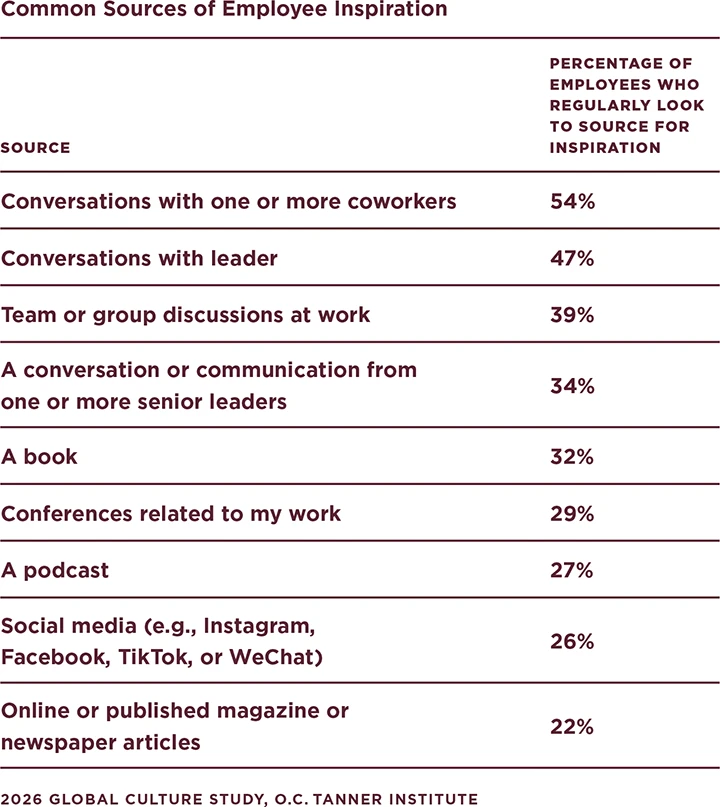
According to our research, 64% of employees often think of new ideas or ways to do their work during conversations with colleagues, and 68% have at least one coworker who inspires them in their work.
And as the following table details, when employees have frequent, meaningful conversations with coworkers who they find inspiring, the odds of several positive perceptions increase significantly.
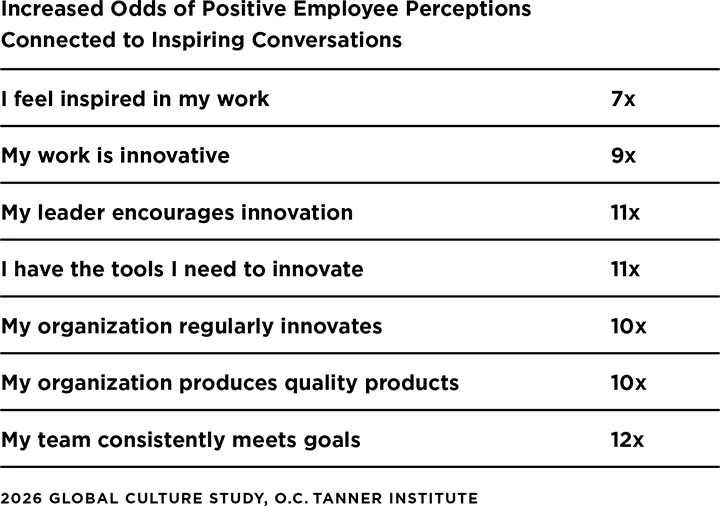
Inspiring teams foster frequent, meaningful opportunities to share new ideas, discuss new ways of accomplishing work, and celebrate the accomplishments of teammates and others.
Moreover, when people have both an inspiring team and an inspiring leader, the odds of several positive employee outcomes soar.
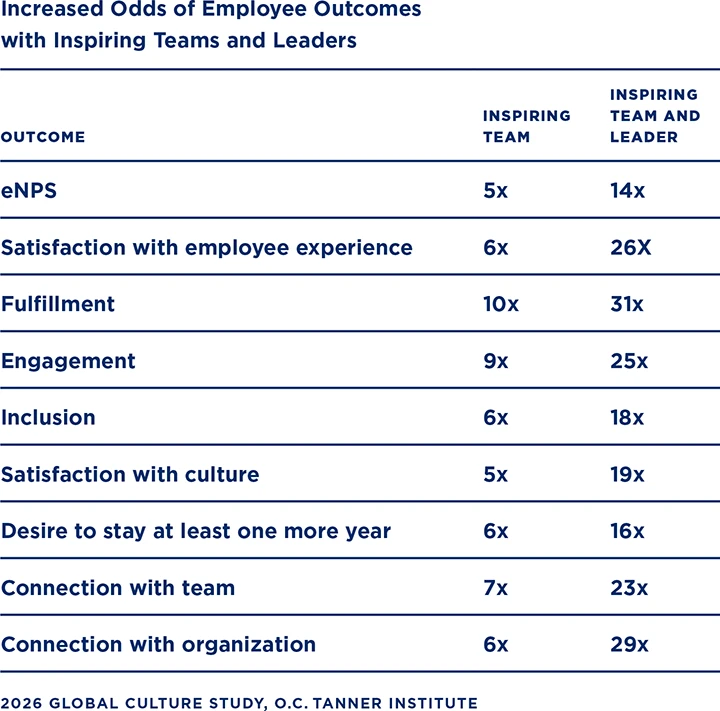
And to punctuate these findings, when both leaders and team members follow inspiring practices, the odds are 38x greater that employees will feel inspired in their work, feel inspired to try new things, or innovate.
Employee Recognition Is a Source of Inspiration
We’ve studied many positive effects of employee recognition over the better part of the last decade, and inspiration now occupies a prominent place on the list. When employees are appreciated for their contributions, they feel inspired to do more great work, go above and beyond, innovate, and solve challenging problems. Indeed, a large majority of employees say recognition inspires them, whether they receive it personally (73%) or hear about the accomplishments of others (65%).
Currently, 64% of workers say recognition is a part of their workplace culture. And organisations with integrated recognition have a strong advantage: employees who are 7x more likely to feel inspired to try new things at work.
When we examine the relationship between appreciation and inspiration, we see the impact of recognition—whether received or observed—is greatest in the days and weeks immediately after the recognition event, as the following graph illustrates.
“When you feel appreciated in the workplace, you’re inspired to go above and beyond. That’s how I feel.”
—Focus group participant, Los Angeles
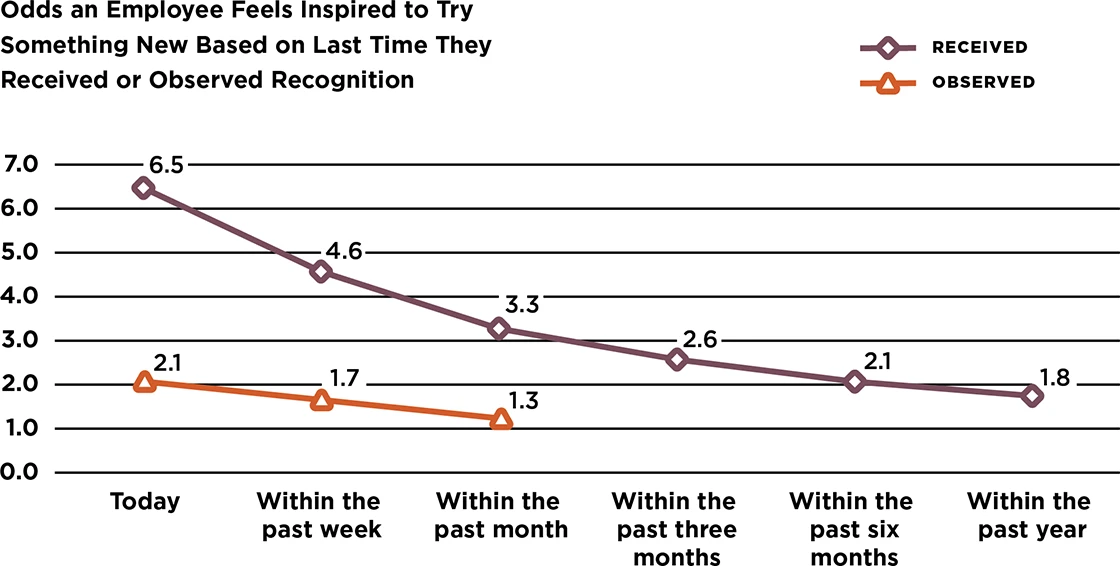
This also shows the importance of frequency. Regular recognition provides ongoing inspiration for employees. And, for organisations that struggle with innovation or productivity, it’s a quick and cost-effective way to encourage new ideas, reinforce behaviours that inspire, or find new ways of working.
{{report_insert_2}}
Recommendations
Organisations can help employees feel inspired at work through leaders, coworkers, and recognition.
1. Connect employees to sources of inspiration
Ensure employees can find inspiration across their employee experience. Encourage leaders to create regular opportunities and time for their people to connect, collaborate, and share ideas. This can take place during team huddles, one-to-ones, company meetings, or organisation-wide events.
In addition, provide access to external resources that employees find inspiring, such as books, articles, podcasts, and conferences. Company emails and newsletters can highlight sources of inspiration, and group gatherings around specific interests or celebrations for achievements and career milestones can further connect and inspire. When employees have access to numerous resources and feel motivated to generate ideas or adopt a new perspective, the odds they’ll feel inspired in their work increase 12x. (Conversely, limited access or exposure to these resources decrease the odds 59%.)
{{report_insert_3}}
2. Provide flexibility, support, and autonomy
Access to resources alone won’t always create inspiring moments. Employees need time to use the resources, support from leaders to take risks, and the freedom to bring their inspiration to life. When they do, the odds they’ll feel inspired to try new ideas increase 6x.
Leaders should take steps to create a culture where employees feel safe and empowered to put ideas into action. This can be a generative process where inspiration leads to innovation, which also inspires others to create great work. In such productive cultures, leaders advocate for their employees, encourage collaboration, solicit employee feedback, actively listen, and provide a psychologically safe work environment.
When employees feel supported by both their leader and their team, even if they fail, the odds they’ll be inspired to try new things at work increase 7x. And when employees have access to multiple sources of inspiration and the flexibility and support to act on that inspiration, the odds increase 11x.
“If you don’t give people a chance to fail, you won’t innovate. If you want to be an innovative company, allow people to make mistakes.”
—Indra Nooyi, Former CEO, PepsiCo
{{report_insert_4}}
3. Give frequent, meaningful, and purposeful recognition
Received or observed, recognition inspires employees. And sharing recognition—through a group celebration, the company intranet, a recognition platform social feed, or screens in common areas—ensures more people feel inspired by great work across the organisation.
Recognition is most effective when it’s frequent, personal, and genuine. Leaders should know how each employee prefers to be recognised and clearly state the person’s contribution and impact on the team or organisation. Involve peers and even family in recognition presentations.
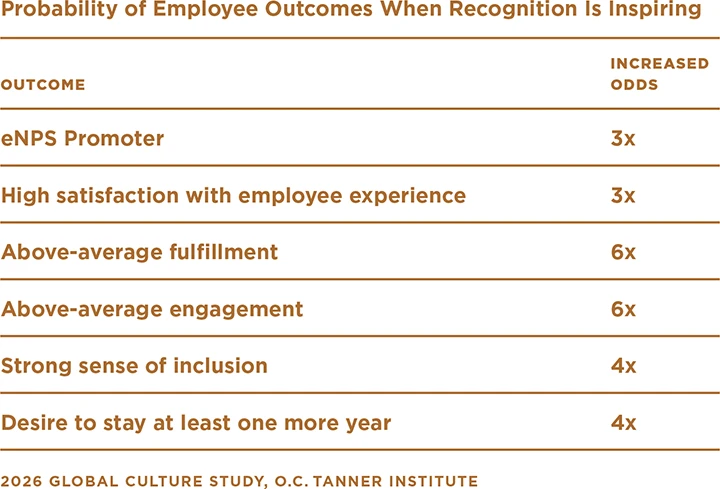
When recognition is personalised, sincere, and given in a meaningful way that makes the employee feel truly appreciated, the odds the employee will find the recognition moment inspiring increase 14x. And when recognition is inspiring, as the following table shows, the odds of several important outcomes improve.
{{report_insert_5}}
Sparking Inspiration—Key Takeaways
Leaders have a significant influence on creating inspiration for employees.
Team members can inspire one another through collaboration and sharing ideas.
Recognition is a valuable source of inspiration to employees.
Employees need access to sources that inspire them, as well as flexibility and autonomy to act on inspiration.
Sparking Inspiration Sources
- State of the Global Workplace: 2025 Report, Gallup.
- “Workers are the unhappiest they’ve been in 3 years—and it can cost the global economy $8.8 trillion,” Morgan Smith, CNBC, October 2, 2023.
- “Inspiration,” APA Dictionary of Psychology, American Psychological Association.
- Leadership, 2021 Global Culture Report, O.C. Tanner Institute.
- REI, www.rei.jobs/careers-home, August 4, 2025.
- “How Amazon Web Services is ‘doubling down’ to create a meaningful EX,” Ian Wilson, HR Executive, January 31, 2023.
- “15 ways employees experience belonging at AWS,” AWS, June 27, 2023.
- AWS, aws.amazon.com/careers/what-does-it-mean-to-be-a-builder?
- “Wellstar: Optimising workplace performance with recognition,” O.C. Tanner, 2025.


Inspiration Can Happen Anywhere
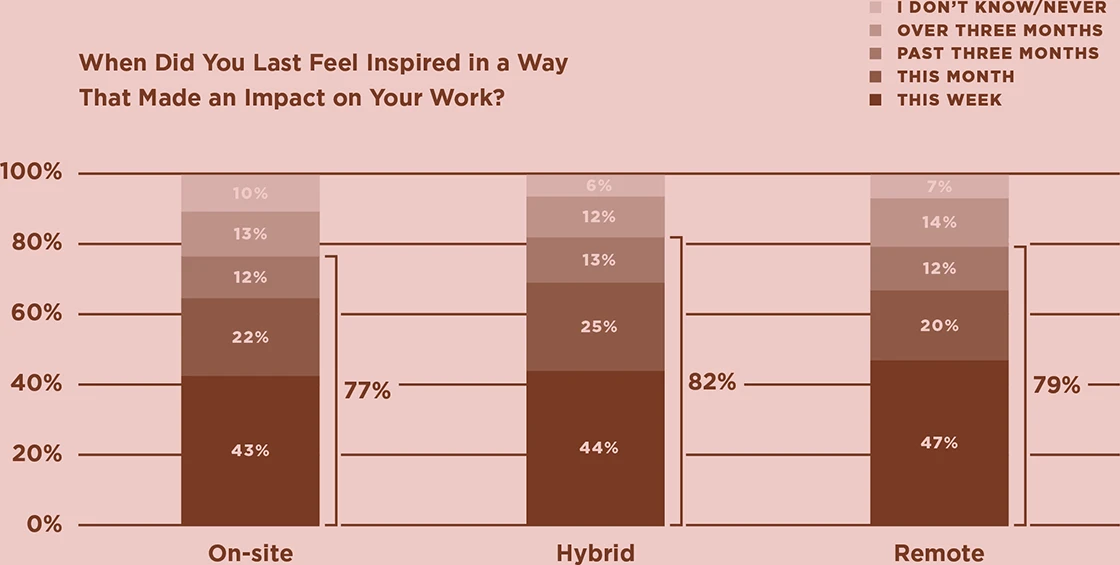
According to our research, remote employees or those in a different location from their leader are no less likely to feel inspired. People experience moments of inspiration regardless of where they work. As the following graph shows, more than three-quarters of employees say they experienced meaningful moments of inspiration that made an impact on their work at least once in the past three months.
As a final point, online productivity and collaboration tools provide employees with inspiring moments when they connect leaders and colleagues and serve inspiring content. Inspired work happens anywhere employees have access to the sources that inspire them most.

Case Study—Inspiration Outside
Outdoor retailer REI inspires its employees by tying its benefits and experiences back to the things that matter most to its people: time and resources to pursue an active, outdoor lifestyle. In addition to everyday inspiration through regular communication including interactive webinars that cultivate community between stores, leaders and coworkers inspire each other by utilising product grants, sabbaticals, and two free days annually to enjoy the outdoor adventures that ultimately connect them more closely to their customers and each other.5

Case Study—Inspiring Innovation
The culture of AWS (Amazon Web Services) champions thinking big, embracing challenges, and building communities that inspire employees to innovate. The company encourages its people to continuously learn, embrace new ideas, and experiment by providing regular training options, collaborative personal development, and robust mentorship experiences. In addition, teams gathered from diverse backgrounds approach problems with a mindset of “building” relationships, strategies, and solutions, and the company recognises employees from around the world who make the biggest impact with the annual Legend Award. It’s a culture that helps inspire AWS employees to continue innovating and delivering for customers.6–8

Case Study—The Equation for Innovation
To inspire employees to find new ways to improve their revenue cycle management, nonprofit healthcare system Wellstar turned to recognition. Their ShineWell platform, by O.C. Tanner, enables the company to recognise employees when they take steps to reduce their work queue age, fostering a sense of accomplishment and teamwork.
The results: In just one month, Wellstar improved its net collection ratio and reduced accounts receivable balances by $13 million.9
Turn Recognition Into Real Connection
Get Started Today
Top