Table of Contents
Table of Contents

Perspective
Most leaders believe they’ve earned their employees’ trust, and by the old measures of competence and integrity, many have. Here’s the problem: those are no longer the only measures that matter. Our research this year finds that trust has evolved.
As AI and constant change upend what roles mean and where people fit, employees now extend trust based on what they experience in moments of uncertainty, and withdraw it when those moments go unanswered. An organisation can be led by capable, well-intentioned people and still quietly lose trust. Keeping it has become an organisational capability that is built on clarity in ambiguity, accountability in disruption, and support when the work people built their identity on begins to move.
Introduction
Today’s workplace is defined by disruption. Market uncertainty, shifting employee expectations, and the growing integration of AI are no longer unique circumstances, but a regular part of the daily workflow.
Amid these changes, employees are struggling to find security and loyalty in work. Once a place to turn for stability, the workplace now feels destabilizing. As disruption accelerates, employees increasingly look for signals that decisions are reliable, leaders are transparent, and change is being managed with accountability. In this environment, trust becomes one of the most critical—and fragile—foundations of performance.
Organisations can’t achieve innovation or long-term performance without establishing a foundation of trust, but many of the changes and transformations happening in organisations to drive high performance unintentionally erode it. While previously trust was confined to personal relationships between employees and leaders, now employees are asked to trust abstract systems like AI and other emerging technologies that they may not fully understand (and often see as perceived threats to their job security or identity). The result is a widening disconnect between organisational ambitions for innovation and employees’ confidence in the systems driving that change.
Our research finds that trust in the modern workplace has evolved. Trust must go beyond simple leadership expertise and integrity. Employees are not only asking whether leaders are competent and honest; they need leaders who can provide clarity in ambiguity, accountability in disruption, and support in environments where work is increasingly unstable or morally uncertain.
Trust must be active—demonstrating transparency, reliability, accountability, psychological safety, and reassurance that organisations support employee identity and long-term stability. Trust becomes active when it’s treated as an organisational capability that is reinforced through leader behaviours and workplace practices. It must also extend beyond people to include the systems that organisations ask employees to rely on every day.
Active trust results in measurable cultural and business outcomes. Organisations with strong trust environments see dramatic increases in connection, collaboration, innovation, and retention. Trust is not just a cultural attribute; it’s the connective tissue that empowers organisations to grow, innovate, and advance in a sustainable way. For HR leaders who want to support the organisation’s demands for high performance while preserving culture and employee wellbeing, active trust is the foundation for both.
“When leaders are willing to prioritise trust over performance, performance almost always follows.”
—Simon Sinek, Author and Speaker
Building active trust includes supporting employee identity and security
While traditional definitions of trust centre around having expertise and demonstrating integrity in the workplace, modern leaders who build active trust exhibit additional characteristics and behaviours. Our research identifies six core elements that define active trust:
Transparency: Leadership is open about the challenges, constraints, and opportunities facing the organisation, and employees understand the reasoning behind organisational changes.
Reliability: Policies and procedures are applied consistently, and leaders follow through on their commitments. Employees can rely on systems and processes to function as intended.
Judgement: Leaders demonstrate sound judgement when making decisions. Employees can rely on people to make the right call when information is incomplete.
Accountability: Mistakes are addressed fairly, and leaders take responsibility for decisions and actions. Problems and failures are acknowledged rather than ignored or minimized.
Safety: Employees can express concerns and raise issues without fear of negative consequences. They can speak honestly about challenges impacting their work, and differing viewpoints are respected.
Care: Employees believe they are valued as people, not just as resources. Both leaders and the organisation genuinely care for the well-being of their people.
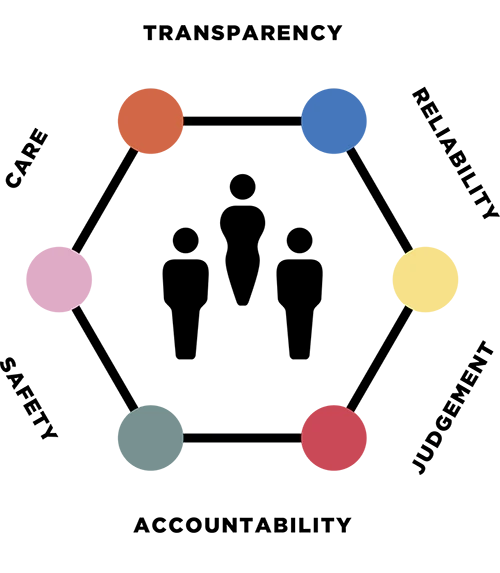
The six core elements that define active trust in the workplace.
When these six elements are present, there is active trust. When organisations have an environment of active trust, employees feel a stronger sense of belonging at work (12x higher odds) and connection to the organisation (9x higher odds).
Active trust also influences how employees feel about their organisation’s growth. Employees with a high sense of active trust have 20x increased odds of believing their organisation is strategic about growth and 31x increased odds of believing the approach to growth is healthy.
Active trust also has a significant impact on cultural and business outcomes—odds of respect, care, and high performance all increase.


Active trust is especially critical for frontline workers. Whether it’s the nurse on the hospital floor or the barista at a café, frontline workers disproportionately feel overlooked and undervalued in workplaces.1 Their contributions are essential to organisational success, but if they lack access to lines of communication and opportunities for growth, it profoundly impacts how they perceive their employee experience.
Frontline workers are almost 25% less likely than their corporate counterparts to trust their leader and 24% less likely to feel a strong connection to their organisation.2 Yet when the six elements of active trust are present for these employees, their experience transforms: there is a 9x increase in odds of having a strong connection to the organisation, 19x increase in their sense of belonging, and 10x increase in the odds they produce great work. There is also a dramatic 38x increase in the odds they believe their leader supports them through periods of change.
“You build that trust with them because you’re in it together, you have a common goal, you’re taking care of things together. That trust is not going to get broken.”
—Jennifer, Focus Group Participant
Employees are skeptical about systems like AI, but still trust people
Enterprise AI adoption has reached a new high, with 88% of organisations using AI in at least one business function, a dramatic 33% increase from just two years earlier.3 This year, that number continues to rise, with organisations across industries racing to embed AI and other advanced automations into their workflows. Yet despite all the organisational energy behind these transformation initiatives, employees aren’t entirely convinced.
Our research found that employees are notably skeptical of abstract systems like AI:
- Only 31% of employees report trusting AI
- Just 30% say they understand how AI arrives at decisions or outputs
- Just over half (51%) say they feel AI is over-hyped
- More than half (60%) say technology increases their cognitive workload
- Only 33% feel their leader understands how tech functions in day-to-day work, making the imperative to “trust the system” feel like a risky bet
The impact? When employees lack trust, either in people or systems, there is a 68% decrease in the odds they will produce great work, a 44% decrease in odds that they will feel connected to their organisation, and a 52% decrease in odds they will want to stay with their company another year.
Fortunately, employees are still willing to place trust in people, as 73% say they trust coworkers and 68% trust leaders. This creates a human backup when systems like AI feel uncertain or unreliable. When trust in systems is low, employees actively look for security in colleagues: 57% say they rely on coworkers to compensate for system limitations, and 62% say when they don’t trust systems, they trust the people they work with instead.
This belief in people makes it critical for organisations to build active trust in teams.
Rebuilding trust requires transparency, accountability, and consistency
Even organisations with the best of intentions can lose the trust of their people. The rate of change and the speed of innovation in today’s workplace mean that mistakes will be made and decisions will be handed down that inadvertently widen divisions and increase uncertainty.
But losing employee trust is more than just compromising interpersonal relationships—it’s risking the adoption and acceptance of transformative initiatives that are essential to performance and organisational success. Trust lost can be rebuilt, but it requires a deliberate strategy of transparency, accountability, and consistency.
Our research found that key leader behaviours are essential to increasing active trust. Leaders who take responsibility for lost trust and make real changes have higher odds of active trust.

Active trust thrives when leaders take steps to build it. Trust that leads to performance is not passive, but something leaders must practice every day.
Recommendations
To build active trust, organisations should operationalize trust practices, support AI with human care, and recognise frequently.
1. Operationalize active trust
Move beyond treating trust as a vague cultural value and instead operationalize it through the six elements of active trust. Embed the six elements into leader training, performance expectations, and change-management practices, so employees experience trust as a consistent part of their day-to-day work. Include your frontline employees, who are often excluded from interactions that foster connection and trust.
When the elements of trust are operationalized, employees are 6x more likely to be promoters and 23x more likely to be engaged. By making trust a measurable organisational capability rather than an abstract leadership trait, companies can strengthen both employee experience and long-term business performance.
2. Prioritise human-centered AI usage
As organisations accelerate AI adoption, rather than assume employees will automatically trust new systems, organisations should leverage team collaboration, peer learning, and manager accessibility as stabilizing forces during technological change.
When employees trust their leader’s judgement about technology implementation, there is a 6x increase in the odds they will perceive systems like AI as reliable. When employees are consulted before major technology systems decisions are made, there is a 4x increase in the odds they will see AI as a useful tool in their work. Building active trust in innovation requires organisations to strengthen the human relations surrounding technology, not just the technology itself.
“What we have on our hands is not a technology issue. It’s going to be a trust and people issue.”
—Ginni Rometty, former Chairman, President, and CEO of IBM
3. Leverage recognition to amplify trust
Frequent, meaningful recognition provides the connection and validation employees need and builds (and rebuilds) the trust that is necessary for employees to perform at their best.
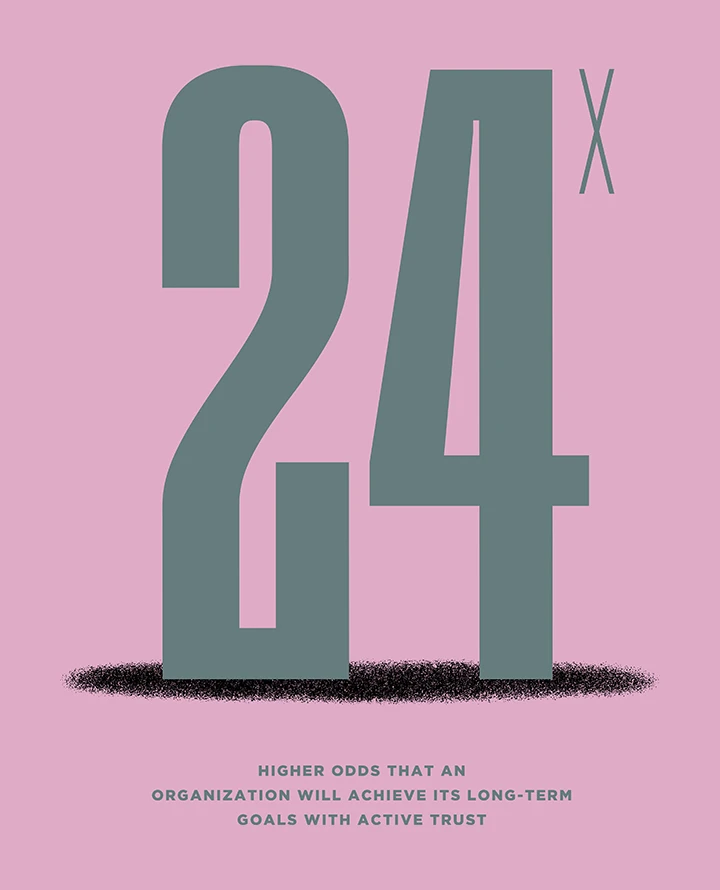
When leaders consistently recognise individual efforts and accomplishments, it demonstrates the empathy, awareness, and care that amplifies connection and trust. Organisations with integrated recognition see a 24x increase in the odds their employees will have a strong sense of active trust.
Integrated recognition strengthens not only employee trust in leaders and coworkers, but also their perceptions of systems like AI:
- I trust my immediate colleagues to use good judgment (10x)
- My direct leader acts with integrity, even under pressure (10x)
- People in my workplace look out for one another (8x)
- The systems I rely on at work are reliable (7x)
- Technology at work reduces risk rather than creating new problems (6x)
At a time when AI can pose a threat to an individual’s professional identity, recognition helps reinforce an employee’s sense of self in the workplace. Employees have 9x increased odds of feeling like themselves at work, feeling they can speak honestly about problems that affect their work, and believing their work allows them to act in ways that align with their own personal values when they are recognised.
{{report_insert_1}}
Active Trust—Key Takeaways
Active trust requires behaviours and practices that reinforce not just expertise and integrity, but also employee identity, security, and reliability.
When trust in abstract systems like AI is low, employees look to people (leaders and peers) for guidance, reassurance, and support.
Recognition provides the critical assurance and connection employees need to build and amplify active trust.
Active Trust Sources
- The 80% Experience, 2024 Global Culture Report, O.C. Tanner Institute.
- The 80% Experience, 2024 Global Culture Report, O.C. Tanner Institute.
- The State of AI in 2025: Agents, innovation, and transformation, November 5, 2025, McKinsey.


Case Study—Trust that soars
Delta Air Lines moves hundreds of thousands of passengers a day, coordinating across a complex network of airports, aircraft, operations centers, and, most importantly, people. That kind of coordination requires trust, and Delta builds it through two practices: continuous listening and everyday recognition.
Leaders at Delta seek ideas and feedback from employees, using frequent surveys to keep channels open across the organisation and to ensure every voice is heard. Delta also hosts 12 to 15 in-person employee engagement conferences each year, known as VELVET events, where frontline employees connect directly with senior leaders, share ideas, and shape decisions about the company’s direction.
Recognition carries that trust into daily operations. When CEO Ed Bastian learns of an employee going above and beyond, he ensures the work is recognised, and he frequently recognises exceptional service personally at live events. The practice extends through the leadership ranks: 64% of Delta’s top executives regularly use Unstoppable Together, Delta’s recognition platform powered by O.C. Tanner, to recognise employees. Stories of excellent work in both large and small moments circulate as a result, building empathy and awareness between employees and the leaders who depend on them.
Employees who feel seen and valued extend the same attention to customers. Passengers experience genuine care, and that care is a meaningful part of why they return to Delta. The trust Delta cultivates inside the organisation becomes the experience it is known for outside it.
“Delta’s culture is to ensure employees feel loved, respected, heard, seen, and recognised.”
—Charles White, Managing Director of Compensation, Recognition, & Mobility, Delta Air lines
Turn Recognition Into Real Connection
Get Started Today
Top