Table of Contents
Table of Contents
Perspective
As AI reshapes how work gets done, organisations feel new urgency to run lean and upskill their people. The logic seems sound. More capable employees means stronger results. Yet our research finds these initiatives stall when employees sense what’s really being asked of them: more output, dressed up as opportunity. It’s an extractive model of performance, and AI has made it more tempting than ever. But extraction has a ceiling.
Performance that lasts is grown through learning that invests in an employee’s sense of community, opportunity, and success along with their capabilities. Organisations that choose growth gain what no technology can extract: healthy, sustained performance, and the elasticity to meet a future no one can predict.

Introduction
Every organisation is chasing innovation and high performance, but AI, intensifying competition, and the accelerating pace of change are making the climb steeper than ever. Leaders are struggling with how to balance the demand for higher performance with employee wellbeing and are turning to skill-building.
The call to upskill has never been louder. The World Economic Forum finds 63% of organisations say skills gaps are the “main barrier to future-proofing their operations.”1 Addressing skills gaps should, in theory, help organisations achieve cultural elasticity (the ability to be agile, change, and build skills in the face of new challenges). Yet despite billions invested in learning and development, many organisations still struggle to build the cultural elasticity they need. Only half (52%) of organisations find their upskilling programmes to be successful.2
Worse, some employees are actively resisting the push to upskill, viewing it as a thinly veiled strategy to extract more from already overextended teams. This resistance results from a lack of trust. It’s a signal that organisations and employees are fundamentally out of alignment regarding what growth is meant to be.
Employees want to grow. In fact, 67% of employees who are considering leaving their jobs cite lack of learning and growth as the main factor.3 Our qualitative research shows employees view learning and growth as very different endeavors. Most learning initiatives today feel one-directional: the organisation sets the agenda, employees are expected to comply by completing some training, and the return on investment flows mostly upward.
In contrast, growth is a holistic, continuous process that is mutual and collaborative, but it only works when employees believe their organisation is genuinely invested in them as people, not just producers of work. When organisations focus solely on high-performance, it can feel extractive and one-sided; when they seek to support employee growth, high-performance comes organically.
It’s time for organisations to shift from a culture of learning to a culture of growth. A growth culture elevates skill building and career development by embedding learning into a broader framework of mutual investment, shared goals, and equitable opportunity. Employees are willing to invest their best selves in their organisations because they feel their organisations invest in them.
Growth cultures achieve what skill-building programmes alone cannot: a true partnership that benefits individuals and organisations alike, delivering the cultural elasticity and healthy performance that every organisation is striving for.

“I could just do a random training and learn something, but that doesn’t mean I’ve grown professionally or personally. Growth to me feels more like: if you’re looking at a resume and you have somebody’s narrative—what is the story that’s being told and what is the next step on their path? That’s growth to me. Learning could just be that you know a lot about a lot, but it’s not all cohesive.”
—Christina, Focus Group Participant
Employees see growth as more than just learning—it’s an ongoing partnership between themselves and the organisation
Employees in our focus groups all described learning and growth as two different concepts. Learning new skills, knowledge, or facts is a good start to growth, but does not embody the holistic, ongoing, more collaborative growth that employees crave.

To sustain a culture of growth over time, organisations must take a broader approach that treats skill-building not as a one-time opportunity, but as an ongoing part of the everyday culture of the organisation. When this happens, growth goes beyond learning or training and becomes a partnership between organisations and employees. This partnership supports individual and organisational performance, as well as cultural elasticity and resilience.

True cultures of growth are made up of six key factors.
Our research identified six elements of growth cultures:
Empathy: Leaders and the organisation understand what employees need to grow and develop, and employees feel understood and valued.
Communication: Leaders and employees have clear, open, easy communication, particularly around growth and goals.
Community: Teams experience a sense of camaraderie and shared goals; employees feel that learning from other employees is essential to their growth.
Support: Employees feel supported when it comes to development goals.
Opportunity: Employees have the opportunity to accomplish goals and apply skills at work.
Balance: Employees experience a mix of high expectations and high support, and feel a healthy balance between meeting workplace goals and wellbeing needs.
When all six of these elements are present, employees feel more supported and see growth as a partnership rather than an organisation-driven initiative. The strength of growth cultures is the collaboration and community they build, allowing employees to learn from one another and grow together.
This leads to tangible ROI for organisations. Not only does a growth culture support employees’ individual growth, but it also has a notable impact on business and cultural outcomes.
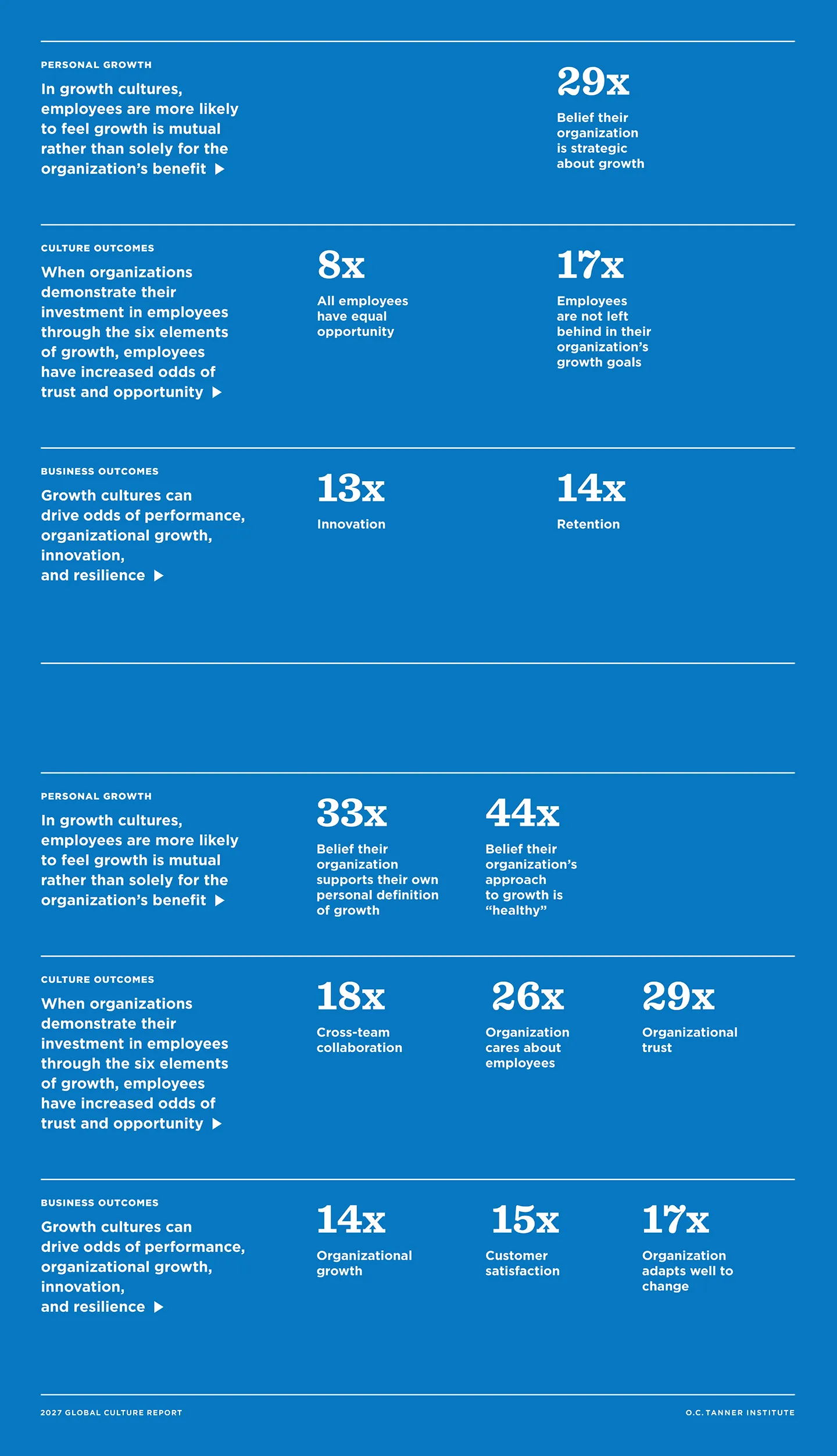
The six elements of growth cultures support employees in ways that not only build their personal growth, but amplify the organisation’s cultural and financial growth as well. They are fundamental elements that, when built into the everyday employee experience rather than an isolated company training or initiative, lay a foundation for community and connection that helps employees, and their companies, thrive.
Unfortunately, compared to other groups, frontline employees often feel they have fewer opportunities for growth and advancement—only 10% feel they have access to the tools, technology, and opportunities necessary to connect and advance in their workplace. For these employees, being part of an organisation with a growth culture increases their sense of opportunity 20x, success 25x, and reduces burnout 90%.
Organisations should provide specific growth opportunities for frontline roles, a clear plan for career development, and have regular conversations about growth with frontline workers. It’s important to ensure they have physical access to growth tools, help them identify ways to apply new skills in their role and on their teams, and recognise them publicly when they complete growth milestones and use new skills.
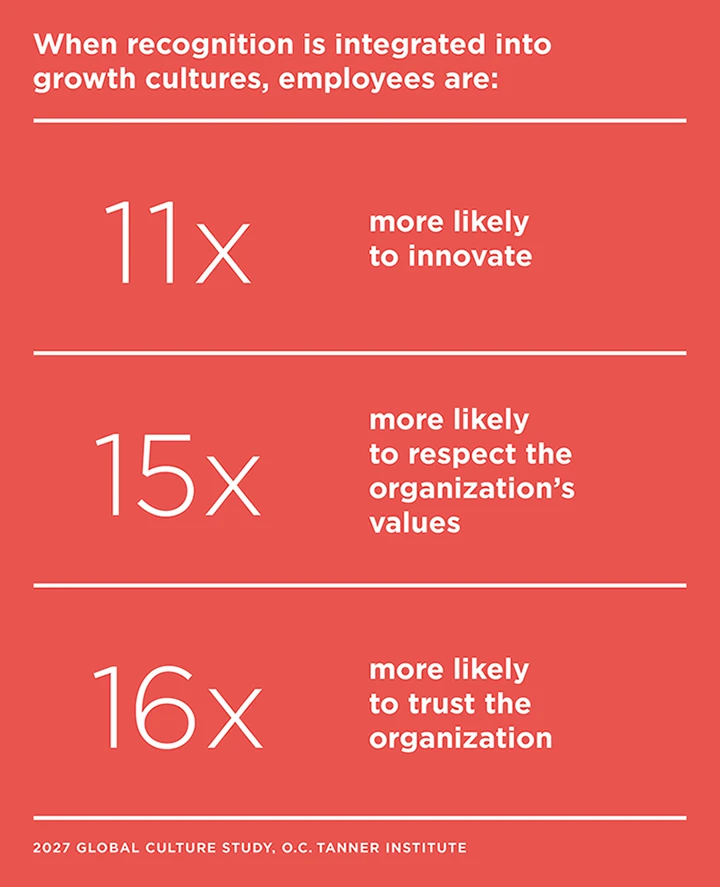
For all workers, recognition is a powerful way to reinforce growth. Acknowledging effort and great work along the way shows employees they are on the right path and encourages them to keep going in their growth goals. It signals that the employee is making progress and building skills in a way that is impactful and valuable. Recognition also amplifies the six elements of growth cultures by demonstrating empathy, building community and support, and communicating opportunity and balance.
“A lot of opportunities: internal upward mobility, space to learn, space for mistakes and to fix those mistakes, etc. Just so everybody understands, if something goes wrong, we can fix this. It has to be a very teamwork-oriented place. I think that’s growth.”
—Kelsey, Focus Group Participant
Growth cultures create cultural elasticity
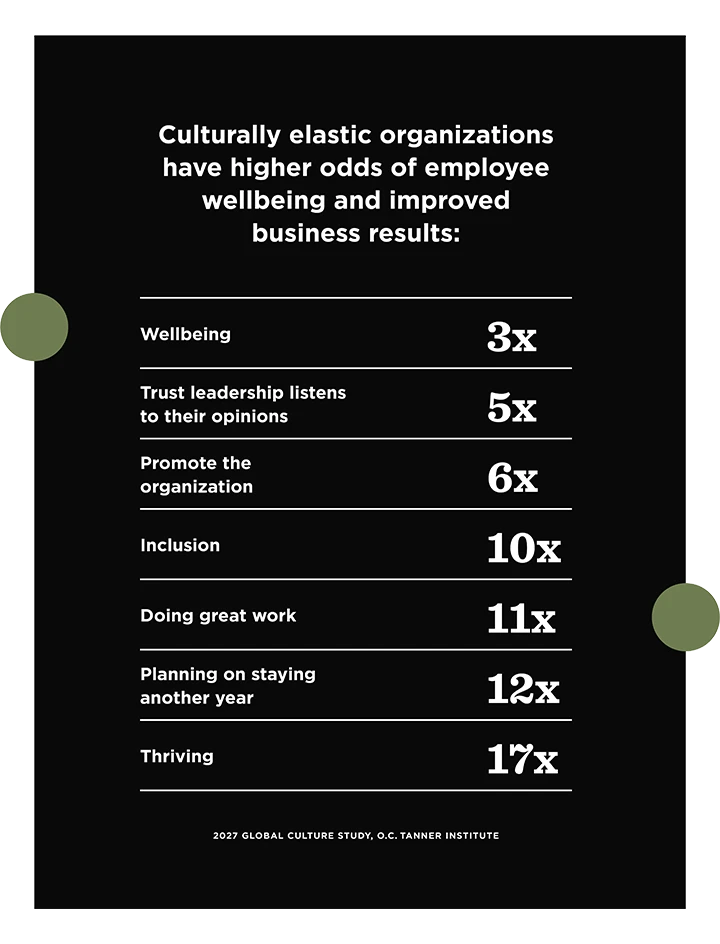
Cultural elasticity4 is an organisation’s ability to be agile, change, and build skills in the face of new challenges. Organisations that are culturally elastic:
- Manage change well
- Maintain a high level of innovation
- Are flexible
- Make decisions with employees, rather than above or outside of them
This is especially crucial as organisations are still learning how to navigate new technologies and workflows around AI. The resulting uncertainty and constant changes require organisations to have higher levels of cultural elasticity to keep pace and adapt.
Growth and learning, when done well, promote cultural elasticity. Employees avoid becoming personally or professionally stagnant when they are actively growing and moving forward in partnership with their organisation. They learn how to navigate changes and challenges through strong collaboration and a sense of ownership in the organisation’s success. Their goals and values are aligned with the organisation’s.
Cultural elasticity is also a sign of equity. Organisations that are elastic make decisions alongside, not apart from, employees. When all employees are treated as valuable contributors to the organisation’s success, the culture is truly elastic.
To fully realise cultural elasticity, organisations must shift their approach from implementing siloed learning and skill-building initiatives to creating a growth culture.
Organisations with growth cultures have 48x increased odds of demonstrating cultural elasticity.
“What’s going to make a difference…is not going to be the ability to recite more rote facts. What’s largely going to make a difference in going forward, in our increasingly ambiguous era where rote stuff gets increasingly automated, is the ability to make decisions in ambiguous and challenging contexts, [that] is going to be what really makes a difference to the success of the organisation.”
—Clark Quinn, Ph.D., Co-Director, The Learning Development Accelerator
Recommendations
To transform skill-building and learning into growth cultures, organisations should approach growth from a collaborative, holistic viewpoint and use recognition to amplify growth practices.
1. Approach growth as a collaborative strategy with leader support
Rather than expecting employees or the organisation to take a one-sided approach to growth, it must feel collaborative. When employees feel the organisation is investing in them, they are willing to invest their time, energy, and efforts back into the organisation.
This can’t happen without leaders. The support and encouragement of leaders is crucial for a growth culture to take root. They must demonstrate commitment to helping employees grow and provide growth opportunities around the six key areas of growth: empathy, communication, community, support, opportunity, and balance.
Allow employees to learn or try new things outside of their job responsibilities. Provide mentorship and time to connect with other teams. Empower them to have the autonomy and flexibility to try new projects or new ways of doing their work. Through these opportunities, employees grow in ways that build community and adaptability.
When leaders take a collaborative approach and include employees in growth strategies, we see increased odds of inclusion and belonging, and decreased odds of burnout.

2. Consider growth holistically, not just economically
Growth loses its collaborative, community-based impact when it’s measured purely by revenue or profits for the organisation. When the success of growth is seen solely through the financial benefit to the organisation, employees question whether the organisation truly cares about them. Organisations that primarily define growth financially or economically have decreased odds of community (-73%), belonging (-75%), and trust (-80%).
To protect employees against burnout, evaluation of growth should include indicators of cultural elasticity in addition to economic indicators. Look at innovation and cross-functional collaboration between teams, along with employee survey ratings for inclusion, trust and wellbeing. Including cultural measures in addition to performance metrics indicates the organisation is not only adaptable and resilient but also cares about employees.
“You want to feel valued, not just like a number, because everybody plays an important role, no matter how big or small. It’s got to go hand in hand. You care about me, I’ll care about you.”
—Stephanie, Focus Group Participant
3. Use recognition to amplify holistic growth
Employee recognition, particularly recognition that is tied to effort or contributions instead of just results, is an effective way to amplify holistic growth that feels like a partnership. Celebrate small wins along the way, collaboration, new ideas, and mid-project milestones to show growth.
Recognising behaviours in addition to results (extra effort, going above and beyond, demonstrating company values, teamwork, taking risks, customer service, etc.) shows employee contributions matter even if they aren’t directly related to revenue. Building a healthy culture through recognition encourages a mutually beneficial relationship between workers and the organisation, a sign of growth. Including frontline workers in recognition efforts is particularly important to help them feel seen and valued.
Organisations that practice integrated recognition5 have employees who are 6x more likely to feel their organisation defines growth holistically and 17x more likely to feel their organisation takes a healthy approach to growth. They are also 11x more likely to say employees are not left behind during a growth phase.
{{report_insert_1}}
Growth Cultures—Key Takeaways
Growth is more than just learning—it is a collaborative partnership between employees and organisations.
Focusing on the six elements of growth cultures builds cultural elasticity and business outcomes.
Recognition amplifies holistic growth by showing employees they matter beyond business results.
Growth Cultures Sources
- Future of Jobs Report 2025, World Economic Forum.
- “Room for Growth: A Survey of Upskilling Approaches,” Haley Glover and Kevin Martin, Upskill America, Aspen Institute, March 2024.
- PWC 2024 Global Workforce Hopes & Fears Survey, PWC.
- The term cultural elasticity appears previously in Drejer, Byrge, Lyndgaard, and Lassen (2019), who propose an organisational model for established firms to innovate new business models. Cultural elasticity, as presented in this report, was developed independently and addresses a different capacity: an organisation’s measured ability to change, innovate, stay flexible, and make decisions with employees, with growth cultures as its strongest antecedent.
- Integrated Recognition, 2023 Global Culture Report, O.C. Tanner Institute.


Case Study—Growing Careers and Culture
ICF empowers employees to drive career growth through four paths: Advance (moving up in scope or role), Broaden (expanding into new areas or capabilities), Deepen (building mastery in a discipline), and Expand (growing influence and enterprise contribution). At ICF, grounded conversations about employee growth are the norm.
Growth is something employees shape, not something handed to them. Development is tracked through a broad network of mentors, peers, and colleagues throughout the company. Career development tools allow employees to map their own paths, exploring various directions and bringing specific goals to conversations with leaders.
Skill building is woven into the work of each employee: peer learning, on-the-job application, targeted sessions on real scenarios, and simulations that let people practice in a supported setting before applying skills more broadly.
Recognition helps reinforce growth as part of ICF’s culture. Recognition messages and internal newsletters recognise employees who complete key learning programmes. They also celebrate the coaches, facilitators, and subject matter experts who help make those experiences meaningful.
ICF designs growth experiences that employees own, resulting in stronger engagement, healthier retention, deeper participation in learning, and more durable leadership pipelines. Because growth is visible in the everyday flow of work, it amplifies performance and connection.
“Employees drive their own careers. Growth happens in the work itself—through the experiences people take on and the people they learn from. Our role is to make the paths clear and the tools within reach, so they can move in directions that matter to them.”
—Liz Janssen, VP, Talent & Organisational Development, ICF
Turn Recognition Into Real Connection
Get Started Today
Top