Table of Contents
Table of Contents

Perspective
Compassion has long been treated as a personal virtue, something individuals either bring to work or don’t. And while a perspective of care is admirable, many leaders worry that too much compassion softens the drive performance demands. Our research tells a different story. While an organisation can’t feel compassion, it can decide whether compassionate behaviour is expected, modeled, and rewarded. And that decision changes everything.
Where leaders set the expectation and demonstrate genuine care themselves, trust deepens, burnout declines, and performance strengthens. Winning leaders understand that compassion isn’t a concession the business makes to its people. It’s the fundamental condition that drives the business forward.

Introduction
The modern workplace operates on relentless mandates: do more with less, change faster, increase expectations, grow exponentially. Organisations are asking employees and their leaders to adapt to unprecedented levels of complexity and change, yet the systems designed to support them haven’t kept pace.
The toll is measurable: employees are burning out and performance is suffering. One study finds more than half of the workforce (55%) is experiencing burnout, with employees saying burnout diminishes their efficiency (72%), hurts their overall job performance (71%), weakens their ability to serve customers (65%), and reduces their ability to innovate (64%).1 Neuroscience research also finds prolonged stress and burnout result in poorer decision making and cognitive flexibility.2
Most employees are not underperforming because of a lack of will. They are struggling because organisational systems—policies, support, resources—were not designed to sustain this level of prolonged pressure. How can organisations navigate this new landscape of work and performance while protecting employees from overload and burnout?
As we saw in last year’s Global Culture Report, healthy, sustainable performance cultures combine high levels of expectation with high levels of support.3 One effective and often overlooked way to provide this support is through systemic, organisational compassion that amplifies the best in people.
Compassion is the capacity to understand the needs of others and take meaningful action to meet those needs. It is an active practice of care. It is proactive, not reactive.
Organisational compassion powers sustainable performance by building trust, preserving employees’ capacity for work, and preventing burnout. Research shows workplace compassion is a significant predictor of employee retention, especially in high pressure and competitive industries.4
Practicing compassion organisation-wide is not a soft skill. It is a strategic approach. When compassion is left to the discretion of individual leaders, it can be inconsistent and inequitable. But when it is embedded into an organisation’s policies, processes, and everyday experience, compassion becomes easier to practice and more equitable. Having systems in place, defined behaviours, set expectations, and measurement around compassion changes it from an invisible feeling to an organisational practice.
Organisational compassion starts with a foundation of care, protects employee capacity, and is guided by clear expectations and boundaries. When compassion becomes part of an organisation’s operating model, it drives measurable business results.
“Instead of striving to be more empathetic, we should all try to cultivate its superior cousin: compassion. Empathy feels noble, but true compassion goes further: it combines understanding, measured feeling, wise action, and the courage to follow through.”
—Arthur Brooks, Author, Professor, and Fellow at the Harvard Business School
There are 3 pillars to organisational compassion that ensure it is equitable and effective
Organisational compassion is an organisation’s ability to integrate compassion into its policies and processes to support employee performance while reducing the risk of burnout.

Our research identifies three pillars of organisational compassion:
1. A foundation of care
Compassion and care are built into the organisation’s cultural architecture, including systems, processes, policies, and decision making. This ensures compassion is an organisational priority rather than dependent on individual leaders’ personalities or discretion.
2. Capacity protection
Organisations must acknowledge and respect employee capacity and treat capacity as an organisational, not an individual, responsibility.
3. Guidelines and boundaries
Clear expectations and boundaries around compassion protect both leaders and employees from favoritism and compassion fatigue.
Pillar 1
A foundation of care
A foundation of care is essential to embedding compassion into an organisation’s culture. This includes:
- Defining what compassion means at an organisational level and how it should be expressed
- Creating decision-making frameworks that empower leaders to consider employee impact alongside business outcomes
- Establishing expectations for transparency: why decisions are made, what tradeoffs exist, and what employees can expect next
- Holding leaders accountable and following through on commitments to employees
- Developing systems to process employee feedback (collecting, acknowledging, responding to, and acting on feedback)
- Building recognition experiences that are equitable, meaningful, and intentional
Organisations demonstrate care5 for their people when their policies, processes, and Total Rewards offerings reflect the belief that people matter.6 Responding to employee needs and investing in offerings that support employees even when times are tough, making improvements based on employee feedback, and taking a people-first approach when making decisions all reflect care for employees.
When there is a foundation of care, the odds that employees feel compassion from their organisation increase 10x, and the odds employees feel they have the tools and autonomy to succeed improve 20x.
Once a foundation of care is established, organisations sustain compassion by respecting and protecting employee capacity, which is the next pillar.
“I feel like compassion is shown in benefits and services and letting your people know that we put you first. Because if we take care of you, you’ll take care of the business. When it comes to organisations, compassion needs to be things that the leaders are talking about, as opposed to just putting it in a mission statement that nobody’s ever going to read again.”
—Isaiah, Focus Group Participant
Pillar 2
Capacity protection
Protecting employee and organisational capacity prevents burnout and ensures sustainable performance.
Capacity is understood in two ways: an employee’s ability to accomplish their work sustainably and the ability for the organisation to practice compassion without overburdening leaders and teams. This includes:
- Understanding and acknowledging employee limits and burnout risk
- Prioritising workloads and adjusting scope when needed
- Communicating clear expectations around goals and available support
- Establishing processes that actively protect capacity
- Reframing leader expectations around healthy performance7
- Creating conditions that enable employees to thrive at work8
Empowering employees to speak up when capacity limits are reached and enabling leaders to adjust, slow down, or re-scope work shows compassion while sustaining high performance. It also removes the emotional burden often placed on leaders by making compassion a shared organisational responsibility.
Check in often on employee workloads and create a safe space for them to express concerns or bring up challenges. Remove obstacles that slow employees’ work and take action when conflicts arise. Encourage peers to support one another when they see an employee having a difficult day.
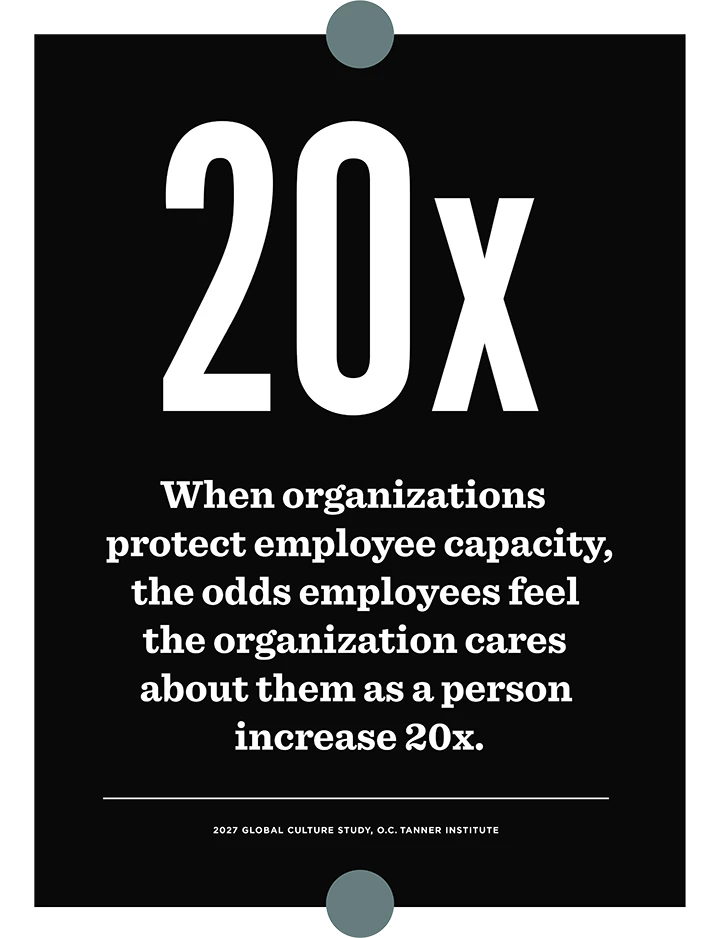
When employee capacity is protected, the odds employees feel their leader demonstrates compassion increase by 10x, and the odds employees feel compassion is shown by team members increase by 8x. The odds of burnout drop 87%, and the odds that employees feel supported in their work increase 12x.
“Compassion is having grace for someone’s situation, understanding that they’re going through a rough patch, and not seeing people as robots and expecting them to work and work and work. Having that compassion is important because we’re all human.”
—Amanda, Focus Group Participant
Pillar 3
Guidelines and boundaries
Guidelines and boundaries ensure compassion is applied consistently and equitably. Without them, compassion can unintentionally introduce bias and favoritism, eroding trust faster than lack of compassion.
When organisations establish clear guidelines and processes, leaders are not left to make isolated decisions on their own about when and how to show compassion. Organisational compassion becomes less subjective and more consistent, still giving leaders the autonomy to respond to individual needs without worrying about how much compassion is appropriate or the right way to express it. Organisations should ensure policies, support, and flexibility are applied equitably across the organisation regardless of position or tenure, while also holding employees accountable for their work.
Boundaries also protect employees and leaders from feeling overburdened. Compassion fatigue can occur when multiple employees need support at the same time or when additional work shifts to others on the team. Have clear, written boundaries in place to prevent saying yes to every request or providing unlimited flexibility. Standardize leave and escalation policies for when employees need exceptions. Have backup plans and processes to protect work hours, response times, and project scope for team members covering for another employee while they are out. This ensures compassion is sustainable, supporting the needs of an individual while protecting the capacity and wellbeing of the team.
When explicit guidelines are in place, the odds employees feel their leader applies organisational policies with fairness and empathy increase by 24x, and the odds employees believe the organisation demonstrates compassion increase 9x. Effective guardrails include:
- Communicating clear expectations for when and how compassionate policies should be applied
- Aligning compassion-related resources with wellbeing initiatives
- Providing leaders with processes, resources, and training to practice compassion
- Establishing boundaries to prevent compassion fatigue
- Measuring compassion in action
“A compassionate leader not only drives success but also fosters a positive and inclusive workplace culture.”
—Edward DeAngelis, Entrepreneur, former CEO of Amerifi
Organisational compassion improves business outcomes
Each of the three pillars of organisational compassion improves culture and business outcomes. When all three pillars are present and compassion becomes embedded in the organisation’s processes and systems, results soar.
When there is a foundation of care, employees feel more connection and trust, and are more positive about their experience at work.

When capacity is protected, odds of connection and community improve, as well as great work and innovation.

When guidelines and boundaries are in place, feelings of belonging and equity increase.

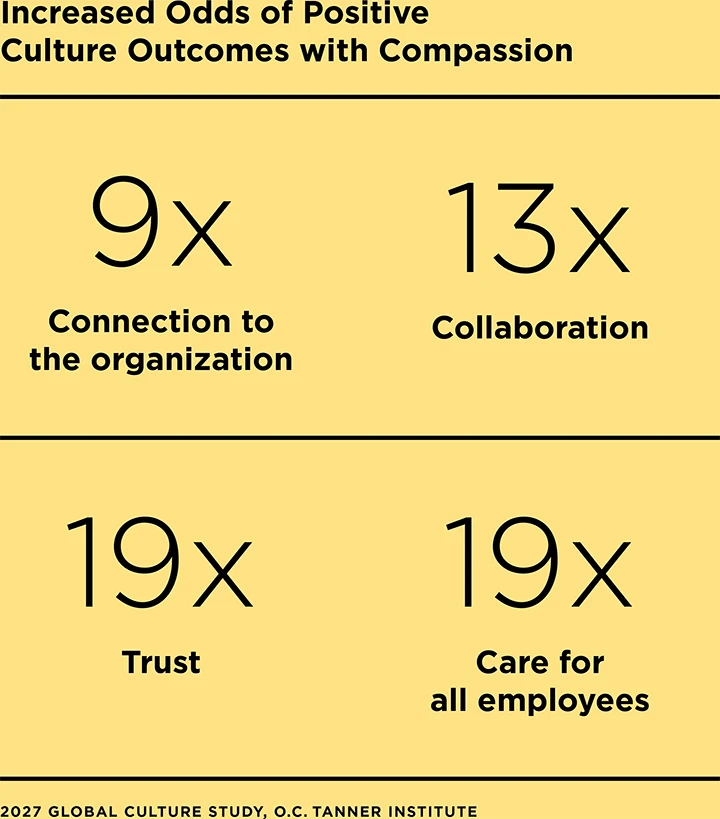
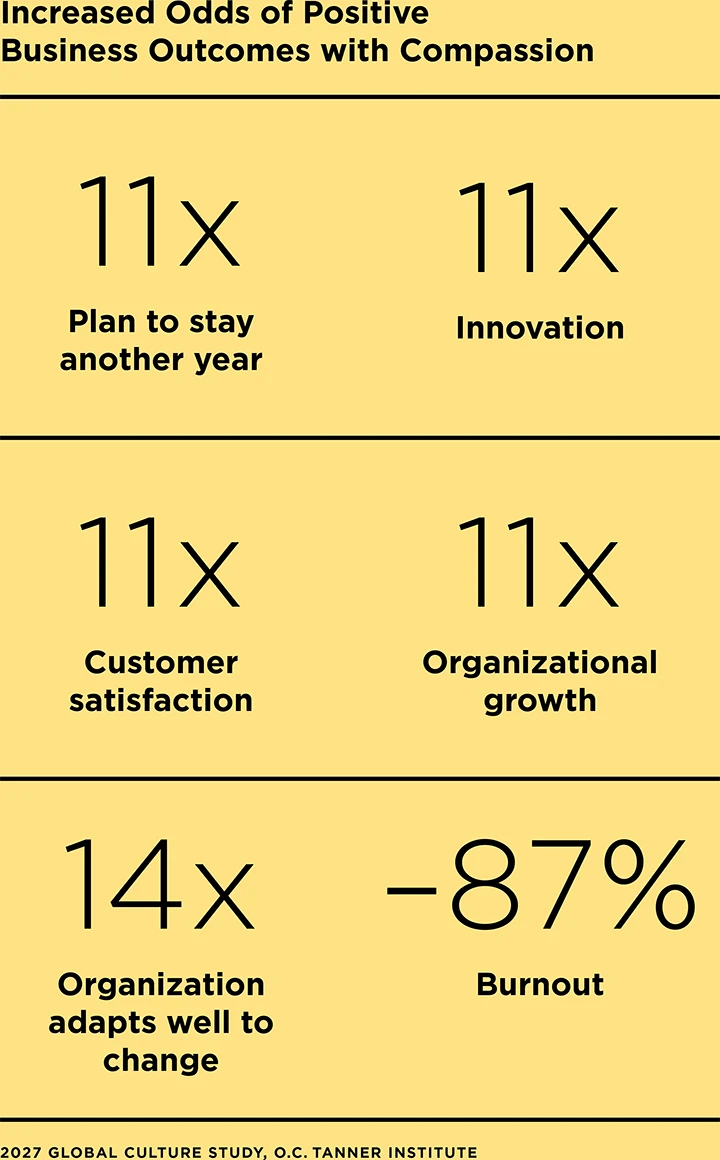
When all three pillars are present, organisational compassion leads to employees feeling more connection, trust, and care. They are less likely to burn out and more likely to stay, fueling innovation and growth.
{{report_insert_1}}
“I refuse to believe that you cannot be both compassionate and strong.”
—Jacinda Ardern, former Prime Minister of New Zealand
Organisational compassion is even more important and impactful for frontline employees, who don’t always have the same flexibility, autonomy, and visibility as office employees, and are often focused solely on surviving at work.9 Showing compassion helps frontline employees feel supported (14x higher odds), appreciated (15x higher odds), and that the organisation cares about them as a person (43x higher odds). It also lowers odds of burnout by 88%.
When compassion is integrated into an organisation’s architecture, it drastically improves the business and becomes a competitive advantage that sustains high performance.
Employee recognition is a practice of care that reinforces the three pillars of organisational compassion
Employee recognition is a practice of care that reinforces core elements of organisational compassion. It is integral to maximising organisational compassion.
Recognition strengthens the three pillars of organisational compassion:
1. A foundation of care
Recognition naturally communicates that the organisation cares about employees as individuals and their contributions. When recognition is integrated into the organisation10 and part of the everyday employee experience, odds of having a foundation of care improve 21x, and employees have 41x higher odds of feeling their organisation consistently demonstrates care for employees through policies and actions.
2. Capacity protection
Recognition demonstrates the organisation sees what employees are doing and cares about their achievements, along with their wellbeing. When recognition is valued and integrated organisation-wide, the odds of the organisation protecting the capacity of its workers improves 18x. By recognising employee efforts in addition to accomplishments, along with protecting their capacity, odds employees feel their organisation cares about them as a person improve 23x.
3. Guidelines and boundaries
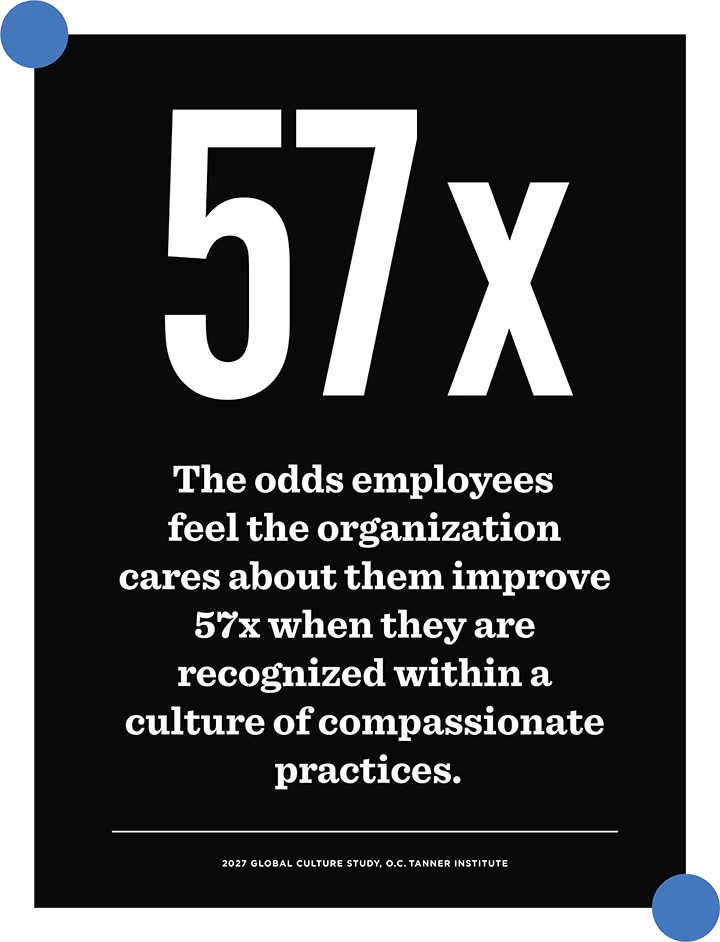
Equitable recognition supports equitable compassion. When organisations have fair, integrated recognition, they will also likely have fair, integrated compassion. Employees then see their organisations showing care consistently through multiple channels. Odds of having successful guardrails and boundaries increase 18x when recognition is integrated into an organisation’s culture, and when guidelines and boundaries are in place and recognition is integrated, there are 58x higher odds employees feel the recognition is genuine, fair, and reflective of real contributions.
Because of its power in strengthening the three pillars of organisational compassion, recognition is a crucial part of creating compassionate workplaces that drive sustainable performance.
Organisational compassion and integrated recognition amplify outcomes, leading to substantially higher odds of:

Recommendations
Organisational compassion thrives when pillars of care are embedded within an organisation’s policies and processes.
1. Integrate compassion into enterprise systems and processes
Build compassion into company policies and processes so leaders and employees know what resources are available to them and how to access them. Hold leaders accountable for prioritising employees in business decisions. Hold regular one-to-ones with employees to ensure their feedback is heard and understood. This is especially important for frontline workers who often have less flexibility and autonomy naturally built into their roles, and who often feel unseen and uncared for by leaders.
Teach boundaries around workloads and provide robust support during times of high demand with regular check-ins, resources, and recognition. Establish protocols to reprioritize work when employees are overloaded and empower leaders to pause or reassign work projects as needed. Empower employees to raise capacity concerns without fear of punishment and build an environment of psychological safety. When employee capacity is protected, the odds of connection to the team improve 6x and engagement 11x.
2. Train leaders on compassion resources and best practices
It can be difficult for leaders to know when and how to show compassion without guidelines or tools. Establish clear expectations for compassionate behaviour and train leaders on the available guidelines, processes, and resources.
Set boundaries to ensure leaders don’t suffer from compassion fatigue. When compassion is an organisational priority rather than solely a leader decision, it becomes sustainable for everyone. With guardrails in place, there are 19x higher odds that employees believe the culture encourages compassion and 27x higher odds of equity.
3. Use recognition as a consistent, organisation-wide way to show care and compassion
Regular recognition is critical as recognition reinforces compassion. Ensure recognition is given often and equitably, and publicly shared. Specify what the individual has done, how it connects to what’s important, and the impact that individual has made.
Most importantly, recognition should communicate care. When care is communicated, demonstrated, and recognised, odds of satisfaction with overall culture improve 7x, and odds of confidence in leadership improve 19x.
{{report_insert_2}}
Organisational Compassion—Key Takeaways
Compassion must be built into an organisation’s policies and processes to be equitable and effective.
A foundation of care, protection of capacity, and clear guidelines are required for organisational compassion.
Organisational compassion has a measurable impact on organisational culture and business results and helps sustain high performance.
Organisational Compassion Sources
- “More Than Half of U.S. Workers Report Burnout, New Eagle Hill Research Finds,” Eagle Hill Consulting, PR Newswire, November 24, 2025.
- “Rethinking Burnout: How High-Impact Performers Protect Brain Health,” Jason Walker, PhD, Forbes, February 25, 2026.
- Healthy Performance Cultures, 2026 Global Culture Report, O.C. Tanner Institute.
- “How Workplace Compassion, Social Support, and Altruism Predict Employee Retention in Highly Competitive Businesses,” Dzakwan Sabil Al Fajri, Muhammad Alfareza, Rio Satrio, Dedi Muhammad Siddiq, Mazlina Mamat, Jurnal Ekonomi dan Bisnis Digital, Vol. 3, No. 3, August 2024.
- Introduction, 2025 Global Culture Report, O.C. Tanner Institute.
- “The Problem with Total Rewards—And How Recognition Can Help,” O.C. Tanner, 2026.
- Healthy Performance Cultures, 2026 Global Culture Report, O.C. Tanner Institute.
- Thriving at Work, 2025 Global Culture Report, O.C. Tanner Institute.
- The 80% Experience, 2024 Global Culture Report, O.C. Tanner Institute.
- Integrated Recognition, 2023 Global Culture Report, O.C. Tanner Institute.


Case Study—Care Comes Full Circle
The digital celebration platform Kudoboard was built on a simple belief: when people come together to support one another, even small gestures can have a profound impact. While organisations often use the platform to celebrate milestones such as birthdays, retirements, and new hires, some of its most powerful moments emerge during times of personal hardship.
An administrator at a large healthcare organisation received an unexpected cancer diagnosis. After years of supporting caregivers and serving others, she suddenly found herself receiving treatment in the very hospital where she worked.
Her colleagues created a Kudoboard and invited everyone to contribute. Coworkers shared words of encouragement, photos, memories, and stories about the difference she had made in their lives and careers.
When she received the board, she was overwhelmed with emotion. She read stories of the lives she had touched and laughed at shared memories and jokes. There was no mention of work, deadlines, or timelines. The board conveyed a message of genuine care: focus on healing. We’ve got this. We’ve got you.
As Aaron Rubens, Co-Founder and CEO of Kudoboard, explains, “When someone experiences a health crisis, it’s hard not to worry about the work being left behind. Expressions of support give people permission to focus on what matters most: healing.”
Compassion in organisations is often expressed through seemingly small acts, but those acts carry significant meaning. By creating intentional practices that support people during life’s most meaningful moments, organisations strengthen connection, reinforce belonging, and build cultures where care is more than a sentiment—it’s a foundational value that drives the business.
Turn Recognition Into Real Connection
Get Started Today
Top