5 Workplace Culture Trends for 2026


Workplaces are constantly shifting, but organisations that stay ahead of the trends and adjust can create cultures where employees are inspired and thrive. See what’s coming for 2026 (based on new research by the O.C. Tanner Institute), and how you can prepare.
Discussions about creating great workplace cultures typically focus on leadership. But the latest research shows that while leaders play a pivotal role in helping employees thrive, they can't do it alone.
Research from the O.C. Tanner Global Culture Report reveals strong teams have a greater impact on inspiring employees, building belonging, and fostering wellbeing. In fact, conversations with coworkers are the top source of inspiration for employees, and 68% of employees have at least one coworker who inspires them at work.

Workplaces with strong, supportive teams report the highest satisfaction and mental health outcomes, as well as high levels of belonging and inclusion. Inspiring teams also lead to higher engagement, retention, and eNPS scores.

AI has proliferated in the workplace, including in culture initiatives. But 63% of employees fear AI will make their experiences less personal.

The more systems and processes become automated, the more employees want to feel seen by other humans in the workplace. We found 70% of employees believe it’s important to use AI responsibly in a recognition programme, and 45% have used AI tools to help write recognition messages. While employees don’t want to completely eliminate AI from their experiences at work, there must be a balance between AI and human connection. Companies should create meaningful, personal recognition moments for their people.
“I’ve got to admit, if I sniffed out AI on a congratulatory note, that would probably be a big turn off. If, all of a sudden, the message said ‘Mr. Jones, we greatly recognise your dedication’, then I know it’s not my boss doing that.”
—Focus Group Participant

To be successful, culture initiatives must be more than just an HR programme or shiny new piece of technology—they must be fully integrated into your organisation’s culture, including your expectations, processes, and practices.
Harvard Business Review found that 72% of culture initiatives led to no improvements as employees felt they were superficial, and 57% of employees felt worse after a culture-building perk was launched, viewing the perks as a band-aid for deeper challenges. By contrast, when senior leaders changed their behaviours and ways of working, despite not having a formal programme for it, trust scores rose 26%.
Truly integrated solutions are built into the daily employee experience—the interactions, processes, and practices employees encounter each day. They include the support of senior leaders, role-modeling, and measurement, and naturally become part of the company’s DNA. When this happens, employees are 18x more likely to say the workplace has a healthy performance culture with high expectations and high support and 10X more likely to say their team is inclusive.

Organisations are looking to measure the impact of culture-building initiatives on business outcomes like engagement, innovation, efficiency, customer service, revenue, etc.
For example, one multinational energy company was able to show a direct relationship between employee recognition and attrition, down to the difference between recognising once a quarter versus once a month. Amazon Web Services found improvements in the likelihood of employee retention (59%), innovation (3%), and career growth (64% increase in advancement) from their recognition efforts. And healthcare organisation Wellstar improved their new collection ratio by 1% and reduced aged insurance accounts receivable balances by $13 million in just one month.

In times of uncertainty, when resources are at stake and companies are pulling back on employee experience programmes, you’ll want a strong business case to prove the ROI of your workplace culture efforts.
Need help measuring the ROI of your recognition efforts? See how the O.C. Tanner Institute can help.
Employee recognition impacts not just the giver and receiver, but everyone who observes that recognition experience.
Research shows 65% of employees feel inspired when they hear about the accomplishments of others, and employees are 2x as likely to try something new when they observe recognition. Teams are also 11x more likely to be inclusive when employees frequently share in recognition moments.
Tools like Post a Win (where any employee can share another’s recognition), Boost (leaders and peers can add extra points to recognition), and Broadcast (leaders can share recognition outside the platform), in Culture Cloud® all build meaningful connections across every level of the organisation.

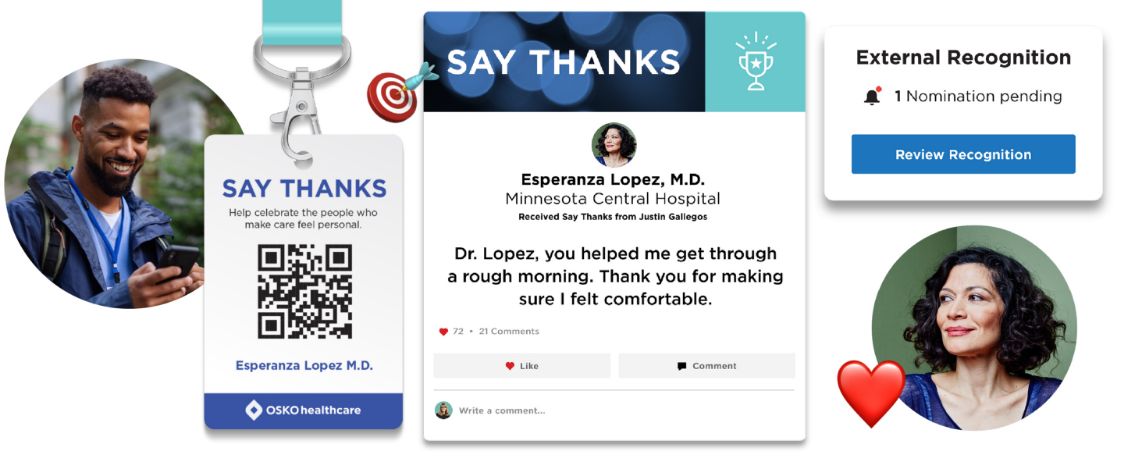
Including customers in employee recognition expands employees’ sense of community and their connection to purpose. In fact, those who regularly hear positive customer feedback are 2.3x more likely to say their work has purpose. Tools like Say Thanks allow customers, patients, and clients to thank frontline employees, making their great work visible across the organisation and building appreciation for those who often feel neglected in recognition efforts.
“When you recognise people for the great work they’re doing and the impact they have, they feel good about being part of the organisation. And when people feel good and feel connected to the organisation, they stay. You can have lofty goals around belonging, but it’s the people you work with day to day that make you feel like you belong.”
—Peggy Essert, Manager of Human Resources, St. Elizabeth Healthcare

Want to create an inspiring, thriving workplace culture in 2026? See how O.C. Tanner can help.