Table of Contents
Table of Contents

Perspective
Transparency at work and in business is a relatively recent principle. For longer than not, organizations intentionally withheld information from employees, leading to a sense of secrecy. Today, leaders know concealment risks disengaged workers, less-accountable leaders, and diminished trust and decision-making. Of course, as with many principles, the more we learn about transparency, the more it has to teach us. When organizations are open and honest in the four areas that matter most to employees, our research finds some profound and even unexpected benefits. To be sure, confidentiality and privacy still have their place, but it’s increasingly clear that open and frequent communications produce better outcomes.
{{report_insert_1}}
Introduction
The practice of transparency in the workplace often runs into problems between what organizations and leaders think they should communicate and what most employees want to know.
Employees typically prefer more than their employers can share, given a complex environment of rules, regulations, and social norms. And many organizations convey news to leaders (who then decide what to pass on to their people), while others rely heavily on HR to act as gatekeepers. Regardless, when employees believe information is withheld or filtered, it can take a toll on feelings of trust and respect.
During the pandemic, employers increased transparency as they changed how they worked, nearly overnight. Many shifted to regular, even daily, communication with employees about company changes, performance, or needs. And employees valued both the information and the honest approach. It helped them feel more engaged and connected to their employers, as well as better equipped to make decisions. Both employees and organizations benefited.
As organizations navigate new cultural, technological, and economic changes, employees’ appetite for transparency remains high. They want to know about their roles, but also the organization’s direction, the rationale behind important decisions or changes, and how leaders are held accountable. Regrettably, only about half of workers say their organization, senior leaders, HR teams, or direct leaders are transparent. The same number report transparency for promotion and compensation processes. And worse, a majority of employees in 28 countries think their leaders deliberately mislead them.1
A few years ago, our research revealed how imperative organizational transparency was to building trust, wellbeing, and engagement, especially during challenging times.2 Now, our studies reveal employees expect transparency in four key areas:
- Personal work
- Connections with others and their workplace community
- Decision-making (both senior leadership and immediate leaders)
- Accountability
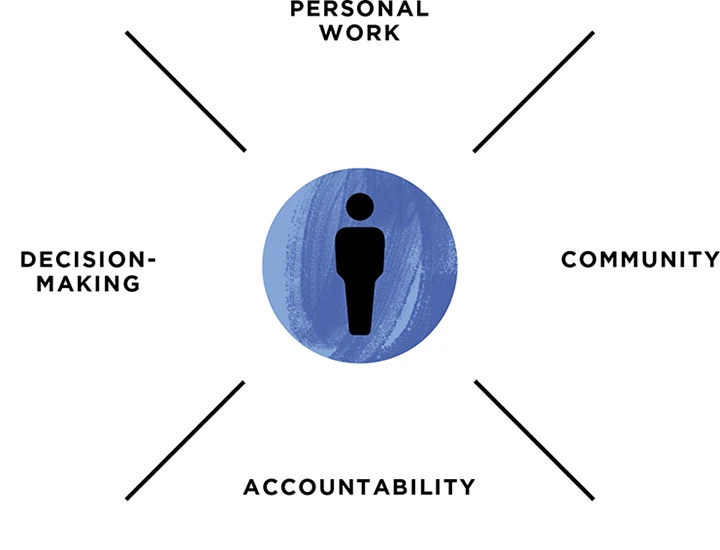
The four areas where organizational transparency has the most impact.
As the following table shows, when organizations make transparency in these four areas part of the daily employee experience, the odds of several positive outcomes improve:
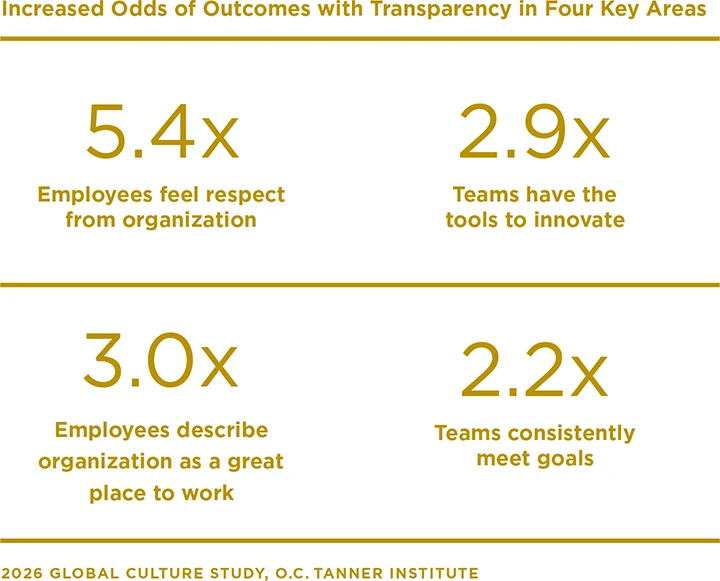
The effect on employee wellbeing is also notable: The odds of probable anxiety decrease 40%.
The importance of transparency isn’t new to organizations, but they’d be well served to look at it in a new light. Rather than an overarching policy or an ethereal cultural element, transparency can be a practice that permeates daily operations, leadership approaches, and core values to build trust, respect, engagement, and belonging.
“Encouraging transparency and open communication in the workplace can be uncomfortable but can have big rewards: true organizational alignment, fewer distractions, increased speed, shared understanding, and higher levels of leadership trust, credibility, and confidence. These benefits help your company operate with less friction and foster a culture that attracts and retains talented people who want to have their voice heard at work.”
—Amanda Atkins, Head of Internal Communications, Slack
The Window Into Personal Work
The first area of transparency involves employees’ individual workload, performance, and evaluation. In our focus groups, we found employees are the most curious about their personal work. Specifically, they want:
- Clear, high, healthy expectations
- Guidance and support to meet those expectations
- Clarity around their responsibilities
- The performance metrics for evaluating their work
- Real-time feedback on their performance
- A connection between their work, overall company goals, and compensation
Remarkably, 60% of employees don’t fully understand their company’s strategies and objectives, much less how their work supports them.3
In addition, people need access to information and tools to do their jobs—as well as visibility into other teams that affect their work—and they want to see their possible future at the organization with well-defined career paths.
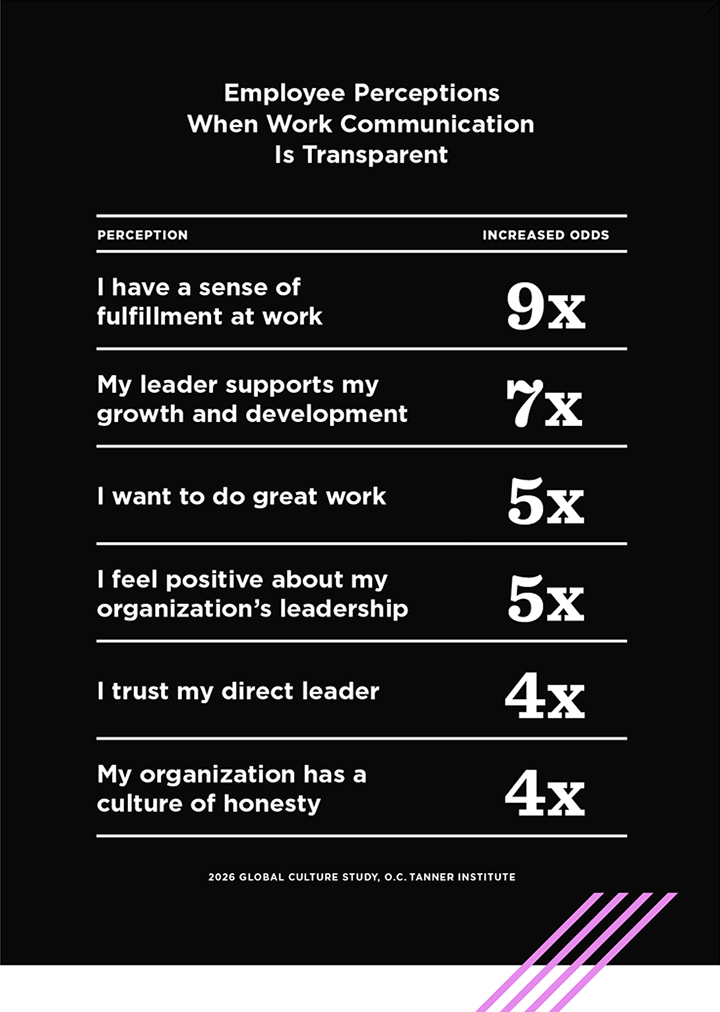
The person who communicates also makes a big difference that can change depending on circumstances. For example, during the Covid pandemic, transparent communication from senior leadership was crucial. Employees needed regular reassurance—sometimes daily—that they were safe, supported, and valued. Today, that emphasis has shifted and transparency about work and performance is 7x more powerful from immediate managers than from senior leaders or HR teams. This communication can take place in formal one-to-ones, everyday emails, or casual conversations.
As the following table shows, when leaders communicate transparently about work, the odds of several positive perceptions improve.
Employees Want Transparency From Coworkers, Too
The second area of transparency, Community, applies to employee dialogue with their coworkers, leaders, and cross-functional team members. This includes collaboration with supportive teams, where employees can share ideas, try, fail, and win together.
High transparency in this area promotes a sense of belonging, cultural cohesion, and trust. Employees are informed about news and events at the organization. They also give, receive, and witness recognition regularly.
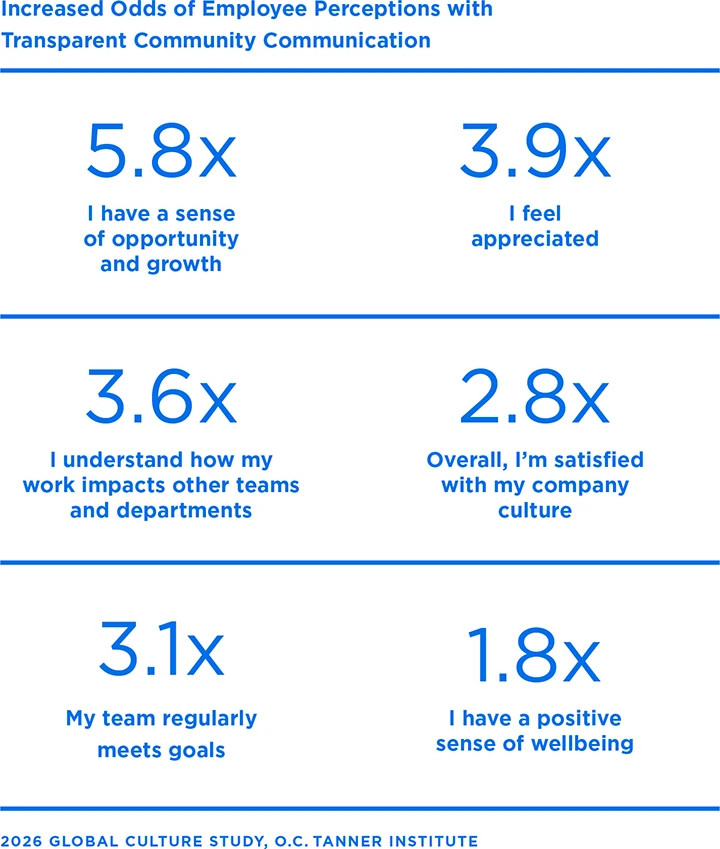
One important note: A transparent workplace community requires intentional effort. Leaders must spend as much time cultivating relationships as they spend on accomplishing tasks and projects. Effective leaders create a transparent environment where everyone can address issues to build trust, share information equitably to foster inclusion, and recognize individual contributors often. They create teams where employees know they belong and where they stand. Transparent communication in workplace communities improves the odds of several other positive perceptions, as the following table shows.
The Time for Transparency in Decision-Making Is Before the Decision
Transparency in decision-making has traditionally meant openly sharing the thinking behind certain choices or actions. Communicating the process and criteria, along with easy-to-access information about changes and updates, can help employees feel connected to decisions as well as an organizational vision.
However, our new lens for this area goes further to ensure employees’ voices are heard even before decisions are made. It includes providing opportunities for feedback, encouraging open dialogue, and making space for input without fear of negative consequences. This approach shows people their insights are valued and considered, and it increases their trust in leadership and sense of inclusion.
As has always been evident, a lack of transparent decision-making leads to employee frustration, mistrust, and a decline in morale, which can ripple across workplace culture. When communication is unclear or inconsistent and employees don’t believe they have a say in decisions, they can feel disconnected from leaders and organizations, which undermines confidence and decreases engagement.
As the following table shows, when decision-making is transparent and employees are actively involved, the odds of several positive perceptions improve.
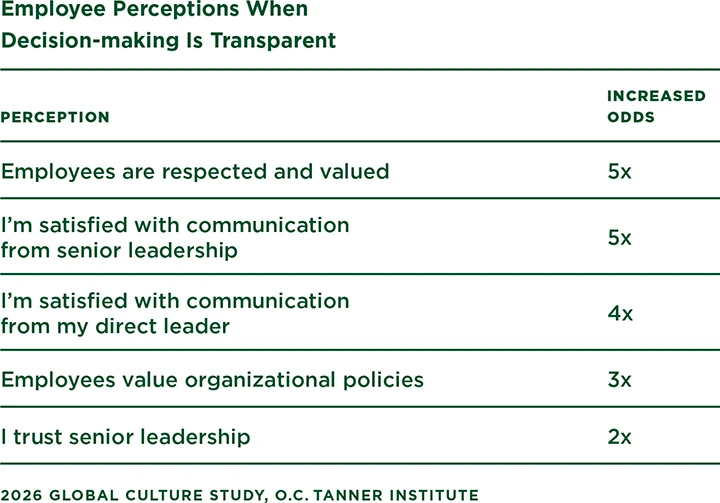
Additionally, employees are 30% less likely to feel powerless over their situation at work.
“Leaders must either invest a reasonable amount of time attending to fears and feelings or squander an unreasonable amount of time trying to manage ineffective and unproductive behavior.”
—Brené Brown, Researcher, Professor, and Author
Accountability and Ownership for Leaders, Recognition for Employees
Finally, employees need to see how leaders are accountable and own their work. This area of transparency involves communicating the responsibilities and expectations set for leaders, which builds trust and respect.
Accountability, in our research, refers to how leaders hold themselves to communicated standards and share how their actions align with organizational goals. This includes the standard of ownership, which applies to how leaders acknowledge their role in decisions and take responsibility for the results—positive or negative.
This might include admitting when a decision creates problems for employees or when a strategy simply fails. Leaders who proactively communicate the reasoning, anticipated outcomes, and any unintended consequences of their choices demonstrate a commitment to both transparency and integrity.
Such practices position leaders as partners with their direct reports rather than distant authority figures. A recent study published in Forbes found that when leaders consistently shared organizational challenges and invited open dialogue, 63% of employees became strong advocates for the company (as opposed to 6% in companies that didn’t).4 Offering candid reflections on a policy shift or sharing lessons learned from a mistake humanizes leadership and strengthens organizational bonds.
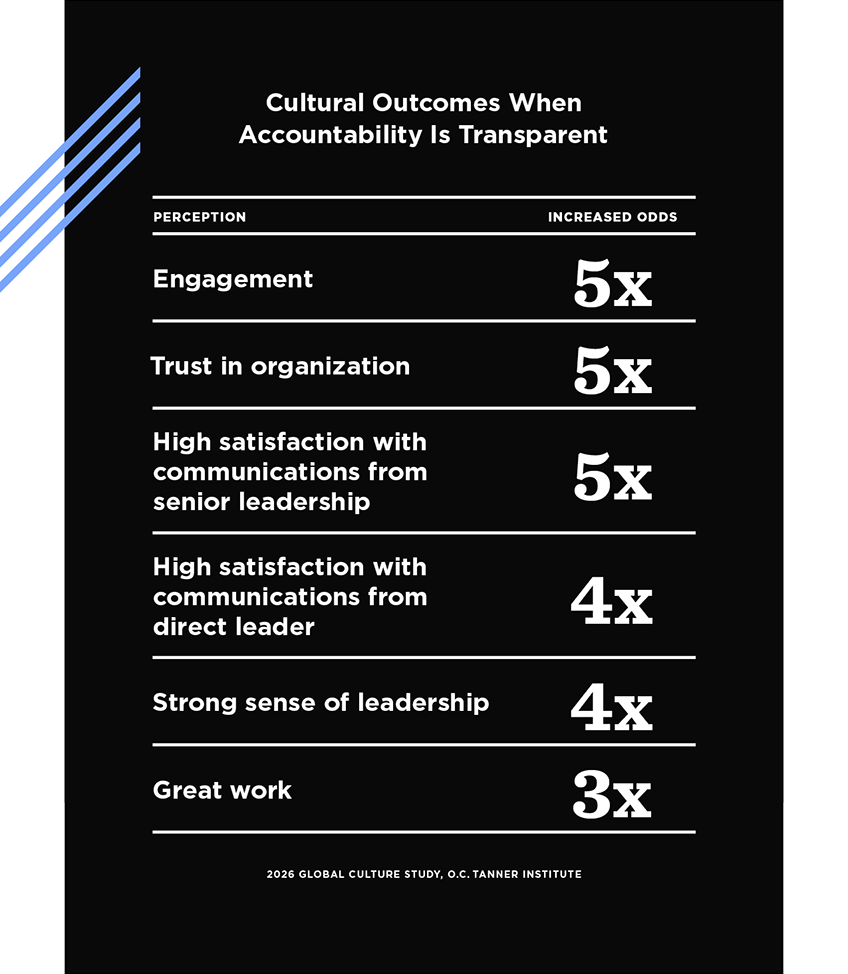
Remarkably, transparent accountability is even more powerful when leaders recognize employees for their good work. Just as transparency reveals the leader’s role in achievements, recognition highlights employees’ contributions. Leaders who openly share challenges facing the organization, admit mistakes, take responsibility, and then recognize employees when things go well can dramatically improve the odds of several positive outcomes.
Recommendations
By focusing on four areas of transparency, organizations can build a workplace culture where employees are informed, feel valued, and understand how they contribute to success.
1. Communicate with employees openly and often
Employees want leaders to not only share information but also explain how it will affect their jobs. This is especially true for organizational challenges, policy changes, and new directives. Leaders should speak with employees regularly and concentrate on the following areas:
Personal work
Have frequent one-to-ones to discuss employee work and personal performance. This should include:
- Workload expectations
- How their performance is evaluated
- How their role contributes to organizational goals
- Conversations about compensation
- Their future at the organization
- Regular, personalized recognition for good work
Community
Provide opportunities for formal and informal dialogue between employees and leaders. This can involve:
- Collaboration between individuals, teams, and departments
- Team assignments that foster inclusion and safety to innovate and fail
- Equitably sharing information with all team members
- Occasions to give, receive, and witness recognition
Decision-making
Do more than share a plan; solicit employee input for decisions through town halls, forums, and feedback tools. Some possible strategies:
- Explain the reasons behind changes and decisions
- Communicate the process for making decisions that affect employees
- Include everyone in the decision-making process early
- Encourage people to respond to leadership with the assurance that feedback is appreciated, never punished
Accountability
Take ownership and accountability for mistakes, but also recognize employees when they contribute to successes. Organizations and leaders should:
- Be open about challenges
- Acknowledge problems and errors
- Accept responsibility for the impact of decisions on employees
- Admit when information is incomplete
- Recognize people for great work
2. Build transparency into workplace processes
Organizations should work to integrate transparent practices into leadership training, formal decision-making procedures, team-building activities, and culture initiatives.
Managers may need specific guidelines from HR and senior leadership on what they can or should share and how, as well as best practices for talking with employees transparently about their work. Provide leaders with the necessary information, support, flexibility, and autonomy to be transparent and show them how to take accountability and use practical empathy to handle tough questions from employees.
Organizations should also create clear pathways for information to flow freely from employees to leaders—and above—so there can be ample communication, feedback, and acknowledgement. Make it easy for employees to give input through surveys, suggestion tools, team meetings, and town halls.
“The greatest gift you can give your team: clarity, communication, and pulling people together around a shared mission.”
—Anne Sweeney, President, Disney-ABC Television Group
{{report_insert_2}}
3. Use employee recognition to amplify the effects of transparency
Recognition from leaders is an excellent way to provide transparent feedback on employees’ work and personal performance, especially when it highlights the unique ways they’re contributing, growing, and making a difference. So be specific when recognizing people and align the recognition to the organization’s purpose, goals, and values.
Likewise, peer-to-peer recognition builds transparency in the area of community when it emphasizes collaboration and helps employees feel included. Ensure there are tools and opportunities for people to recognize one another across teams and departments. And involve team members in recognition moments to comment on the work being recognized and observe the praise firsthand.
Furthermore, empower all employees to give recognition, even to their leaders, and provide a variety of tools so they can recognize frequently.
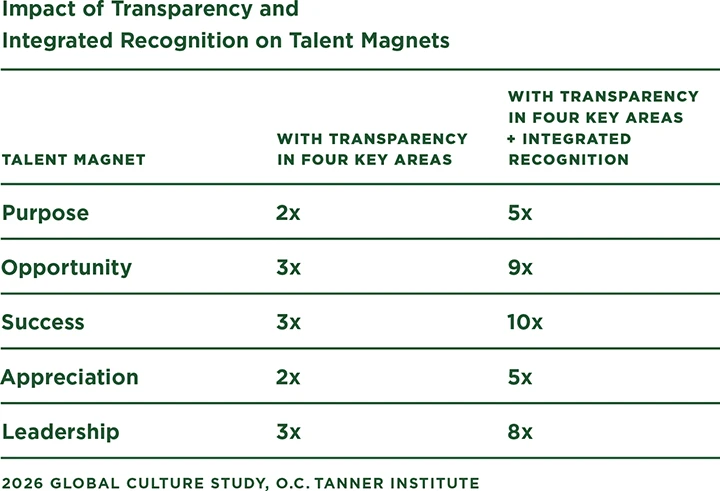
While focusing on transparency in the four key areas improves culture measures—including Talent Magnets like purpose, opportunity, and success—our research shows that adding integrated recognition6 (recognition that’s an embedded, daily part of the employee experience) can double or triple the impact.
{{report_insert_3}}
Transparency Revisited—Key Takeaways
Employees need transparency in four key areas: Personal Work, Community, Decision-making, and Accountability.
Employees desire transparency from both leaders and peers.
Transparency requires clear, honest communication, as well as including the voice of employees when making decisions.
Greater transparency helps employees feel informed and valued and gives them a greater sense of belonging.
Transparency Revisited Sources
- 2025 Edelman Trust Barometer, Edelman Trust Institute.
- Crisis, 2021 Global Culture Report, O.C. Tanner Institute.
- “The Case For Transparency In The Workplace, And Its Impact On Organizational Performance,” Andrew Rahaman, Forbes, June 16, 2023.
- “Why Leadership Transparency Will Define Organizational Success In 2025,” Kara Dennison, Forbes, January 15, 2025.
- “Zions Bancorporation: Strengthening Community with Recognition,” O.C. Tanner.
- Integrated Recognition, 2023 Global Culture Report, O.C. Tanner Institute.
- “Deloitte India: Recognition that Pushes Boundaries and Delivers Excellence,” O.C. Tanner.



Case Study—Transparency and Recognition Add Up
Zions Bancorporation is heavily invested in employee recognition and ensuring transparency is an integrated part of its processes. Leaders receive direct reminders to recognize and send out regular communication to their teams about the importance of recognition. Encouraging leaders to recognize people through the bank’s Value You platform, by O.C. Tanner, makes recognition more transparent, and live stats on dashboards and reports help keep managers accountable for recognition.
In addition to posting employees’ upcoming anniversaries internally, Zions also sends regular emails to leaders to remind them to celebrate and write messages of congratulations in employees’ keepsake Yearbooks™. Building this level of transparency into the recognition process has resulted in a 30% increase in the number of messages celebrating employee anniversaries, and recognition has strengthened connection and inclusion at the bank.5

Case Study—Improving Transparency With Recognition
Deloitte India puts people at the center of everything it does, so when the professional services firm rolled out its new recognition platform, Dot of Fame, by O.C. Tanner, it made transparency a priority.
First, the HR team met with individual business leaders and all managers to explain the new program and the reasons for change. Next, they spent several months socializing the platform, conducting training sessions so people understood how to use it. Then, to hold leaders accountable, they included recognition metrics in their KPIs, and both their CEO and Chief People and Experience Officer now regularly mention the importance of recognition in town hall meetings. And finally, the firm began conducting regular pulse surveys to track the results.
Key result: Employee retention increased by 10 points.7
Turn Recognition Into Real Connection
Get Started Today
Top