Table of Contents
Table of Contents

Foreword
To say change in workplace cultures is constant does not mean it’s predictable. The challenges employees and organizations face this year are new, in part, because the world outside of work is still rapidly changing—economically, politically, technologically—and has become less separated from work. The question at hand now is, how can organizations move their people toward a meaningful vision of the future when surrounded by uncertainty? The answers in this year’s report provide a roadmap to help workers, leaders, and employers achieve greater personal and professional outcomes together. And it all starts with inspiration, a powerful spark that drives action, fosters inclusion, and cultivates success.
Most organizations embrace the fact that to remain competitive, they must continually evolve and grow. The problem is that the motivations of senior leadership don’t always reach or move the workforce. This year, our report offers a path forward that reignites employee passion and illuminates strategies to achieve goals.
This year’s report begins with inspiration, a measurable force that arises from meaningful interactions and stokes vision and engagement. Next, the active practice of hope capitalizes on inspiration while drawing on the support and guidance of teams and leaders. Taken together, inspiration and hope elevate the employee experience and positively impact both cultural and business metrics.
Our report continues by providing a new framework to help employees feel included in ways that are practical, sustainable, and scalable. It also explores the subject of healthy performance cultures, specifically highlighting what’s possible when high expectations are matched by the same level of support. Then, we take a closer look at the topic of transparency in the workplace and how it can improve communication, empower leaders, and create space for feedback and dialogue that ensures employees are seen, valued, and inspired to contribute at a high level. And throughout, we examine how recognition amplifies outcomes for both productivity and wellbeing.
To gain these important insights, the O.C. Tanner Institute examined the perspectives of tens of thousands of employees, leaders, HR practitioners, and business executives around the globe.
According to our research, the challenges facing employees, both on and off the clock, are more demanding than ever. And we feel privileged to share our findings and a blueprint for organizations to spark inspiration, drive hope, and champion the power of inclusive teams to achieve powerful and lasting outcomes.
{{report_insert_1}}
As we saw in last year’s Global Culture Report, nearly one-third of employees are operating in survival mode. People can struggle both on and off the job, and without a reliable way to feel whole or recharged, they face higher risks of absenteeism, burnout, and mental health struggles. Conversely, those who report thriving show higher resilience, engagement, and performance. And in environments of relentless change, a high-performing workforce is a critical component of business success.
Of course, organizations and HR leaders can’t remove every employee challenge—personal or professional. But what if work could be a place of renewal instead of a drain? A place that helps people feel and perform their best, where individuals see immediate obstacles as paths to greater opportunity?
What if the workplace were a place of intentional inspiration?
In our context, to inspire means to rally and energize; to align to a common goal with clarity and excitement. Beyond motivational books and speeches, or even charismatic leaders, what employees need is a workplace with vision, connection, and opportunity that inspires them, especially in difficult circumstances.
This year’s report explores how organizations can foster cultures that help employees thrive despite the challenges of work and life. Specifically, it examines key drivers of these cultures, including inspiration, hope, inclusive teams, healthy performance, and the power of transparency and recognition.
If there’s ever been a time when your people want to be as inspired as your organization needs them to be, it’s now.
{{report_insert_2}}
Opportunities for Organizations in 2026
Our research identifies several ways organizations can benefit their people. Each is the subject of a chapter in this year’s report.
1. Connect employees with sources of inspiration
Whether it’s outside resources, conversations with leaders or peers, or safe environments to take risks and learn quickly, connecting employees with the spark for inspirational, innovative thinking is the first step.
2. Practice hope
More than wishful thinking, the practice of hope helps employees use their inspiration to overcome obstacles and reach goals.
3. Build inclusive teams
Rethink what inclusion means and how all employees can contribute, feel they belong, and inspire one another.
4. Create a culture of healthy performance
Employees want to achieve their potential. High, sustainable performance involves a combination of big expectations and robust support.
5. Be transparent and help employees find their place
More than just open communication, true transparency gives employees a voice and helps them see where they fit in the bigger picture of your organization.
We hope these opportunities and the specific findings behind them help clarify the importance of inspiration in creating workplaces where every employee can find new strength, innovate, and thrive.
{{report_insert_4}}
Talent Magnet Areas
Each year, we measure changes in the six core elements of workplace culture that together determine employee decisions to join, engage with, and remain at any place of work. We call them Talent Magnets because of their power to attract and connect people to their teams and organizations.
This year, each of our Talent Magnet scores increased 1–2%. This indicates that while organizations are making improvements to their cultures, there’s still significant opportunity for more gains, particularly in the areas of wellbeing, leadership, and appreciation.
“The only real voyage of discovery consists not in seeking new landscapes but in having new eyes.”
—Marcel Proust, French Novelist
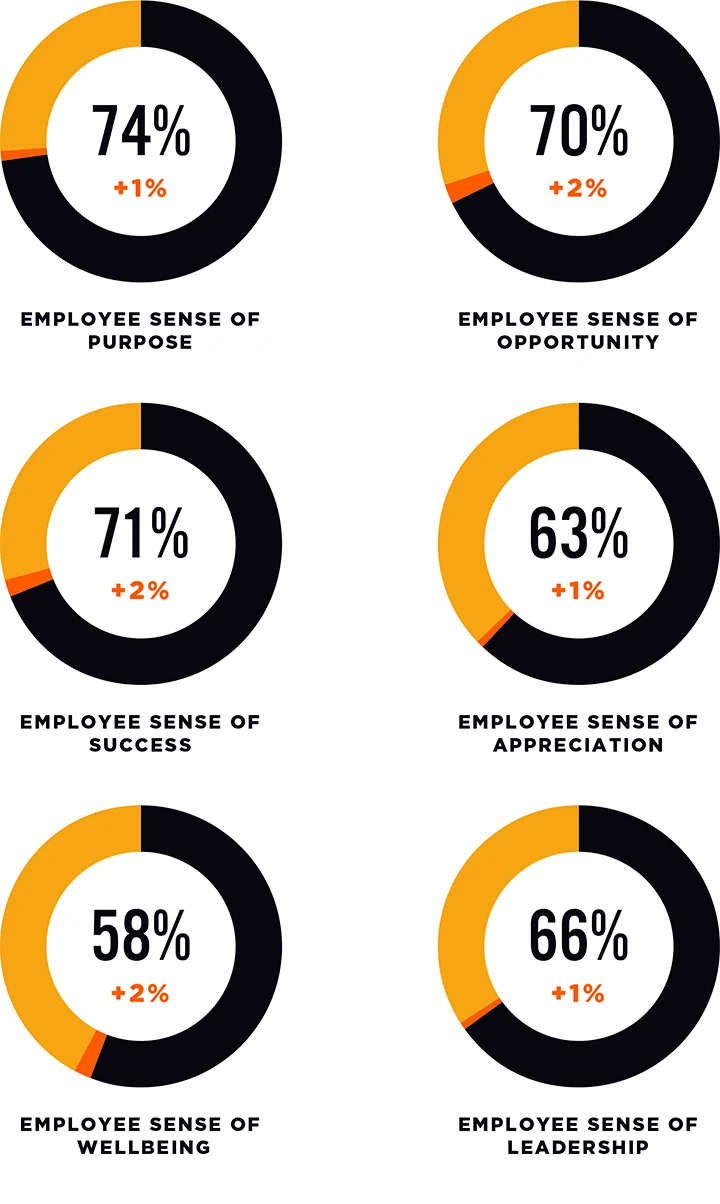
Current state of the six essential elements that define thriving cultures.
{{report_insert_3}}
Great Work Explained
O.C. Tanner knows forward-thinking organizations need measures that consider more than just employee commitment and motivation. They need practical metrics that capture the quality, efficiency, and innovation shaping and amplifying business outcomes. It’s called great work.
Based on our research, we’ve established an index for great work identifying five behaviors that directly correspond to employee performance, business results, and strategies for improvement. Employees who consistently do great work demonstrate the following:
1. Ask the right question
Great workers ask how they can make a difference and then focus on who their work serves—whether it’s customers, clients, team members, or leaders.
2. Go and see
Next, they observe and examine what’s being done and how people experience it to discover new possibilities.
3. Talk to an outer circle
They also talk to others they wouldn’t normally interact with and generate ideas they wouldn’t have otherwise. Inviting others to join them, they expand their network beyond those they know.
4. Improve the mix
Employees who do great work think, plan, and fine-tune the changes they make, often adding improvements and removing elements that don’t work or add value.
5. Deliver the difference
Lastly, great workers are laser-focused on positive outcomes and persist until they get results. If their work isn’t loved the first time, they learn why and try again.

Great work is both a measure of productivity and a proven indicator of success. As you’ll see throughout this report, organizations that score high in areas like inspiration, hope, and inclusive teams also see strong performance in great work.
Introduction
You could argue that employees are spinning more plates and have more on those plates than ever. From the myriad trials of employment to the daily economic and technological stressors of modern life to the personal health and family challenges every human endures, there’s no shortage of tasks and disruptions. And they take a large toll on people’s wellbeing. The simple truth is people don’t naturally return to their jobs each day refreshed and ready to do their best work or move their organizations forward. We all need assistance and sustenance—to perform or just to recover. Fortunately, our research has found that the workplace is uniquely suited to meet these needs.

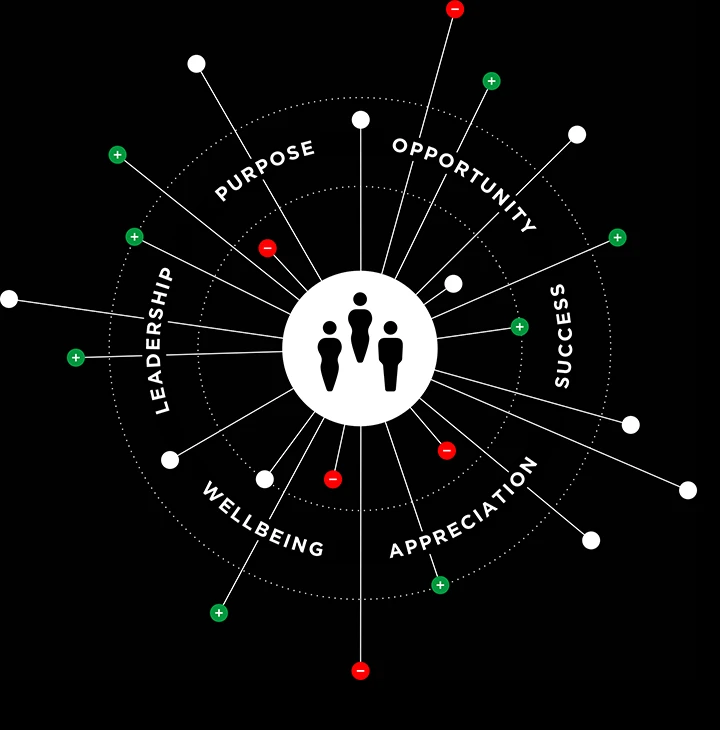
Six essential elements that define thriving workplace cultures.
Purpose
An organization’s reason for being besides profits. The difference it makes in the world, why the company exists. Employees need to feel connected to purpose and understand how their jobs contribute to it. Once they do, their work takes on meaning. Organizations should clearly articulate the connection between work and purpose.
Leadership
The mentoring, coaching, inspiring, and facilitating that allow individuals, teams, and, ultimately, organizations to thrive. Great leaders co-create a shared purpose for their teams and empower their employees to do great work. As the most influential of the six Talent Magnets, leadership cultivates the other five.
Wellbeing
Caring about the employee as a whole—their physical, emotional, social, and financial health. Wellbeing ensures employees can be their strongest, most capable, most authentic selves at work. A comprehensive approach to wellbeing requires leaders to create an environment of inclusivity, life balance, and connection.
Opportunity
The chance to develop new skills, contribute to meaningful work, feel challenged, have a voice, and grow. Opportunity is more than the lure of promotions and pay increases. It’s about preparing and empowering employees to make decisions, inviting them to participate, and offering them projects that will expand their skills and relationships.
Success
The thrill of accomplishment, innovation, breaking barriers, playing on a winning team, and experiencing victories. Employees must find success at the individual, team, and organizational levels, and it should be nurtured and celebrated publicly.
Appreciation
Feeling valued for one’s contributions and being recognized for one’s worth. Appreciation is essential to employees—they need to know their leaders and peers notice and are grateful for their efforts and contributions. Appreciation is most effective when it’s delivered in timely, personal, and meaningful ways.
Useful Tools and Models
Gathering data, measuring trends, and identifying insights are easier and more accurate with the right instruments. The following pages contain a closer look at two of our proprietary frameworks, Talent Magnets™ and the Great Work Index. Together they help assess many of the most important factors in workplace cultures.
Turn Recognition Into Real Connection
Get Started Today
Top