Embedding Employee Recognition into Change Management
Learn how embedding employee recognition into change management boosts trust and engagement—especially for offline workers.

Learn how embedding employee recognition into change management boosts trust and engagement—especially for offline workers.
.png)
Change is challenging for every organization. Gartner finds only 34% of all organizational change initiatives are considered a “clear success” and 50% are “clear failures.”
Traditional management practices are not keeping pace when it comes to helping offline, shift-based, distributed workforces adapt to new realities. To support frontline workers through times of transition, change management efforts are most successful when focused on people-centered strategies and creative approaches using offline outreach.
Reaching offline employees and managing them through organizational and industry-wide shifts presents a complex challenge for leaders. Change often affects frontline employees more significantly than their in-office counterparts, for multiple reasons:
Traditional strategies for supporting employees through change, such as digital communication, manager-led cascades, and corporate town halls, often don’t reach frontline workers, due to their limited access to technology and physical distance from corporate headquarters. And the resulting fall-out can lead to lower engagement for this critical segment of the workforce.
.png)
Taking a people-centered approach to change management helps support and retain these vital employees. Employee recognition can bridge psychological and cultural divides, especially for frontline workers who lack access to key resources, experience low levels of autonomy and ability to voice their concerns, and perceive a lack of empathy from management.
Get all the data on people-centered change management in our Global Culture Report.
Embedding strategic employee recognition into change management efforts can strengthen trust and enhance resilience for the 80% of workers worldwide who are frontline, offline, or deskless. These workers in particular may feel skeptical about corporate efforts and intentions, having experienced inconsistent change efforts in the past and a reduced sense of psychological safety on the whole.
.png)
Learn how offline and frontline workers feel about their experiences at work in our survey results.
When your people feel seen and valued, they can be more confident the organization is implementing change with them in mind. Employees at organizations with integrated recognition are significantly more likely to:
Recognition is a tangible signal of respect and belonging that strengthens trust in leaders and increases the likelihood that workers will support organizational change.
Managing rapid and disruptive change requires a new framework centered on people, culture, and transparency.
Developing a company culture where employees have high trust in leadership and feel they are valued and included can mitigate negative feelings related to change. Start by incorporating the principles of modern leadership—mentoring, advocating, connecting, appreciating, and inspiring people rather than gatekeeping, commanding, or controlling. This will help employees feel a sense of community and lessen the sting of change.
Offline employees in particular need to be engaged early in the change process, not as an afterthought when decisions have already been finalized.
.png)
Messaging around change can feel insensitive when cultural and geographical nuances are not taken into consideration. When Insurance Australia Group Limited (IAG) embarked on a cultural transformation, they gathered feedback from employees at every level and in every region to understand what mattered most in different locales.
.png)
Their campaign was broadcast across multiple channels, providing clear communication which united the organization and brought individual voices to life. The success of this approach led IAG to create a standing committee of employees who meet regularly to share data and ideas with leadership, influencing cultural change across the organization.
.png)
Because frontline workers are often dispersed and disconnected from online channels of communication, it’s important to solicit, use, and acknowledge employee feedback using multiple channels. Think surveys, focus groups, town halls, and one-to-one meetings. When organizations use all four of these methods of gathering feedback, the odds that a change will be perceived positively improves by 1,284%.
“Change cannot be put on people. The best way to instill change is to do it with them. Create it with them.”
—Lisa Bodell, CEO, FutureThink
Develop a consistent communication strategy, and train leaders to communicate about change in a way that’s transparent, builds connection, and allows employees to give feedback. Frontline workers need to hear that their concerns are acknowledged and that leaders recognize the emotional labor required of them during times of transition.
One of the best ways to help frontline, deskless, and offline employees feel seen and valued is to ensure that the tools in your recognition program are easily accessible to them. Here’s how to incorporate employee recognition throughout your change management planning.
Before any changes occur, it’s important to shore up employees with messaging that shows the organization sees their strengths and appreciates their contributions. Use recognition to:
Focus on leader-to-employee and peer-to-peer recognition moments to spark positive momentum. On-the-floor shout-outs in pre-shift meetings can help everyone on your team see and participate in recognition.
.png)
In the middle of change, employees can become tired, discouraged, and uncertain about the future. Use recognition to:
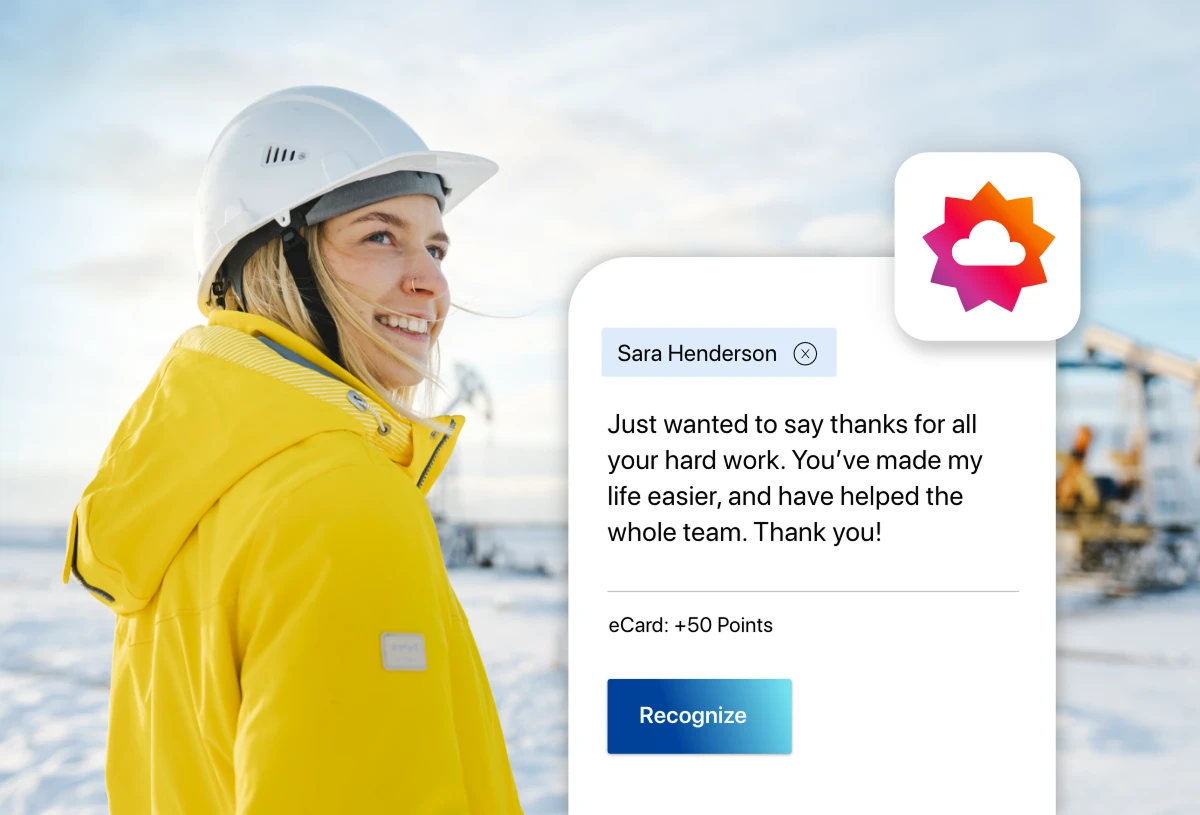
Ensure deskless employees can give and receive recognition through a mobile recognition platform (such as the Culture Cloud mobile app), through shared recognition kiosks, or using Outlook and other integrations, as global manufacturing giant 3M provided for their production workers.
Manager Dashboard, available on Culture Cloud mobile, gives leaders at-a-glance recognition data for their team and reminds them to recognize great work.
.png)
On the other side of change, it’s important to keep employees looking forward with hope for the future. Use recognition to:
Give managers the tools they need to reinforce post-change wins.
Plan a milestone celebration to honor collective effort, and include a Group Points Deposit (all employees receive a set number of points) or a one-time Event Store where employees can select a gift (choose from 5 pre-selected gifts) to maximize the positive, lasting effects of recognition.
Broadcast allows managers to share recognition moments via email with up to 500 people, spreading awareness of great work beyond their immediate team.
Use Incentives to reinforce and reward new behaviors or skill building, and give leaders access to company branded swag and other custom awards for their team through Manager Store.
.png)
Watch our on-demand webinar with two recognition experts to get tips for activating recognition across your organization and getting the most out of your recognition program features.
Bridging the recognition gap for frontline workers is critical for retaining these employees through periods of intense change. Consider working with an experienced recognition provider, like O.C. Tanner, to implement and sustain a program that reaches every employee, no matter where they work—from oil rigs to the factory floor, from semi trucks to ocean liners.
Identify gaps in your recognition program that affect frontline engagement and work toward offline and other solutions to achieve greater recognition parity.
Partner with plant managers, shift supervisors, and employee committees to determine best practices for frontline employee recognition.
Provide scripts, templates, and micro-learning on what effective recognition looks and sounds like.
Track key indicators of successful recognition practices, such as:
Integrate recognition with ongoing performance cycles and safety routines.
%20Medium.jpeg)
When your company or your industry is in the midst of organizational, operational, technological, or strategic shifts, employee recognition can support and encourage your people through it all. By embedding recognition into change management, you can create an environment where employees are motivated to move forward and help build your company’s future.
Learn how O.C. Tanner can support your organizational transformation with Culture Cloud, the world’s most complete employee recognition solution. Schedule a demo today.


.png)