Updated on
July 6, 2026
6 July 2026
Key takeaways:
Every generation brings a different approach to work, shaped by when and how they entered the workforce.
Managing generations separately doesn't work. Building generational synergy does.
Recognition is one of the most practical ways to build that synergy, and it works for every generation.
The state of generations in the workplace
Most workforces are currently made up of four generations: Baby Boomers, Gen X, Millennials, and Gen Z, working side by side, often on the same teams.
The conversation about generations at work has focused on friction. Which generation is hardest to manage. Which one doesn't get along with the others. What HR needs to handle next.
But new research suggests the real problem isn't the generational differences themselves. It's how organizations respond to multigenerational workforces. O.C. Tanner's 2026 State of Generations at Work report, based on a survey of 5,702 employees across 17 countries and nine focus groups, found that when organizations try to manage each generation separately, they end up consistently underperforming compared with those that focus on getting generations to work well together.
The good news: if leadership can manage effectively, generational differences can actually become an asset to the company. This is what research refers to as “generational synergy.” Which is what you get when different generations feel supported to collaborate effectively. Right now, only 26% of employees say they actually experience it at work. That gap is the opportunity.
Download the 2026 State of Generations at Work report for all the data and insights.
What does each generation actually want from work?
The 2026 State of Generations Report introduces a useful lens for thinking about generational contracts. Each generation entered the workforce under different conditions and developed a different sense of what they owe to their employer and what their employer owes them in return. These unspoken expectations shape how each generation approaches trust, loyalty, feedback, and belonging at work.
Here is a quick look at each one.
Baby Boomers (born 1946-1964): Loyalty for security
Baby Boomers came up in a world that prioritized hard work and loyalty. You put in the time, and the organization took care of you. That contract runs deep. Baby Boomers have 59% higher odds of believing hierarchy matters at work, and they tend to be the steadiest, most committed employees in any organization when that loyalty is recognized and honored.
Gen X (born 1965-1980): Competence for autonomy
Gen X watched institutions fail their parents and learned early: count on your skills, not the company. They value independence, competence, and getting things done without being micromanaged. 75% of Gen X describe themselves as self-sufficient at work. They are excellent at what they do, but they are also 21% less likely to trust the organization to do the right thing, which shapes how they show up in cross-generational situations.

Millennials (born 1981-1996): Meaning for commitment
Millennials want their work to matter. When the gap between what an organization says and what it does is too wide, they disengage quickly. 63% of Millennials feel disengaged when leaders don't do the right thing, and that misalignment increases their odds of burnout by 52%. When values alignment is real, they are 7x more likely to do great work.
Gen Z (born 1997-2013): Inclusion for engagement
Gen Z grew up in online communities, and they are looking for that same sense of belonging at work. 77% say inclusion is very important to them. The hard part: they are struggling to find it. Gen Z has 47% higher odds of saying they can't find community at work, making them the generation most hungry for connection and, right now, the least likely to have it.
Why does a multigenerational workforce actually matter?
It is tempting to think of generational diversity as something to manage around. The research makes a different argument: It is one of the most underused advantages in most organizations.
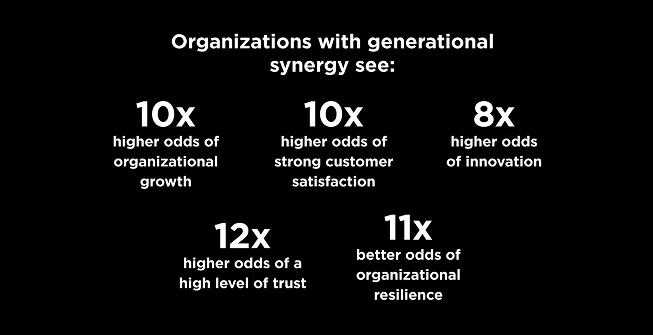
When generations work well together, the business results are real. Organizations with generational synergy see:
- 10x higher odds of organizational growth
- 10x higher odds of strong customer satisfaction
- 8x higher odds of innovation
- 12x higher odds of a high level of trust
- 11x better odds of organizational resilience
Each generation also brings something the others don't. Baby Boomers bring institutional knowledge and stability. Gen X brings pragmatism and a high tolerance for ambiguity. Millennials bring energy, purpose, and genuine investment in a company’s mission. Gen Z brings adaptability and a collaborative instinct.
None of those strengths show up fully when generations are siloed from each other. But in organizations with true generational diversity, strengths compound as people actually work together.
How do you manage generational differences at work?
The honest answer from the data: stop trying to manage them separately.
When organizations build distinct programs for each generation (different recognition tracks, different wellbeing strategies, different communication protocols), they actually reinforce silos. And they create a lot of extra work in the process.
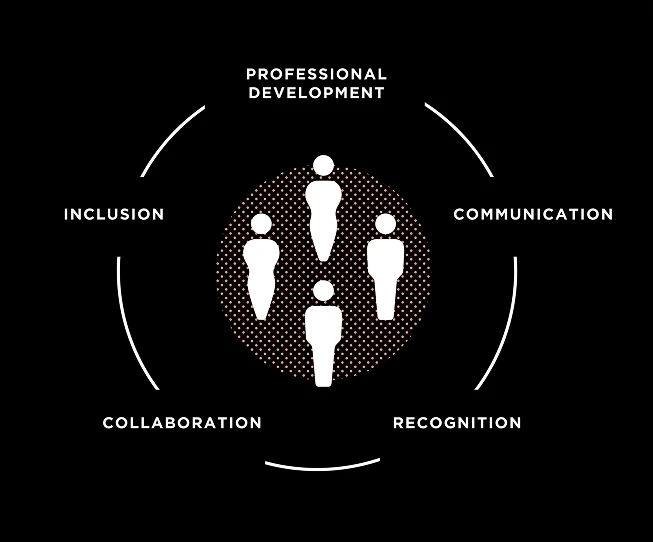
What works is building shared conditions where all generations in the workplace can thrive. Workplace culture research from the O.C. Tanner Institute identifies five elements that foster generational synergy: professional development, communication, recognition, collaboration, and inclusion. These are not generation-specific. They are foundations that support everyone, and when they are strong, every generation benefits.
When these elements are weak or missing, the consequences are measurable. Poor generational synergy leads to 6x higher odds of burnout, 88% lower odds of doing great work, and 93% lower odds of employee engagement.
The better question for HR leaders is not "how do we manage Gen Z differently?" It is "what do we need to build so all of our people can work well together?"
How do you encourage collaboration across generations in the workplace?
One of the more surprising findings in the research involves technology. Organizations invest heavily in collaboration tools expecting them to bridge generational gaps. The data tells a more complicated story.
44% of employees say that being encouraged to use AI has made them seek out human subject matter experts less. And 38% say technology makes cross-generational collaboration harder, not easier. ADP research has found that people who use AI on a daily basis also describe weaker connections to their colleagues.
When AI usage is over-encouraged, younger employees in particular stop reaching across generations in the workplace for guidance. They go to the tool instead of their colleague. That shuts down some of the most valuable knowledge-sharing in any organization.
What actually builds generational collaboration is universal across industries and international borders: human connection. Cross-generational mentorship, shared projects, knowledge-sharing. These are the conditions where real understanding takes root.
The good news: When generational synergy is present, technology usage improves too. Employees in high-synergy workplaces are 4x more likely to see technology as a collaboration tool and 5x more likely to form meaningful connections with coworkers online. Generational synergy makes the tech work better, not the other way around.
How does recognition connect generations at work?
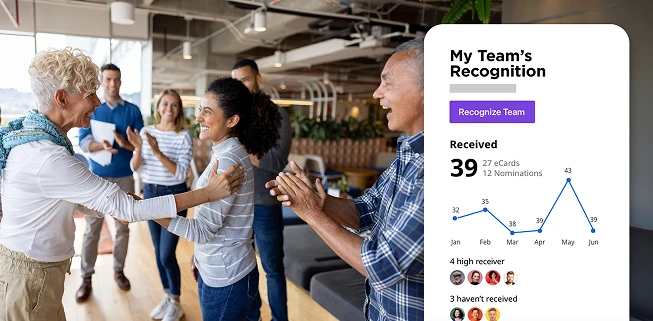
Recognition is one of the five elements of generational synergy, and it is also the most direct way to strengthen the other four. When people feel genuinely seen and valued for what they contribute, professional development, communication, collaboration, and inclusion all get easier.
Our research puts a clear number on it: Integrated recognition boosts generational synergy 16x. And it lands differently for each generation in ways that align with their contracts:
- Baby Boomers: Celebrating tenure and loyalty matters deeply. When organizations mark career milestones consistently, odds of a strong sense of loyalty improve 7x overall and 24x for Baby Boomers specifically.
- Gen X: Recognition that calls out skills, expertise, and independence resonates. With integrated recognition, trust in senior leaders increases 12x across generations and 14x for Gen X specifically.
- Millennials: Connecting recognition to purpose is what makes it stick. Odds of experiencing generational synergy improve 10x overall and 16x for Millennials when work and values align.
- Gen Z: Peer-to-peer and cross-team recognition build the community they are looking for. Integrated recognition increases odds of a strong sense of community 7x and inclusion 9x. And 70% of Gen Z say recognition helps them feel they are growing in their career.
The most effective approach is not building a different recognition program for each generation. A holistic strategy that includes career milestones, everyday performance recognition, peer appreciation, and personal celebrations covers all four generational contracts at once. Every employee gets a reason to feel they belong.
Culture Cloud® by O.C. Tanner is built to make that kind of recognition work at scale, for every employee, wherever they work.
A different way to think about generations at work
Managing multigenerational workforces is a persistent challenge for many HR leaders. Different expectations, different communication styles, different ideas about what good work looks like.
The 2026 State of Generations Report points somewhere else. The generations in your workforce are not a problem to solve. They bring a set of complementary strengths that most organizations have not figured out how to use yet.
Getting there requires building the conditions where all generations can understand each other, trust one another, and do their best work together. The organizations that achieve this grow faster, innovate more, and keep their people longer.
Download the full State of Generations at Work research
Top

.png)