
Updated on
April 16, 2026
16 April 2026
Key Takeaways:
Effective leadership drives company culture because the employee-leader relationship is core of employees’ workplace experiences.
Six "Talent Magnets"—purpose, opportunity, success, appreciation, wellbeing, and leadership—are essential for attracting and retaining top talent.
Modern leaders build strong cultures by creating micro-experiences that connect employees to company purpose, individual accomplishments, and their peers.
Effective leadership is key to building great organizational cultures.
The core of your company culture is the relationship individual employees have with their immediate leader.
– Mindi Cox, Chief People Officer, O.C. Tanner
Leaders are the first line of defense for your company culture. They are in charge of living and enforcing your company’s values, ideals, and policies. If employees don't see your company's cultural goals embodied in their immediate leaders, your culture will suffer.
What contributes to a strong company culture?
A positive culture provides a solid foundation for your organization to thrive and succeed. In the course of our global workplace research, we discovered 6 key elements that create a positive and thriving culture—we call them the Talent Magnets.

These Talent Magnets build connection, belonging, mastery, autonomy and fulfillment— the aspects of a positive company culture that attract and retain top talent. Let’s break each of these elements down:
Talent Magnet 1: Purpose
By connecting employees to your organization’s purpose, you help them understand how their work makes a difference. This leads to an increased sense of connection, belonging, and fulfillment at work.
Talent Magnet 2: Opportunity
Providing opportunities for employees to grow, build new skills, and develop themselves beyond pay raises and promotions. Meaningful access to opportunity also means giving employees autonomy, flexibility, and a voice. This builds a sense of mastery in their roles and fulfillment at work, while creating a company culture focused on personal development.
Talent Magnet 3: Success
Helping employees innovate, accomplish, be part of a winning team, do great work, and find success at work. As with other Talent Magnets, success can contribute to a sense of mastery, autonomy, and fulfillment. And feeling success at the individual, team, and organizational level is important to building a strong and connected company culture.
Talent Magnet 4: Appreciation
Appreciation comes down to feeling seen and valued for the work you do and how you do it. When employees feel like their work matters, and that their teammates and leaders appreciate them, they feel a sense of connection, mastery, and belonging.
Appreciation is top of mind for the best leaders. Learn about the 5 essential types of employee recognition and how to use them at work.
Talent Magnet 5: Wellbeing
Giving employees balance in their lives, caring about them as a whole person (emotional, physical, and social wellbeing), and providing a sense of inclusion and belonging. Wellbeing increases connection, belonging, and the likelihood that your employees will want to stay.
Talent Magnet 6: Leadership
Leaders that mentor, coach, inspire, advocate, appreciate, and connect employees build workplace cultures employees want to join. Teams with modern leaders who truly invest in their employees and their growth experience higher levels of connection, belonging, mastery, and fulfillment at work.
We unpack why company culture is important in our modern leader’s guide to company culture.
Understanding how your workplace reinforces, or deters from, each of these Talent Magnets is key to developing a positive culture where your employees engage and contribute their best work. Ignore them and you run the risk of a negative company culture that fosters disengagement and attrition.
How do leaders impact company culture?
As one of the six Talent Magnets for a strong culture, leadership is key to crafting the company culture you want.
Company culture initiatives are often seen as a Human Resources function, but without buy-in from leaders across your company, your investment in culture will not deliver the results you need.
Leaders are critical to building positive employee experiences, and they act as the most immediate example of company culture to each of your employees.
Think of the daily experiences leaders influence in your organization.
- Leaders hire the teams employees work with
- Leaders set the tone for the team
- Leaders affect team morale and wellbeing
- Leaders provide direction and resources
- Leaders help each individual to succeed, grow and develop
- Leaders (should) share appreciation and support
- Leaders translate the purpose and values of the organization and personalize them for their team
Each of these daily experiences compound to build your overall company culture. When leaders cultivate positive experiences in these moments, your company culture will be better for it.
What are the qualities of a good leader?
At a high level, a good leader cares about, and brings out, the best in others through coaching, mentoring, and active listening. The best leaders go beyond traditional leadership practices and embody the characteristics of modern leaders.
Modern leaders are inspiring mentors and influencers, providing support, encouragement, and advice to help employees succeed and grow in their work. They motivate employees to aim high and do their best work and this, in turn, contributes significantly to both personal and organizational success.
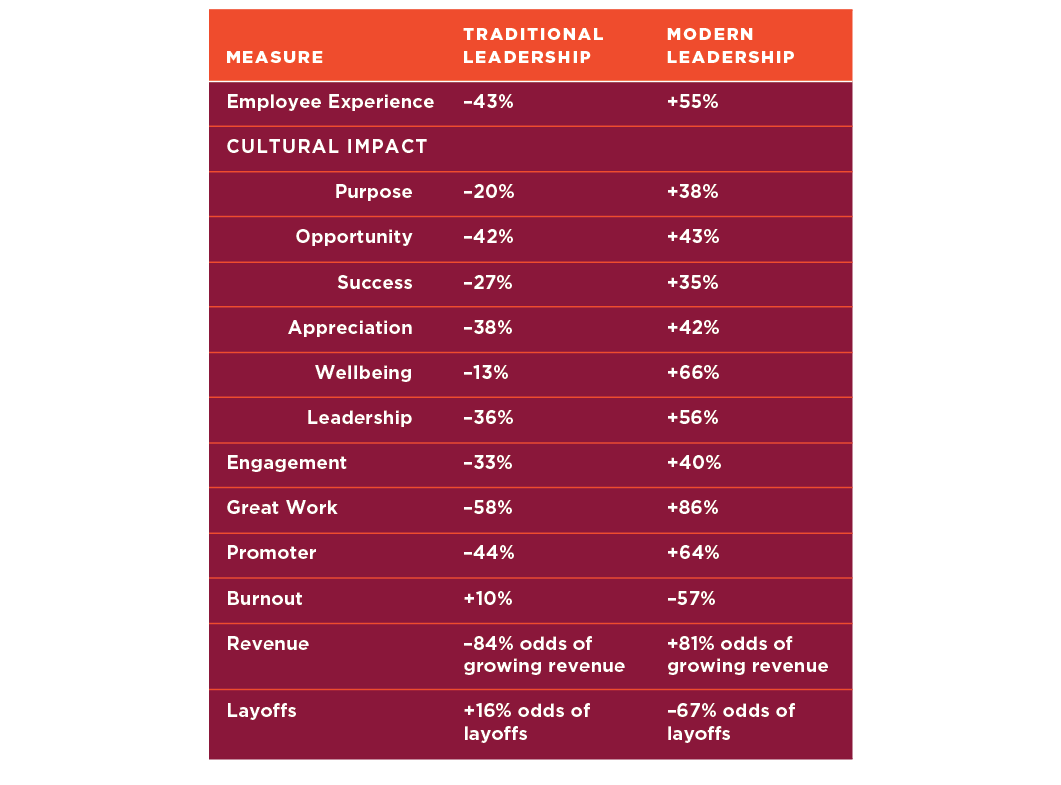
Modern leadership practices have a remarkable positive impact on the major indicators of company culture (the Talent Magnets) and other key measures like engagement, productivity, Net Promoter Score, and higher revenue.
11 ways leaders can build a positive company culture
Modern leaders can build a strong company culture by helping and encouraging employees to connect to the company’s purpose, their personal accomplishments, and other teammates.

These three pillars of connection can be influenced by leaders with the following practices:
Connection to purpose
1. Understand what your employees actually do.
While this seems elementary, only 54% of employees report that their leader knows what they do. When leaders make an effort to understand their employees’ jobs—their struggles, challenges, workload, and responsibilities—employees feel their leader is invested in the work they do. In fact, there is a:
- 36% increase in employees feeling they have the support of their direct leader
- 35% increase in the feeling that their leader acknowledges the great work they do
- 29% increase in engagement
2. Articulate why your employees’ work has meaning
We all want to do something that matters. By clearly communicating the meaning and impact of an employee’s contributions, companies can see a:
- 27% increase in pride in the organization
- 21% increase in putting discretionary effort into helping the organization succeed
- 200% increase in great work
3. Show how your work affects the customer
How does your employees’ work improve the lives of your end-user, your customer, and your community?
When leaders can express the specific way an employee’s work impacts customers, there is a 22% increase in feeling like the organization inspires employees to work toward a collective goal.
4. Create shared plans and goals with your team and connect them all back to your organization’s purpose
There’s an 87% increase in the amount of great work happening when leaders are transparent with their team about how they can work together to achieve the company’s purpose.
Connection to accomplishment
5. Actively show you believe in your people and value their career goals
Talk with employees often about their personal goals and dreams for their role. Tell them you value their unique skills and talents and believe they can succeed. Trust them to make decisions and work autonomously. When this happens, there is a:
- 39% increase in an employee feeling like they have the opportunity to grow
- 43% increase in an employee feeling like they belong at the organization
6. Stay involved during the entire process of achievement, providing specific, constructive feedback throughout, not just at the beginning or the end
Don’t micromanage projects or processes. Instead, celebrate small accomplishments, act as a guide and advocate for your people, and work to break down barriers inhibiting innovation.
Check in often with your people on their progress and offer coaching and support. When leaders do this, they see a:
- 43% increase in feeling like they receive the support they need from their leader to do their job well
- 207% increase in feeling like their leader connects them with opportunities
- 133% increase in the incidence of great work
7. Recognize your people throughout the process, not just when they cross the finish line
By recognizing small wins and efforts along the way, leaders see an 83% increase in engagement. A word or note expressing appreciation when a team member puts in extra effort, overcomes an obstacle, innovates, helps a peer, or goes above and beyond provides extra encouragement and motivation to succeed.
Learn how leaders can share effective and meaningful recognition at key moments for employees in our purposeful appreciation guide.
8. Share leadership
Give employees latitude to lead out on their own. Employees don’t want a micromanager—they want a leader who inspires them. When you empower your people to take ownership, make decisions, lead, and innovate, you’ll find:
- 88% increase in the sense of opportunity at the organization
- 78% increase in engagement
Connection to teammates
9. Connect employees to their team, either for mentorship opportunities or project guidance
When employees feel connected to their teams, there is a:
- 91% increase in feeling like they belong at the organization
- 55% increase in engagement
- 83% increase in the incidence of great work
10. Encourage collaboration within and outside the team whenever possible
This is a departure from traditional, “territorial” behaviors. When leaders do this, companies see a:
- 43% decrease in the incidence of observed exclusion
- 44% decrease in the incidence of moderate-to-severe burnout
11. Build a team that cares about each other, can depend on one another, and celebrates each member’s success
Teams with leaders that do this well have members with a:
- 284% increase in feeling like the employee belongs at the organization
- 33% increase in engagement
- 41% increase in likelihood to stay
- 88% increase in a sense of wellbeing
Modern leadership is moving beyond telling employees what to do—it’s about inspiring them to find and carve out their own path.
Smart leaders look for opportunities to create micro-experiences that connect employees to purpose, accomplishment, and one another. These micro-experiences add up to build a culture of motivation and success that propels employees to do great things.
Making the shift as a leader from a traditional mentality to a more modern mindset takes time (and active development), but it will dramatically improve the everyday employee experience, create a thriving workplace culture, and lead to business success.
Great leaders create your company culture
Leadership is the backbone of your organizational culture. Luckily, there are many tangible ways for leaders to encourage the values and actions that enforce a positive company culture.
Want more information? The O.C. Tanner Institute's Global Culture Report offers simple, actionable steps you can use right away to create an engaged, thriving workplace culture.
Turn Recognition Into Real Connection
Top